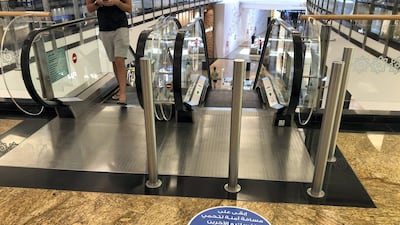
Officials said some stores have been slow to get to grips with new trading rules. Chris Whiteoak / The National

Coronavirus: fresh warning as more Dubai stores shut down


  • English
  • Arabic

More shops have been closed down for failing to adhere to rules on trading during the virus outbreak, Dubai's retail regulator said on Thursday

Nineteen shops were closed, two were fined and 165 others were given warnings during an inspection campaign by Dubai Economy. It said 505 shops were found to be fully compliant with the measures in place to protect public health as shopping centres and businesses begin to reopen.

Inspections were carried out at malls and high-street markets. The logged offences were mostly related to staff not wearing face masks and gloves, failing to maintain social distancing, and opening fitting rooms and offering sales promotions - both of which are currently prohibited because they could encourage a build up of customers.

On Tuesday, 13 retailers were closed, 18 were fined and 211 were given warnings, Dubai Economy said.

Inspectors said offences mostly related to staff not wearing masks and gloves and failing to ensure customers kept their distance from one another.

Officials said inspections were carried out across the city and the closures were in Jumeirah, Deira, Bur Dubai, International City, Satwa and Al Qusais, among other areas.

Dubai Economy reiterated a message to managers that staff must wear masks and gloves, whatever the type of store. Customers must wear masks before leaving their homes but gloves are optional.

On Monday, inspectors closed 26 stores, imposed penalties on 14 and warned a further 234.

And on Sunday the regulator closed down 21 shops, issued warnings to 65, and imposed penalties on seven others.

Separately, the regulator closed 17 barber shops and beauty salons on Sunday after restrictions on trading were lifted on Friday.

Officials did not state how long businesses must remain closed until the ban was lifted.

How tumultuous protests grew
  • A fuel tax protest by French drivers appealed to wider anti-government sentiment
  • Unlike previous French demonstrations there was no trade union or organised movement involved 
  • Demonstrators responded to online petitions and flooded squares to block traffic
  • At its height there were almost 300,000 on the streets in support
  • Named after the high visibility jackets that drivers must keep in cars 
  • Clashes soon turned violent as thousands fought with police at cordons
  • An estimated two dozen people lost eyes and many others were admitted to hospital 

SM Town Live is on Friday, April 6 at Autism Rocks Arena, Dubai. Tickets are Dh375 at www.platinumlist.net

THE%20HOLDOVERS
%3Cp%3E%3Cstrong%3EDirector%3A%20%3C%2Fstrong%3EAlexander%20Payne%3C%2Fp%3E%0A%3Cp%3E%3Cstrong%3EStarring%3A%3C%2Fstrong%3E%20Paul%20Giamatti%2C%20Da'Vine%20Joy%20Randolph%2C%20Dominic%20Sessa%3C%2Fp%3E%0A%3Cp%3E%3Cstrong%3ERating%3A%3C%2Fstrong%3E%204.5%2F5%3C%2Fp%3E%0A
PROFILE BOX

Company name: Overwrite.ai

Founder: Ayman Alashkar

Started: Established in 2020

Based: Dubai International Financial Centre, Dubai

Sector: PropTech

Initial investment: Self-funded by founder

Funding stage: Seed funding, in talks with angel investors

Mercer, the investment consulting arm of US services company Marsh & McLennan, expects its wealth division to at least double its assets under management (AUM) in the Middle East as wealth in the region continues to grow despite economic headwinds, a company official said.

Mercer Wealth, which globally has $160 billion in AUM, plans to boost its AUM in the region to $2-$3bn in the next 2-3 years from the present $1bn, said Yasir AbuShaban, a Dubai-based principal with Mercer Wealth.

Within the next two to three years, we are looking at reaching $2 to $3 billion as a conservative estimate and we do see an opportunity to do so,” said Mr AbuShaban.

Mercer does not directly make investments, but allocates clients’ money they have discretion to, to professional asset managers. They also provide advice to clients.

“We have buying power. We can negotiate on their (client’s) behalf with asset managers to provide them lower fees than they otherwise would have to get on their own,” he added.

Mercer Wealth’s clients include sovereign wealth funds, family offices, and insurance companies among others.

From its office in Dubai, Mercer also looks after Africa, India and Turkey, where they also see opportunity for growth.

Wealth creation in Middle East and Africa (MEA) grew 8.5 per cent to $8.1 trillion last year from $7.5tn in 2015, higher than last year’s global average of 6 per cent and the second-highest growth in a region after Asia-Pacific which grew 9.9 per cent, according to consultancy Boston Consulting Group (BCG). In the region, where wealth grew just 1.9 per cent in 2015 compared with 2014, a pickup in oil prices has helped in wealth generation.

BCG is forecasting MEA wealth will rise to $12tn by 2021, growing at an annual average of 8 per cent.

Drivers of wealth generation in the region will be split evenly between new wealth creation and growth of performance of existing assets, according to BCG.

Another general trend in the region is clients’ looking for a comprehensive approach to investing, according to Mr AbuShaban.

“Institutional investors or some of the families are seeing a slowdown in the available capital they have to invest and in that sense they are looking at optimizing the way they manage their portfolios and making sure they are not investing haphazardly and different parts of their investment are working together,” said Mr AbuShaban.

Some clients also have a higher appetite for risk, given the low interest-rate environment that does not provide enough yield for some institutional investors. These clients are keen to invest in illiquid assets, such as private equity and infrastructure.

“What we have seen is a desire for higher returns in what has been a low-return environment specifically in various fixed income or bonds,” he said.

“In this environment, we have seen a de facto increase in the risk that clients are taking in things like illiquid investments, private equity investments, infrastructure and private debt, those kind of investments were higher illiquidity results in incrementally higher returns.”

The Abu Dhabi Investment Authority, one of the largest sovereign wealth funds, said in its 2016 report that has gradually increased its exposure in direct private equity and private credit transactions, mainly in Asian markets and especially in China and India. The authority’s private equity department focused on structured equities owing to “their defensive characteristics.”

Zimbabwe v UAE, ODI series

All matches at the Harare Sports Club:

1st ODI, Wednesday, April 10

2nd ODI, Friday, April 12

3rd ODI, Sunday, April 14

4th ODI, Tuesday, April 16

UAE squad: Mohammed Naveed (captain), Rohan Mustafa, Ashfaq Ahmed, Shaiman Anwar, Mohammed Usman, CP Rizwan, Chirag Suri, Mohammed Boota, Ghulam Shabber, Sultan Ahmed, Imran Haider, Amir Hayat, Zahoor Khan, Qadeer Ahmed

The biog

Date of birth: 27 May, 1995

Place of birth: Dubai, UAE

Status: Single

School: Al Ittihad private school in Al Mamzar

University: University of Sharjah

Degree: Renewable and Sustainable Energy

Hobby: I enjoy travelling a lot, not just for fun, but I like to cross things off my bucket list and the map and do something there like a 'green project'.
