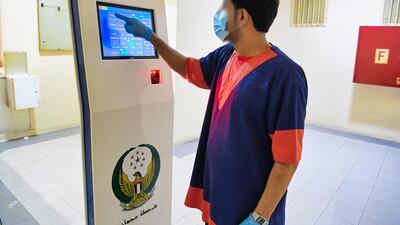
Ajman's prisons are taking steps to combat the spread of coronavirus.
Families of inmates serving sentences in the emirate can now deposit money for their relatives remotely thanks to an initiative led by Ajman Police in Ajman Bank.
Previously, visitors have been allowed to deposit money at jails to be used by prisoners to purchase certain goods through a smart supermarket introduced in 2018.
The service allows inmates to use a card - usually topped up by loved ones - to buy goods online on touch screens installed in prisons which are then delivered to the institution in which they are in custody.
“The service is part of a series of preventive and precautionary measures to limit the presence of people at institution who come to hand over cash to be deposited for inmates,” Brig Gen Mubarak Khalfan Al-Razi, director of the Punitive and Correctional Institution in Ajman, said.
He said that money can now be deposited remotely in a dedicated account in Ajman Bank.
Families of inmates can visit any branch of Ajman Bank across the country, to deposit the amount. They need to mention the name of the inmate and his unified number.
“This service saves time, effort, and the trouble of coming to the punitive institution’s headquarters to deposit money, and it also limits the use of banknotes,” said Brig gen Al-Razi.

Oppenheimer
%3Cp%3E%3Cstrong%3EDirector%3A%20%3C%2Fstrong%3EChristopher%20Nolan%3C%2Fp%3E%0A%3Cp%3E%3Cstrong%3EStars%3A%20%3C%2Fstrong%3ECillian%20Murphy%2C%20Emily%20Blunt%2C%20Robert%20Downey%20Jr%2C%20Florence%20Pugh%2C%20Matt%20Damon%3C%2Fp%3E%0A%3Cp%3E%3Cstrong%3ERating%3A%20%3C%2Fstrong%3E5%2F5%3Cbr%3E%3C%2Fp%3E%0A
Company%20profile%20
%3Cp%3E%3Cstrong%3EName%3A%20%3C%2Fstrong%3EYodawy%3Cbr%3E%3Cstrong%3EBased%3A%3C%2Fstrong%3E%20Egypt%3Cbr%3E%3Cstrong%3EFounders%3A%20%3C%2Fstrong%3EKarim%20Khashaba%2C%20Sherief%20El-Feky%20and%20Yasser%20AbdelGawad%3Cstrong%3E%3Cbr%3ESector%3A%20%3C%2Fstrong%3EHealthTech%3Cbr%3E%3Cstrong%3ETotal%20funding%3A%20%3C%2Fstrong%3E%2424.5%20million%3Cbr%3E%3Cstrong%3EInvestors%3A%20%3C%2Fstrong%3EAlgebra%20Ventures%2C%20Global%20Ventures%2C%20MEVP%20and%20Delivery%20Hero%20Ventures%2C%20among%20others%3Cstrong%3E%3Cbr%3ENumber%20of%20employees%3A%3C%2Fstrong%3E%20500%3Cbr%3E%3C%2Fp%3E%0A
MATCH INFO
Champions League quarter-final, first leg
Ajax v Juventus, Wednesday, 11pm (UAE)
Match on BeIN Sports
UAE currency: the story behind the money in your pockets
What the law says
Micro-retirement is not a recognised concept or employment status under Federal Decree Law No. 33 of 2021 on the Regulation of Labour Relations (as amended) (UAE Labour Law). As such, it reflects a voluntary work-life balance practice, rather than a recognised legal employment category, according to Dilini Loku, senior associate for law firm Gateley Middle East.
“Some companies may offer formal sabbatical policies or career break programmes; however, beyond such arrangements, there is no automatic right or statutory entitlement to extended breaks,” she explains.
“Any leave taken beyond statutory entitlements, such as annual leave, is typically regarded as unpaid leave in accordance with Article 33 of the UAE Labour Law. While employees may legally take unpaid leave, such requests are subject to the employer’s discretion and require approval.”
If an employee resigns to pursue micro-retirement, the employment contract is terminated, and the employer is under no legal obligation to rehire the employee in the future unless specific contractual agreements are in place (such as return-to-work arrangements), which are generally uncommon, Ms Loku adds.
