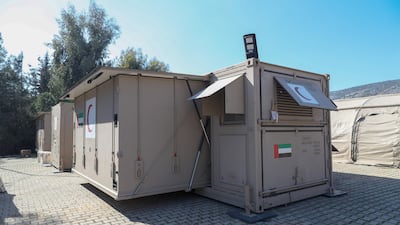
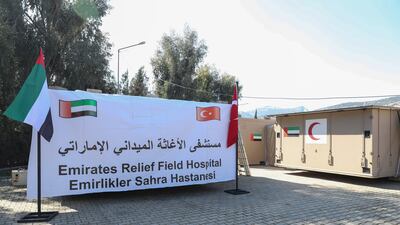
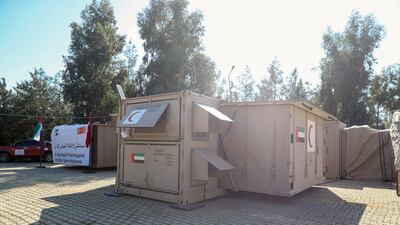
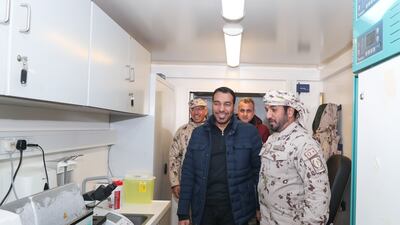
The UAE's second field hospital in Turkey opened on Saturday and has started receiving patients.
The Sheikh Mohamed bin Zayed Field Hospital in the Reyhanli district of Hatay is the second to be established after a 50-bed hospital was set up at Gaziantep Airport last week.
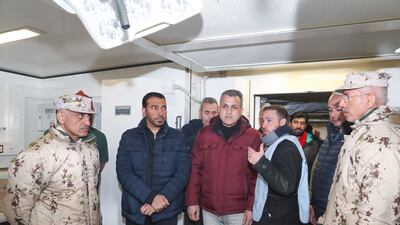
The new 200-bed site has 20 intensive care beds, two operating rooms with full medical equipment, two intensive care units, a laboratory and a pharmacy, said news agency Wam.
Saeed Thani Hareb Al Dhaheri, the UAE's ambassador to Turkey, Brig Gen Dr Sarhan Al Neyadi, commander of the Medical Services Corps at the Ministry of Defence, and a number of Turkish officials attended the opening.
Brig Gen Dr Al Neyadi said it was set up completely in only five days after it was flown to Turkey.
The Emirates has played a significant role in a major international response to the humanitarian crisis unfolding in Turkey and Syria.
Support is being carried out under Operation Gallant Knight/2, led by the ministries of Defence, Interior, Foreign Affairs and International Co-operation, alongside the Khalifa bin Zayed Al Nahyan Foundation and Emirates Red Crescent.
Emirati rescue teams have been conducting life-saving operations and essential medical equipment has been being flown in.
As of Sunday, the UAE had sent 113 flights carrying 3,200 tonnes of aid to the stricken countries, the Ministry of Defence said.
Lt Col Hamad Al Kaabi, commander of the Emirati Search and Rescue in Syria, is training Syrian emergency services personnel on the ground.
“We are racing against time to qualify the Syrian Civil Defence personnel through an intensive training course on the mechanism of using the advanced technical devices and equipment," he told state news agency Wam
On Tuesday, the UAE announced that an Emirati search and rescue team had pulled two young men, aged 19 and 21, from under the rubble in the Turkish city of Kahramanmaras.
Col Khaled Al Hammadi, commander of the UAE search and rescue team in Turkey, said sniffer dogs were being used alongside staff working in shifts in the hope of finding survivors.
On February 11, an Emirati team rescued an 11-year-old child trapped under the rubble in the Kahramanmaras province.
The crew also pulled a man thought to be in his 50s to safety.
On February 8, the Emirati team rescued a Syrian family of four from the rubble in the same city. A mother, her son and two daughters were saved after more than five hours of digging through the debris.
UAE's first field hospital at Gaziantep Airport - in pictures
Our legal consultant
Name: Hassan Mohsen Elhais
Position: legal consultant with Al Rowaad Advocates and Legal Consultants.
Mercer, the investment consulting arm of US services company Marsh & McLennan, expects its wealth division to at least double its assets under management (AUM) in the Middle East as wealth in the region continues to grow despite economic headwinds, a company official said.
Mercer Wealth, which globally has $160 billion in AUM, plans to boost its AUM in the region to $2-$3bn in the next 2-3 years from the present $1bn, said Yasir AbuShaban, a Dubai-based principal with Mercer Wealth.
“Within the next two to three years, we are looking at reaching $2 to $3 billion as a conservative estimate and we do see an opportunity to do so,” said Mr AbuShaban.
Mercer does not directly make investments, but allocates clients’ money they have discretion to, to professional asset managers. They also provide advice to clients.
“We have buying power. We can negotiate on their (client’s) behalf with asset managers to provide them lower fees than they otherwise would have to get on their own,” he added.
Mercer Wealth’s clients include sovereign wealth funds, family offices, and insurance companies among others.
From its office in Dubai, Mercer also looks after Africa, India and Turkey, where they also see opportunity for growth.
Wealth creation in Middle East and Africa (MEA) grew 8.5 per cent to $8.1 trillion last year from $7.5tn in 2015, higher than last year’s global average of 6 per cent and the second-highest growth in a region after Asia-Pacific which grew 9.9 per cent, according to consultancy Boston Consulting Group (BCG). In the region, where wealth grew just 1.9 per cent in 2015 compared with 2014, a pickup in oil prices has helped in wealth generation.
BCG is forecasting MEA wealth will rise to $12tn by 2021, growing at an annual average of 8 per cent.
Drivers of wealth generation in the region will be split evenly between new wealth creation and growth of performance of existing assets, according to BCG.
Another general trend in the region is clients’ looking for a comprehensive approach to investing, according to Mr AbuShaban.
“Institutional investors or some of the families are seeing a slowdown in the available capital they have to invest and in that sense they are looking at optimizing the way they manage their portfolios and making sure they are not investing haphazardly and different parts of their investment are working together,” said Mr AbuShaban.
Some clients also have a higher appetite for risk, given the low interest-rate environment that does not provide enough yield for some institutional investors. These clients are keen to invest in illiquid assets, such as private equity and infrastructure.
“What we have seen is a desire for higher returns in what has been a low-return environment specifically in various fixed income or bonds,” he said.
“In this environment, we have seen a de facto increase in the risk that clients are taking in things like illiquid investments, private equity investments, infrastructure and private debt, those kind of investments were higher illiquidity results in incrementally higher returns.”
The Abu Dhabi Investment Authority, one of the largest sovereign wealth funds, said in its 2016 report that has gradually increased its exposure in direct private equity and private credit transactions, mainly in Asian markets and especially in China and India. The authority’s private equity department focused on structured equities owing to “their defensive characteristics.”
RESULTS
6.30pm: Maiden (TB) Dh 82,500 (Dirt) 1.600m
Winner: Miller’s House, Richard Mullen (jockey), Satish Seemar (trainer).
7.05pm: Maiden (TB) Dh 82,500 (D) 2,000m
Winner: Kanood, Adrie de Vries, Fawzi Nass.
7.50pm: Handicap (TB) Dh 82,500 (D) 1,600m
Winner: Gervais, Sandro Paiva, Ali Rashid Al Raihe.
8.15pm: The Garhoud Sprint Listed (TB) Dh 132,500 (D) 1,200m
Winner: Important Mission, Royston Ffrench, Salem bin Ghadayer.
8.50pm: The Entisar Listed (TB) Dh 132,500 (D) 2,000m
Winner: Firnas, Xavier Ziani, Salem bin Ghadayer.
9.25pm: Conditions (TB) Dh 120,000 (D) 1,400m
Winner: Zhou Storm, Connor Beasley, Ali Rashid Al Raihe.
BABYLON
%3Cp%3EDirector%3A%20Damien%20Chazelle%3C%2Fp%3E%0A%3Cp%3EStars%3A%20Brad%20Pitt%2C%20Margot%20Robbie%2C%20Jean%20Smart%3C%2Fp%3E%0A%3Cp%3ERating%3A%204%2F5%3C%2Fp%3E%0A
Education reform in Abu Dhabi
The emirate’s public education system has been in a constant state of change since the New School Model was launched in 2010 by the Abu Dhabi Education Council. The NSM, which is also known as the Abu Dhabi School Model, transformed the public school curriculum by introducing bilingual education starting with students from grades one to five. Under this new curriculum, the children spend half the day learning in Arabic and half in English – being taught maths, science and English language by mostly Western educated, native English speakers. The NSM curriculum also moved away from rote learning and required teachers to develop a “child-centered learning environment” that promoted critical thinking and independent learning. The NSM expanded by one grade each year and by the 2017-2018 academic year, it will have reached the high school level. Major reforms to the high school curriculum were announced in 2015. The two-stream curriculum, which allowed pupils to elect to follow a science or humanities course of study, was eliminated. In its place was a singular curriculum in which stem -- science, technology, engineering and maths – accounted for at least 50 per cent of all subjects. In 2016, Adec announced additional changes, including the introduction of two levels of maths and physics – advanced or general – to pupils in Grade 10, and a new core subject, career guidance, for grades 10 to 12; and a digital technology and innovation course for Grade 9. Next year, the focus will be on launching a new moral education subject to teach pupils from grades 1 to 9 character and morality, civic studies, cultural studies and the individual and the community.
Benefits of first-time home buyers' scheme
- Priority access to new homes from participating developers
- Discounts on sales price of off-plan units
- Flexible payment plans from developers
- Mortgages with better interest rates, faster approval times and reduced fees
- DLD registration fee can be paid through banks or credit cards at zero interest rates