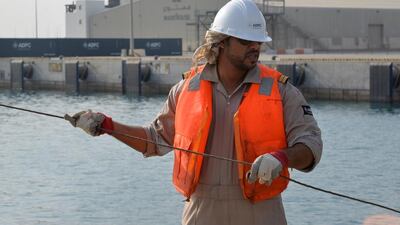
Authorities have reiterated that private sector companies which fail to hit Emiratisation targets for this year will face substantial fines from January 1.
The Ministry of Human Resources and Emiratisation on Thursday said businesses with at least 50 employees must ensure that 2 per cent of their workforce is made up of Emiratis to avoid stiff financial penalties.
The new law does not apply to companies registered in free zones, although they are being encouraged to hire Emiratis.
Employers that fail to reach the 2 per cent target by the end of the year will have to pay a Dh72,000 fine ($19,602) in January for each Emirati worker they fail to hire, equivalent to Dh6,000 a month for the year.
This target will rise to 4 per cent by the end of 2023, 6 per cent in 2024, 8 per cent in 2025 and 10 per cent in 2026.
The government is determined to increase local participation in the private sector, saying it remains central to the economic prosperity of the country.
Fines for failing to reach Emiratisation staffing goals will increase by Dh12,000 each year.
Employers that fail to reach the 4 per cent mark in 2023 will pay Dh84,000 for each Emirati not hired, with this figure rising to Dh120,000 per worker for 2026.
“We aim to achieve an effective participation of the private sector in the development process of the UAE, as raising the participation of Emiratis in this sector will have a positive impact on the competitiveness, attractiveness, and stability of the business environment in the country,” said the Ministry statement on Thursday.
“We will continue to activate the partnership between the government and the private sectors on Emiratisation, based on our belief that Emiratis can make a positive impact within the vital economic sectors, as well as our aspiration to advance the growth of the private sector companies and improve their ability to keep pace with successive developments locally and globally.”
The Ministry said that legislation governing Emiratisation will contribute to “strengthening the diversification of the labour market and will consolidate the UAE’s position as an incubator of national and international talents and an ideal destination to work, live and invest.”
It praised those companies that have met Emiratisation requirements for 2022.
“Now, we look forward to witnessing a greater impact in 2023, as the Emiratisation targets will increase by 2 per cent until 2026, resulting in a growth by 10 per cent of Emirati skilled employees,” it said.
Policy will bring about 'fundamental change'
Abdulrahman Al Awar, Minister of Human Resources and Emiratisation, this month held talks with leading recruitment agencies to emphasise the positive role Emiratis can play in private companies.
Dr Al Awar met senior officials from 66 companies, including those offering temporary employment and labour supply services.
“The labour market in the UAE is entering a new phase that focuses on the central role of national human capital within the private sector,” the minister said.
“The Emirati skilled employees, who constitute most Emirati employees registered within the ministry’s system, are proving their positive effects on the economy.
“We are on the verge of fundamental changes in the country's labour market in line with increasing the participation of citizens and improving the competitiveness of the local business environment.

The Birkin bag is made by Hermès.
It is named after actress and singer Jane Birkin
Noone from Hermès will go on record to say how much a new Birkin costs, how long one would have to wait to get one, and how many bags are actually made each year.
UAE currency: the story behind the money in your pockets
RESULTS
5pm: Watha Stallions Cup Handicap (PA) Dh 70,000 (Dirt) 2,000m
Winner: Dalil De Carrere, Bernardo Pinheiro (jockey), Mohamed Daggash (trainer)
5.30pm: Maiden (TB) Dh 70,000 (D) 2,000m
Winner: Miracle Maker, Xavier Ziani, Salem bin Ghadayer
6pm: Maiden (PA) Dh 70,000 (D) 1,600m
Winner: Pharitz Al Denari, Bernardo Pinheiro, Mahmood Hussain
6.30pm: Maiden (PA) Dh 70,000 (D) 1,600m
Winner: Oss, Jesus Rosales, Abdallah Al Hammadi
7pm: Handicap (PA) Dh 70,000 (D) 1,400m
Winner: ES Nahawand, Fernando Jara, Mohamed Daggash
7.30pm: Maiden (PA) Dh 70,000 (D) 1,000m
Winner: AF Almajhaz, Abdul Aziz Al Balushi, Khalifa Al Neyadi
8pm: Maiden (PA) Dh 70,000 (D) 1,000m
Winner: AF Lewaa, Bernardo Pinheiro, Qaiss Aboud.
COMPANY PROFILE
Name: Lamsa
Founder: Badr Ward
Launched: 2014
Employees: 60
Based: Abu Dhabi
Sector: EdTech
Funding to date: $15 million
The President's Cake
Director: Hasan Hadi
Starring: Baneen Ahmad Nayyef, Waheed Thabet Khreibat, Sajad Mohamad Qasem
Rating: 4/5
What is a Ponzi scheme?
A fraudulent investment operation where the scammer provides fake reports and generates returns for old investors through money paid by new investors, rather than through ligitimate business activities.
The biog
Family: He is the youngest of five brothers, of whom two are dentists.
Celebrities he worked on: Fabio Canavaro, Lojain Omran, RedOne, Saber Al Rabai.
Where he works: Liberty Dental Clinic
PSA DUBAI WORLD SERIES FINALS LINE-UP
Men’s:
Mohamed El Shorbagy (EGY)
Ali Farag (EGY)
Simon Rosner (GER)
Tarek Momen (EGY)
Miguel Angel Rodriguez (COL)
Gregory Gaultier (FRA)
Karim Abdel Gawad (EGY)
Nick Matthew (ENG)
Women's:
Nour El Sherbini (EGY)
Raneem El Welily (EGY)
Nour El Tayeb (EGY)
Laura Massaro (ENG)
Joelle King (NZE)
Camille Serme (FRA)
Nouran Gohar (EGY)
Sarah-Jane Perry (ENG)
Who's who in Yemen conflict
Houthis: Iran-backed rebels who occupy Sanaa and run unrecognised government
Yemeni government: Exiled government in Aden led by eight-member Presidential Leadership Council
Southern Transitional Council: Faction in Yemeni government that seeks autonomy for the south
Habrish 'rebels': Tribal-backed forces feuding with STC over control of oil in government territory
Dengue%20fever%20symptoms
%3Cp%3EHigh%20fever%20(40%C2%B0C%2F104%C2%B0F)%3Cbr%3ESevere%20headache%3Cbr%3EPain%20behind%20the%20eyes%3Cbr%3EMuscle%20and%20joint%20pains%3Cbr%3ENausea%3Cbr%3EVomiting%3Cbr%3ESwollen%20glands%3Cbr%3ERash%26nbsp%3B%3C%2Fp%3E%0A
Mercer, the investment consulting arm of US services company Marsh & McLennan, expects its wealth division to at least double its assets under management (AUM) in the Middle East as wealth in the region continues to grow despite economic headwinds, a company official said.
Mercer Wealth, which globally has $160 billion in AUM, plans to boost its AUM in the region to $2-$3bn in the next 2-3 years from the present $1bn, said Yasir AbuShaban, a Dubai-based principal with Mercer Wealth.
“Within the next two to three years, we are looking at reaching $2 to $3 billion as a conservative estimate and we do see an opportunity to do so,” said Mr AbuShaban.
Mercer does not directly make investments, but allocates clients’ money they have discretion to, to professional asset managers. They also provide advice to clients.
“We have buying power. We can negotiate on their (client’s) behalf with asset managers to provide them lower fees than they otherwise would have to get on their own,” he added.
Mercer Wealth’s clients include sovereign wealth funds, family offices, and insurance companies among others.
From its office in Dubai, Mercer also looks after Africa, India and Turkey, where they also see opportunity for growth.
Wealth creation in Middle East and Africa (MEA) grew 8.5 per cent to $8.1 trillion last year from $7.5tn in 2015, higher than last year’s global average of 6 per cent and the second-highest growth in a region after Asia-Pacific which grew 9.9 per cent, according to consultancy Boston Consulting Group (BCG). In the region, where wealth grew just 1.9 per cent in 2015 compared with 2014, a pickup in oil prices has helped in wealth generation.
BCG is forecasting MEA wealth will rise to $12tn by 2021, growing at an annual average of 8 per cent.
Drivers of wealth generation in the region will be split evenly between new wealth creation and growth of performance of existing assets, according to BCG.
Another general trend in the region is clients’ looking for a comprehensive approach to investing, according to Mr AbuShaban.
“Institutional investors or some of the families are seeing a slowdown in the available capital they have to invest and in that sense they are looking at optimizing the way they manage their portfolios and making sure they are not investing haphazardly and different parts of their investment are working together,” said Mr AbuShaban.
Some clients also have a higher appetite for risk, given the low interest-rate environment that does not provide enough yield for some institutional investors. These clients are keen to invest in illiquid assets, such as private equity and infrastructure.
“What we have seen is a desire for higher returns in what has been a low-return environment specifically in various fixed income or bonds,” he said.
“In this environment, we have seen a de facto increase in the risk that clients are taking in things like illiquid investments, private equity investments, infrastructure and private debt, those kind of investments were higher illiquidity results in incrementally higher returns.”
The Abu Dhabi Investment Authority, one of the largest sovereign wealth funds, said in its 2016 report that has gradually increased its exposure in direct private equity and private credit transactions, mainly in Asian markets and especially in China and India. The authority’s private equity department focused on structured equities owing to “their defensive characteristics.”
UPI facts
More than 2.2 million Indian tourists arrived in UAE in 2023
More than 3.5 million Indians reside in UAE
Indian tourists can make purchases in UAE using rupee accounts in India through QR-code-based UPI real-time payment systems
Indian residents in UAE can use their non-resident NRO and NRE accounts held in Indian banks linked to a UAE mobile number for UPI transactions
MOUNTAINHEAD REVIEW
Starring: Ramy Youssef, Steve Carell, Jason Schwartzman
Director: Jesse Armstrong
Rating: 3.5/5