



The UAE's Emiratisation Minister is determined to take tough action against companies found guilty of abusing the rules that encourage more citizens to go to work in the private sector.
Abdulrahman Al Awar, Minister of Human Resources and Emiratisation, said some companies had cut salaries provided to Emirati candidates in the knowledge they would receive financial benefits from the government.
Dr Al Awar said the ministry would deal with businesses flouting regulations “in the right manner”.
“The Ministry of Human Resources and Emiratisation is closely monitoring the implementation of Emiratisation in the labour market and has come across some unfortunate cases,” the minister said in a statement released by the MoHRE.
-
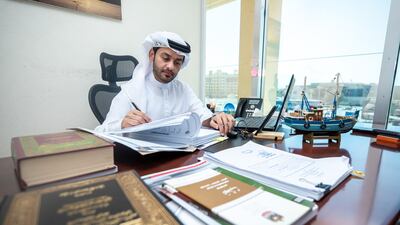
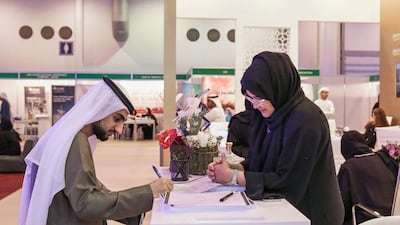
Rashed Abdulla Al Sumaity, an associate at Galadari Advocates & Legal Consultants in Dubai. The legal and banking professions have the highest Emiratisation in the private sector. All photos by Victor Besa / The National -

Official announcements show the UAE government’s resolve to encourage citizens to take on private sector jobs and persuade companies to take Emiratis on board. -

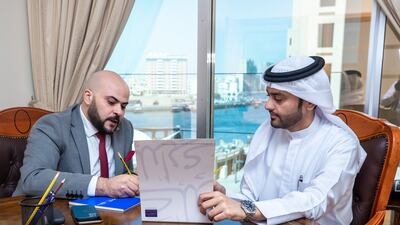
Raka Roy (R), partner at Galadari Advocates & Legal Consultants and Eslam Oraif, legal counsel, break down the government announcements that offer extra salary and benefits to UAE citizens taking jobs in the private sector. -
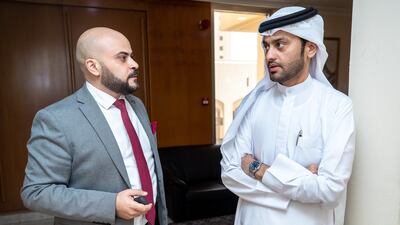
Rashed Abdulla Al Sumaity (R) with Eslam Oraif of Galadari Advocates & Legal Consultants. The UAE government's Nafis scheme has set a target of 75,000 Emiratis in private sector jobs by 2026. -
The UAE Cabinet approved that private companies with more than 50 employees should have at least a 2 per cent Emirati workforce by 2021. -
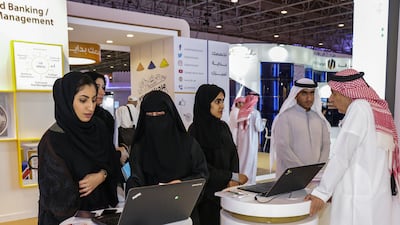
UAE government support programmes will empower and protect Emirati employees in the private sector. -
Salary incentives are being offered to Emirati university graduates and UAE citizens in training for skilled jobs.


“Some companies have been found to reduce salaries of Emirati job candidates given that Nafis would offer them several benefits, including salary top-ups when they are hired.
“Therefore, we reiterate that the ministry will be firm in implementing the necessary procedures with any company that attempts to abuse Emiratisation-related policies and decisions, including Nafis' benefits.
“MoHRE will address and deal with any such abuse in the right manner.”
UAE aims to boost Emirati private-sector workforce
Emiratis with a university degree who work in the private sector will now receive a Dh7,000 monthly salary top-up, up from Dh5,000 at present.
The changes were announced at a meeting of 500 senior government leaders on Wednesday.
The payment will be Dh6,000 for diploma holders and Dh5,000 for high school graduates.
The move is designed to attract more Emiratis away from government jobs, where salaries tend to be higher.
The Nafis scheme was set up to support the government's push to ensure citizens make up 10 per cent of the private sector by 2026, including 2 per cent by January 1.
“Some of these false and negative practices are considered as a clear violation of the federal decree Law No 33 of 2021, regarding regulation of labour relations as it falls under discrimination between persons that would impact career opportunities in the labour market,” Dr Al Awar said.
“We call on Emirati job seekers or those who are currently working in the private sector or community members at large to report any false practices pertaining to Emiratisation in the labour market through MoHRE's call centre — 600 59 0000 — to raise compliance with the relevant decisions, policies, laws and legislations.”
Clamping down on rule-breakers
The ministry announced this month that there was an investigation into the conduct of a private company.
The unnamed business is facing legal action on claims it wrongly deducted money from the salaries of Emirati staff intended to support their training under a government employment initiative.
The Ministry of Human Resources and Emiratisation referred the case to public prosecutors after a complaint was lodged by a female Emirati trainee.
Investigations revealed the woman and other workers who were part of the UAE's Nafis programme were instructed to pay monthly contributions to their employer, which were taken out of the additional payments they were due to receive for a period of 12 months.

