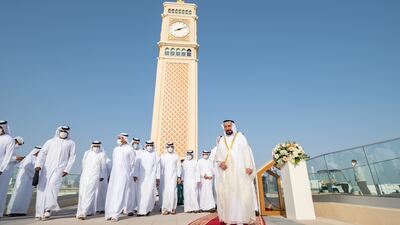
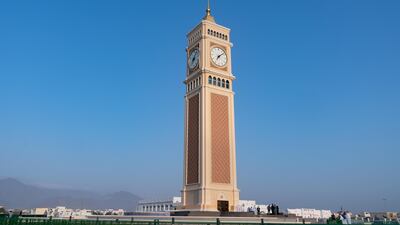
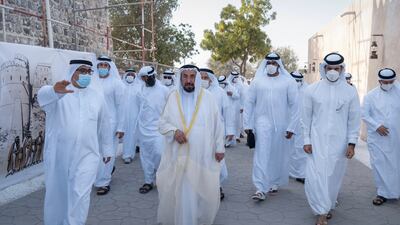
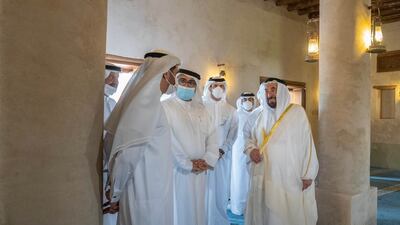
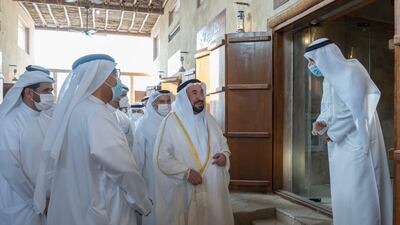
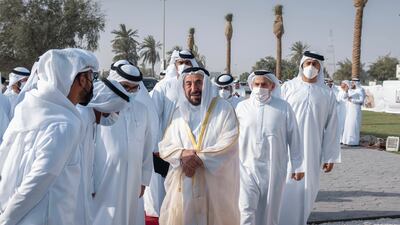
The first phase of a census for Sharjah will begin on Thursday.
The Department of Statistics and Community Development said 300 trained personnel would begin to visit all homes, buildings, businesses and other facilities to collect initial data from families and individuals.
The You Count Sharjah Census 2022 aims to build a clear picture of the emirate's demographics and help the government shape development plans.
The first listing phase of the project will end on November 20.
The census team will gather data on the nationality of the head of the family, number of family members as well as age, academic and vocational qualification of each member, contact information, and primary language for communications.
Data collected on buildings will include name, type, number of storeys, entrances, and occupancy and whether it is a residential or commercial building.
Information about housing will include number, characteristics, function, status and number of rooms, while business data will feature name, type, activity, number of workers and employees and their nationalities.
The department has urged both Emiratis and residents to participate and said information provided will remain confidential.
The census team members will carry an identification tag and wear vests with DSCD and Sharjah Census 2022 logos.
The self-counting stage of the process will follow the listing phase and will require all citizens and residents to fill out census forms.
“The comprehensive listing phase is the most critical and important period in the census, as it translates our experience in overcoming the challenges we faced previously,” said Abdullah Al Kadeed, director of the statistics department at DSCD.
“We call on all nationals and residents, families and individuals alike, SMEs, and private sector companies in the emirate to co-operate with the census teams, as it benefits everyone and contributes to advancing the development of the emirate’s services.”
“The census provides relevant entities with accurate data and comprehensive information to formulate developmental plans and strategies to support all segments of the community in the emirate.
“Every piece of information provided to the census teams contributes to serving the community, whose members are an integral part of Sharjah’s comprehensive developmental plan.”
Ruler says census to make voices heard
The 2022 Sharjah Census was launched in September.
Sharjah’s overall population according to its latest census in 2015 was 1,405,843, with Emiratis accounting for 12 per cent of this number.
Preliminary results of the census will be shared with Sheikh Dr Sultan bin Muhammad Al Qasimi, the Ruler of Sharjah, in March 2023.
Sheikh Dr Sultan this month called on people to take part in the emirate's census.
During the live radio programme Al Khat Al Mubasher (The Direct Line), he told listeners the You Count Sharjah Census 2022 matters because it will provide data that is otherwise difficult to collate from different departments.
“Its hard to ask this and that department for data, therefore the census is very important,” said Sheikh Dr Sultan.
“It will help provide the information that is needed for wider studies which will subsequently turn into projects, decrees, buildings and funding.”
He said the projects would vary across different sectors, such as housing and education.
“It will also lead to a change in the administrative structure in the emirate and the powers of districts councils in Sharjah, a change that will make the voices of people better heard,” said Sheikh Dr Sultan.

The specs
- Engine: 3.9-litre twin-turbo V8
- Power: 640hp
- Torque: 760nm
- On sale: 2026
- Price: Not announced yet
Mercer, the investment consulting arm of US services company Marsh & McLennan, expects its wealth division to at least double its assets under management (AUM) in the Middle East as wealth in the region continues to grow despite economic headwinds, a company official said.
Mercer Wealth, which globally has $160 billion in AUM, plans to boost its AUM in the region to $2-$3bn in the next 2-3 years from the present $1bn, said Yasir AbuShaban, a Dubai-based principal with Mercer Wealth.
“Within the next two to three years, we are looking at reaching $2 to $3 billion as a conservative estimate and we do see an opportunity to do so,” said Mr AbuShaban.
Mercer does not directly make investments, but allocates clients’ money they have discretion to, to professional asset managers. They also provide advice to clients.
“We have buying power. We can negotiate on their (client’s) behalf with asset managers to provide them lower fees than they otherwise would have to get on their own,” he added.
Mercer Wealth’s clients include sovereign wealth funds, family offices, and insurance companies among others.
From its office in Dubai, Mercer also looks after Africa, India and Turkey, where they also see opportunity for growth.
Wealth creation in Middle East and Africa (MEA) grew 8.5 per cent to $8.1 trillion last year from $7.5tn in 2015, higher than last year’s global average of 6 per cent and the second-highest growth in a region after Asia-Pacific which grew 9.9 per cent, according to consultancy Boston Consulting Group (BCG). In the region, where wealth grew just 1.9 per cent in 2015 compared with 2014, a pickup in oil prices has helped in wealth generation.
BCG is forecasting MEA wealth will rise to $12tn by 2021, growing at an annual average of 8 per cent.
Drivers of wealth generation in the region will be split evenly between new wealth creation and growth of performance of existing assets, according to BCG.
Another general trend in the region is clients’ looking for a comprehensive approach to investing, according to Mr AbuShaban.
“Institutional investors or some of the families are seeing a slowdown in the available capital they have to invest and in that sense they are looking at optimizing the way they manage their portfolios and making sure they are not investing haphazardly and different parts of their investment are working together,” said Mr AbuShaban.
Some clients also have a higher appetite for risk, given the low interest-rate environment that does not provide enough yield for some institutional investors. These clients are keen to invest in illiquid assets, such as private equity and infrastructure.
“What we have seen is a desire for higher returns in what has been a low-return environment specifically in various fixed income or bonds,” he said.
“In this environment, we have seen a de facto increase in the risk that clients are taking in things like illiquid investments, private equity investments, infrastructure and private debt, those kind of investments were higher illiquidity results in incrementally higher returns.”
The Abu Dhabi Investment Authority, one of the largest sovereign wealth funds, said in its 2016 report that has gradually increased its exposure in direct private equity and private credit transactions, mainly in Asian markets and especially in China and India. The authority’s private equity department focused on structured equities owing to “their defensive characteristics.”
RESULTS
1.45pm: Maiden Dh75,000 1,400m
Winner: Dirilis Ertugrul, Fabrice Veron (jockey), Ismail Mohammed (trainer)
2.15pm: Handicap Dh90,000 1,400m
Winner: Kidd Malibu, Sandro Paiva, Musabah Al Muhairi
2.45pm: Maiden Dh75,000 1,000m
Winner: Raakezz, Tadhg O’Shea, Nicholas Bachalard
3.15pm: Handicap Dh105,000 1,200m
Winner: Au Couer, Sean Kirrane, Satish Seemar
3.45pm: Maiden Dh75,000 1,600m
Winner: Rayig, Pat Dobbs, Doug Watson
4.15pm: Handicap Dh105,000 1,600m
Winner: Chiefdom, Royston Ffrench, Salem bin Ghadayer
4.45pm: Handicap Dh80,000 1,800m
Winner: King’s Shadow, Richard Mullen, Satish Seemar
Desert Warrior
Starring: Anthony Mackie, Aiysha Hart, Ben Kingsley
Director: Rupert Wyatt
Rating: 3/5
Key facilities
- Olympic-size swimming pool with a split bulkhead for multi-use configurations, including water polo and 50m/25m training lanes
- Premier League-standard football pitch
- 400m Olympic running track
- NBA-spec basketball court with auditorium
- 600-seat auditorium
- Spaces for historical and cultural exploration
- An elevated football field that doubles as a helipad
- Specialist robotics and science laboratories
- AR and VR-enabled learning centres
- Disruption Lab and Research Centre for developing entrepreneurial skills
Why your domicile status is important
Your UK residence status is assessed using the statutory residence test. While your residence status – ie where you live - is assessed every year, your domicile status is assessed over your lifetime.
Your domicile of origin generally comes from your parents and if your parents were not married, then it is decided by your father. Your domicile is generally the country your father considered his permanent home when you were born.
UK residents who have their permanent home ("domicile") outside the UK may not have to pay UK tax on foreign income. For example, they do not pay tax on foreign income or gains if they are less than £2,000 in the tax year and do not transfer that gain to a UK bank account.
A UK-domiciled person, however, is liable for UK tax on their worldwide income and gains when they are resident in the UK.
Earth under attack: Cosmic impacts throughout history
- 4.5 billion years ago: Mars-sized object smashes into the newly-formed Earth, creating debris that coalesces to form the Moon
- 66 million years ago: 10km-wide asteroid crashes into the Gulf of Mexico, wiping out over 70 per cent of living species – including the dinosaurs.
- 50,000 years ago: 50m-wide iron meteor crashes in Arizona with the violence of 10 megatonne hydrogen bomb, creating the famous 1.2km-wide Barringer Crater
- 1490: Meteor storm over Shansi Province, north-east China when large stones “fell like rain”, reportedly leading to thousands of deaths.
- 1908: 100-metre meteor from the Taurid Complex explodes near the Tunguska river in Siberia with the force of 1,000 Hiroshima-type bombs, devastating 2,000 square kilometres of forest.
- 1998: Comet Shoemaker-Levy 9 breaks apart and crashes into Jupiter in series of impacts that would have annihilated life on Earth.
-2013: 10,000-tonne meteor burns up over the southern Urals region of Russia, releasing a pressure blast and flash that left over 1600 people injured.
The burning issue
The internal combustion engine is facing a watershed moment – major manufacturer Volvo is to stop producing petroleum-powered vehicles by 2021 and countries in Europe, including the UK, have vowed to ban their sale before 2040. The National takes a look at the story of one of the most successful technologies of the last 100 years and how it has impacted life in the UAE.
Read part four: an affection for classic cars lives on
Read part three: the age of the electric vehicle begins
Read part one: how cars came to the UAE