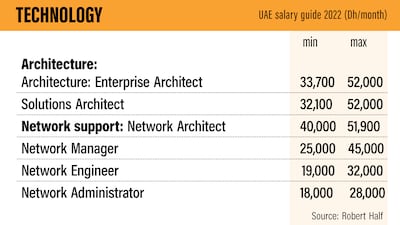
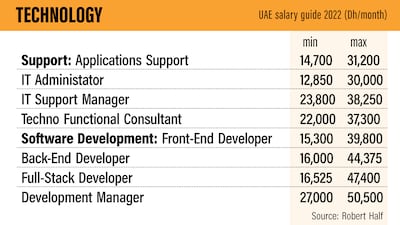
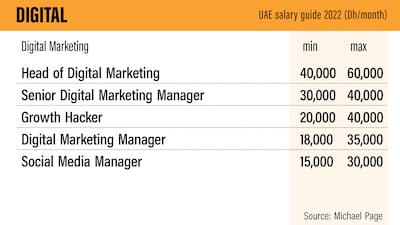
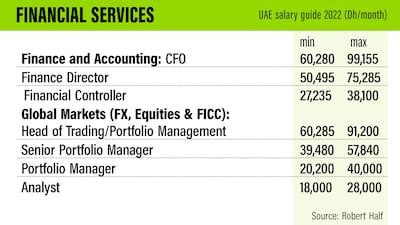
New laws have shaken up the private sector work landscape in the UAE.
The amended labour regulations, which were first outlined by the government in November 2021 and came into effect on Feburary 2, 2022 provide options that were not available before and strengthen employees' rights.
One of the major changes under the new rules is that people will be able to live in the country for up to six months after leaving a job.
Shorter, fixed-term contracts will also be introduced for most private-sector employees and some residents will now have the option to condense their working week as long as the contracted hours are met.
This may spur some individuals to make the jump and look for a role that is better for them
Emily Roberts,
Genie recruitment
Louise Vine, managing director at Inspire Selection recruitment agency in Dubai, said she is encouraged by the new law.
“When someone loses their job, they have six months to find a new one instead of only 30 days, so it offers more stability for their family,” she said.
“Also, when someone wants to quit because they really do not like their job, they now have six months to find another, so feel less pressured into accepting a job they do not want.
“It also gives them time to find a job that they're really happy with, at the right level and the right salary and so on.”
In her years as a recruiter, Ms Vine said she has come across people who have “accepted jobs out of desperation”, only to have a visa, which buys them time to find their ideal job.
She said this short-term employment is financially detrimental to the employer and creates an unstable work environment.
“Despite the law change, we don't see the great resignation phenomenon which has been reported in the US happening here,” said Ms Vine.
“The UAE is very different from the US and while this new law does allow people to walk away from their jobs more easily, the majority of people we come across are looking for work and are very keen to continue earning. Not many are in a position to spend six months with no pay due to the high cost of living.”
Emily Roberts, a consultant at Genie, a recruitment agency in Dubai, said the move will have a positive effect on workplace well-being and environments, as many job seekers can now spend time searching for the right opportunity.
“I believe this may spur some individuals to make the jump and look for a role that is better for them,” she said.
“As a recruiter, I do come across a lot of candidates who are deeply unhappy in their roles, which can be due to a number of reasons [such as] poor management or no work-life balance.”
A lot of people could not take the leap of resigning in the past, without another role confirmed, mainly because of the visa restrictions they would face, she said.
“The 180-day security will support those individuals who are itching to make a move and allow time to find a new position that suits them rather than perhaps rushing a process to accept something quickly,” said Ms Roberts.
“This will also give the opportunity for good talent to stay within the region as there's longer to secure something adequate.”
With an influx of expatriates looking to move to the region, she said the law changes will lead to “better retention rates for employers”, as they can be assured that the individual has had the time to consider all of their options before taking the best role for them.
Emirati lawyer Awatif Mohammed said the new law enhances the rights of both employers and employees.
“Employees will not fear losing jobs on the spot with the mandatory 14-day notice period during probation that employers must abide to,” he said.
“The market will further attract talents and skills from across the world, especially after allowing different styles of work, a move that came in response to the challenges forced by Covid-19 but proved necessary to the progress the country is witnessing.”
How job sharing works
Under the condensed hours options, if an employee is expected to work 40 hours a week under their contract, they can now work those hours over three days, said Abdulrahman Al Awar, Minister of Human Resources and Emiratisation.
Other flexible working options include shared jobs, when two people work in a single role and split the hours after agreeing to the arrangement with their employer.
David McKenzie, group managing director of recruitment agency Mackenzie Jones, said the shared job option would be beneficial for those looking to get back to work after time off.
“If you think about people doing job shares, they will most likely be working mothers looking to get back to part-time work,” he said.
“As they will already be supported by a spousal visa, all they would need is a labour card.
“By introducing this working structure as an option, what you’re doing is empowering people in the workplace who didn’t have many options before.”
With input from Salam Al Amir
COMPANY%20PROFILE%20
%3Cp%3E%3Cstrong%3ECompany%3A%20%3C%2Fstrong%3EOlive%20Gaea%3Cbr%3E%3Cstrong%3EStarted%3A%3C%2Fstrong%3E%202021%3Cbr%3E%3Cstrong%3ECo-founders%3A%3C%2Fstrong%3E%20Vivek%20Tripathi%2C%20Jessica%20Scopacasa%3Cbr%3E%3Cstrong%3EBased%3A%3C%2Fstrong%3E%20Dubai%3Cbr%3E%3Cstrong%3ELicensed%20by%3A%20%3C%2Fstrong%3EDubai%20World%20Trade%20Centre%3Cbr%3E%3Cstrong%3EIndustry%3A%3C%2Fstrong%3E%20Climate-Tech%2C%20Sustainability%3Cbr%3E%3Cstrong%3EFunding%3A%20%3C%2Fstrong%3E%241.1%20million%3Cbr%3E%3Cstrong%3EInvestors%3A%20%3C%2Fstrong%3ECornerstone%20Venture%20Partners%20and%20angel%20investors%3Cbr%3E%3Cstrong%3ENumber%20of%20employees%3A%3C%2Fstrong%3E%208%3Cbr%3E%3C%2Fp%3E%0A
The specs
Engine: 1.5-litre turbo
Power: 181hp
Torque: 230Nm
Transmission: 6-speed automatic
Starting price: Dh79,000
On sale: Now
RoboCop%3A%20Rogue%20City
%3Cp%3E%3Cstrong%3EDeveloper%3A%20%3C%2Fstrong%3ETeyon%3Cbr%3E%3Cstrong%3EPublisher%3A%20%3C%2Fstrong%3ENacon%3Cbr%3E%3Cstrong%3EConsole%3A%3C%2Fstrong%3E%20PlayStation%205%2C%20Xbox%20Series%20X%2FS%20and%20PC%3Cbr%3E%3Cstrong%3ERating%3A%20%3C%2Fstrong%3E3%2F5%3C%2Fp%3E%0A
Profile of Bitex UAE
Date of launch: November 2018
Founder: Monark Modi
Based: Business Bay, Dubai
Sector: Financial services
Size: Eight employees
Investors: Self-funded to date with $1m of personal savings
The five pillars of Islam
Lexus LX700h specs
Engine: 3.4-litre twin-turbo V6 plus supplementary electric motor
Power: 464hp at 5,200rpm
Torque: 790Nm from 2,000-3,600rpm
Transmission: 10-speed auto
Fuel consumption: 11.7L/100km
On sale: Now
Price: From Dh590,000
Company Fact Box
Company name/date started: Abwaab Technologies / September 2019
Founders: Hamdi Tabbaa, co-founder and CEO. Hussein Alsarabi, co-founder and CTO
Based: Amman, Jordan
Sector: Education Technology
Size (employees/revenue): Total team size: 65. Full-time employees: 25. Revenue undisclosed
Stage: early-stage startup
Investors: Adam Tech Ventures, Endure Capital, Equitrust, the World Bank-backed Innovative Startups SMEs Fund, a London investment fund, a number of former and current executives from Uber and Netflix, among others.
Ten tax points to be aware of in 2026
1. Domestic VAT refund amendments: request your refund within five years
If a business does not apply for the refund on time, they lose their credit.
2. E-invoicing in the UAE
Businesses should continue preparing for the implementation of e-invoicing in the UAE, with 2026 a preparation and transition period ahead of phased mandatory adoption.
3. More tax audits
Tax authorities are increasingly using data already available across multiple filings to identify audit risks.
4. More beneficial VAT and excise tax penalty regime
Tax disputes are expected to become more frequent and more structured, with clearer administrative objection and appeal processes. The UAE has adopted a new penalty regime for VAT and excise disputes, which now mirrors the penalty regime for corporate tax.
5. Greater emphasis on statutory audit
There is a greater need for the accuracy of financial statements. The International Financial Reporting Standards standards need to be strictly adhered to and, as a result, the quality of the audits will need to increase.
6. Further transfer pricing enforcement
Transfer pricing enforcement, which refers to the practice of establishing prices for internal transactions between related entities, is expected to broaden in scope. The UAE will shortly open the possibility to negotiate advance pricing agreements, or essentially rulings for transfer pricing purposes.
7. Limited time periods for audits
Recent amendments also introduce a default five-year limitation period for tax audits and assessments, subject to specific statutory exceptions. While the standard audit and assessment period is five years, this may be extended to up to 15 years in cases involving fraud or tax evasion.
8. Pillar 2 implementation
Many multinational groups will begin to feel the practical effect of the Domestic Minimum Top-Up Tax (DMTT), the UAE's implementation of the OECD’s global minimum tax under Pillar 2. While the rules apply for financial years starting on or after January 1, 2025, it is 2026 that marks the transition to an operational phase.
9. Reduced compliance obligations for imported goods and services
Businesses that apply the reverse-charge mechanism for VAT purposes in the UAE may benefit from reduced compliance obligations.
10. Substance and CbC reporting focus
Tax authorities are expected to continue strengthening the enforcement of economic substance and Country-by-Country (CbC) reporting frameworks. In the UAE, these regimes are increasingly being used as risk-assessment tools, providing tax authorities with a comprehensive view of multinational groups’ global footprints and enabling them to assess whether profits are aligned with real economic activity.
Contributed by Thomas Vanhee and Hend Rashwan, Aurifer
THE CLOWN OF GAZA
Director: Abdulrahman Sabbah
Starring: Alaa Meqdad
Rating: 4/5
Company Profile
Name: Thndr
Started: 2019
Co-founders: Ahmad Hammouda and Seif Amr
Sector: FinTech
Headquarters: Egypt
UAE base: Hub71, Abu Dhabi
Current number of staff: More than 150
Funds raised: $22 million
UAE SQUAD
Khalid Essa (Al Ain), Ali Khaseif (Al Jazira), Adel Al Hosani (Sharjah), Mahmoud Khamis (Al Nasr), Yousef Jaber (Shabab Al Ahli Dubai), Khalifa Al Hammadi (Jazira), Salem Rashid (Jazira), Shaheen Abdelrahman (Sharjah), Faris Juma (Al Wahda), Mohammed Shaker (Al Ain), Mohammed Barghash (Wahda), Abdulaziz Haikal (Shabab Al Ahli), Ahmed Barman (Al Ain), Khamis Esmail (Wahda), Khaled Bawazir (Sharjah), Majed Surour (Sharjah), Abdullah Ramadan (Jazira), Mohammed Al Attas (Jazira), Fabio De Lima (Al Wasl), Bandar Al Ahbabi (Al Ain), Khalfan Mubarak (Jazira), Habib Fardan (Nasr), Khalil Ibrahim (Wahda), Ali Mabkhout (Jazira), Ali Saleh (Wasl), Caio (Al Ain), Sebastian Tagliabue (Nasr).
Scoreline
Al Wasl 1 (Caio Canedo 90 1')
Al Ain 2 (Ismail Ahmed 3', Marcus Berg 50')
Red cards: Ismail Ahmed (Al Ain) 77'
Fines for littering
In Dubai:
Dh200 for littering or spitting in the Dubai Metro
Dh500 for throwing cigarette butts or chewing gum on the floor, or littering from a vehicle.
Dh1,000 for littering on a beach, spitting in public places, throwing a cigarette butt from a vehicle
In Sharjah and other emirates
Dh500 for littering - including cigarette butts and chewing gum - in public places and beaches in Sharjah
Dh2,000 for littering in Sharjah deserts
Dh500 for littering from a vehicle in Ras Al Khaimah
Dh1,000 for littering from a car in Abu Dhabi
Dh1,000 to Dh100,000 for dumping waste in residential or public areas in Al Ain
Dh10,000 for littering at Ajman's beaches
COMPANY%20PROFILE
%3Cp%3E%3Cstrong%3ECompany%20name%3A%20%3C%2Fstrong%3ESupy%0D%3Cbr%3E%3Cstrong%3EStarted%3A%20%3C%2Fstrong%3E2021%0D%3Cbr%3E%3Cstrong%3EFounders%3A%20%3C%2Fstrong%3EDani%20El-Zein%2C%20Yazeed%20bin%20Busayyis%2C%20Ibrahim%20Bou%20Ncoula%0D%3Cbr%3E%3Cstrong%3EBased%3A%20%3C%2Fstrong%3EDubai%0D%3Cbr%3E%3Cstrong%3EIndustry%3A%20%3C%2Fstrong%3EFood%20and%20beverage%2C%20tech%2C%20hospitality%20software%2C%20Saas%0D%3Cbr%3E%3Cstrong%3EFunding%20size%3A%20%3C%2Fstrong%3EBootstrapped%20for%20six%20months%3B%20pre-seed%20round%20of%20%241.5%20million%3B%20seed%20round%20of%20%248%20million%0D%3Cbr%3E%3Cstrong%3EInvestors%3A%20%3C%2Fstrong%3EBeco%20Capital%2C%20Cotu%20Ventures%2C%20Valia%20Ventures%20and%20Global%20Ventures%3C%2Fp%3E%0A
MATCH INFO
Real Madrid 2
Vinicius Junior (71') Mariano (90 2')
Barcelona 0
More on Quran memorisation:
MATCH INFO
Burnley 1 (Brady 89')
Manchester City 4 (Jesus 24', 50', Rodri 68', Mahrez 87')
Benefits of first-time home buyers' scheme
- Priority access to new homes from participating developers
- Discounts on sales price of off-plan units
- Flexible payment plans from developers
- Mortgages with better interest rates, faster approval times and reduced fees
- DLD registration fee can be paid through banks or credit cards at zero interest rates
The 12
England
Arsenal, Chelsea, Liverpool, Manchester City, Manchester United, Tottenham Hotspur
Italy
AC Milan, Inter Milan, Juventus
Spain
Atletico Madrid, Barcelona, Real Madrid
The five pillars of Islam
The specs: 2018 Mercedes-AMG C63 S Cabriolet
Price, base: Dh429,090
Engine 4.0-litre twin-turbo V8
Transmission Seven-speed automatic
Power 510hp @ 5,500rpm
Torque 700Nm @ 1,750rpm
Fuel economy, combined 9.2L / 100km
The five stages of early child’s play
From Dubai-based clinical psychologist Daniella Salazar:
1. Solitary Play: This is where Infants and toddlers start to play on their own without seeming to notice the people around them. This is the beginning of play.
2. Onlooker play: This occurs where the toddler enjoys watching other people play. There doesn’t necessarily need to be any effort to begin play. They are learning how to imitate behaviours from others. This type of play may also appear in children who are more shy and introverted.
3. Parallel Play: This generally starts when children begin playing side-by-side without any interaction. Even though they aren’t physically interacting they are paying attention to each other. This is the beginning of the desire to be with other children.
4. Associative Play: At around age four or five, children become more interested in each other than in toys and begin to interact more. In this stage children start asking questions and talking about the different activities they are engaging in. They realise they have similar goals in play such as building a tower or playing with cars.
5. Social Play: In this stage children are starting to socialise more. They begin to share ideas and follow certain rules in a game. They slowly learn the definition of teamwork. They get to engage in basic social skills and interests begin to lead social interactions.