


As one of the many Expo 2020 attractions inspired by nature, it was no surprise a sacred river entrenched in the heart of the indigenous Maori community would take centre-stage at the New Zealand pavilion.
How a natural river can be recognised as having legal personhood is a puzzling concept, but Maori leaders said it ensures the natural world is protected for generations to come.
Long-running talks between the New Zealand government and the Te Ati Haunui-a-Paparangi tribe - all people of Maori descent - culminated in legal status being offered to the Whanganui River in 2017, protecting it from agricultural pollution and over development.
An indigenous rights framework based around nature has given Maori in New Zealand’s wildly beautiful North Island a voice.
Gerrard Albert, a senior member of the Maori community, said pavilion visitors will gain an understanding of the close bond his people have with nature.
Maori leader
“Nature’s sovereignty must be recognised as it has far more power and authority than we ever will have,” he said.
“We are now getting constantly buffeted by nature, with floods, cyclones, and we are only making it worse.
“It is continuously ignored and we are edging closer to the precipice. We are intimately part of nature and we cannot be divorced from it.
“The arrangements we have in place for the Whanganui River came from a place of indigenous rights.”
Under the Te Awa Tupua (Whanganui River Claims Settlement) Act 2017, the river is recognised as a living and indivisible whole, to better provide for its health and well-being.
Under any legal disputes, it can be represented in court by two appointed Maori.
At 290 kilometres, it is the third-longest river in New Zealand, known as Aotearoa by the Maori, and flows through three active volcanoes.
The river is treasured by the Maori, many of whose ancestors relied on its free-flowing waters.

Tributaries from the river now service the Tongariro Power Scheme, a 360-megawatt hydroelectricity generator and several power stations, providing municipality power to large swathes of North Island.
It is not the first time that legal status has been offered to part of New Zealand to protect it from development and preserve Maori rights.
Te Urewera, a sparsely populated area of mostly forested, rugged hill country in the northern Hawke’s Bay region of North Island also benefits from protected status.
Like the River Whanganui, Te Urewera was granted legal personhood in 2014, meaning it is not owned and is no longer vulnerable to unrestricted development.
The story of Whanganui is told inside the 2,000-square-metre pavilion, with the river represented by a nine-metre cascading waterfall.
At the heart of the area is a toka (boulder), brought to Dubai from Mount Tongariro, the river's source.
“We are now expressing our rights as indigenous people through our sovereignty and the sovereignty of our river,” said Mr Albert, who is on a two-week visit to the UAE.
“It is now an indigenous rights framework based in nature.
“We have local government and regional councils, and we elect people on to these councils to speak on our behalf.
“There are huge demands on the river, and for 170 years now we have been fighting to have a voice.
“The pavilion story tells us we are not where we want to be, but we are getting there.
“The river speaks through us to remind us of our obligation to it.”
Tiaki: inside the New Zealand pavilion's restaurant
-

Inside Tiaki, the New Zealand Pavilion's full-service restaurant operated by Emirates Flight Catering. All photos: Pawan Singh/The National -

Sliding doors allow the restaurant to be separated into more private spaces for temporary events -

The furniture, tableware and lighting has been designed by prominent New Zealand brands especially for the restaurant -

The restaurant offers different seating options -

Tiaki will be open daily within the New Zealand pavilion, once Expo Dubai 2020 begins -

The menu at Tiaki showcases ingredients New Zealand is famous for. Seen here, the roasted lamb rack -

Greenshell mussels at Tiaki -

Mount Aspiring, a grapefruit mocktail -
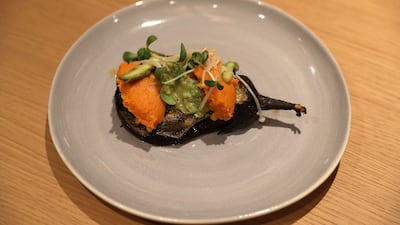
A Kawakawa roasted aubergine -

Blue cheese and roasted beets -

Fresh fruit carpaccio with mango sorbet -

Anzac biscuit ice cream sandwich with Manuka honey ice cream



