
Abu Dhabi has set up a company to find new supply chains, boost yields of essential produce and oversee an emergency food reserve for the population.
ADQ, a government-affiliated holding company, has set up Silal to further the country’s food security drive.
Silal will perform several functions, including:
– conducting research and development into desert farming technology to support smaller, local farmers growing fruit and vegetables
– securing supply chains for essential food
– managing and securing strategic reserves of emergency food supplies
Silal, which means “baskets” in Arabic, will be led by Jamal Salem Al Dhaheri, as chief executive.
“Silal will facilitate sustained production, sourcing and distribution of essential foods in Abu Dhabi for the benefit of retailers, farmers and the community,” he said.
“The name Silal... denotes the variety and abundance of produce that is at the core of what the new company will deliver. Our team will work collaboratively across the entire value chain to ensure an adequate, reliable supply of fresh and longer-life food items for our local communities.”
Khalifa Sultan Al Suwaidi, chief investment officer at ADQ, said: “The creation of Silal helps to ensure that the UAE population has access to safe, sufficient and nutritious food at affordable prices.
“Silal also complements ADQ’s existing investments in the food and agriculture sector as we seek to expand this important economic cluster. Under Jamal’s leadership, Silal will benefit from his depth of industry experience as we deliver upon this key national initiative.”
Earlier this year, ADQ acquired a 50 per cent stake in Al Dahra Holding Company, an agribusiness specialising in animal feed and essential food commodities. It also owns Agthia and Al Foah, which produce a variety of food and beverages, including dates and date products.
Since the coronavirus outbreak, the UAE government has looked to boost local food production and reduce the need for imports, on which the country has long relied.
Speaking last month, Sheikh Mohammed bin Rashid, Vice President and Ruler of Dubai, said the challenges of the pandemic have highlighted the crucial need for the country to make its food and water security strategy a top priority.
He said: “Food and water security is part of our national security... and requires us to enhance national awareness on the importance of preserving our resources and creating a self-sufficient system.”
7 foods produced in the UAE – in pictures
-
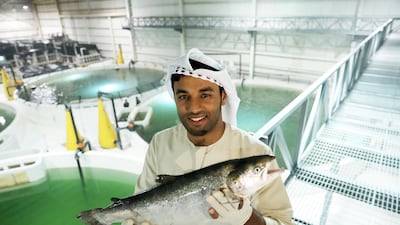
Salmon is the country's second favourite fish but imported salmon must travel at least 7,000 km from Norway before it reaches the dinner plate. Fish Farm introduced its locally farmed salmon to supermarkets last year. Bader Al Mabarak, chief executive of the Jebel Ali company, holds a salmon. Pawan Singh / The National -
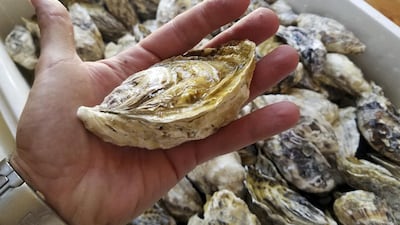
Spinneys sells fresh Dibba Bay oysters -
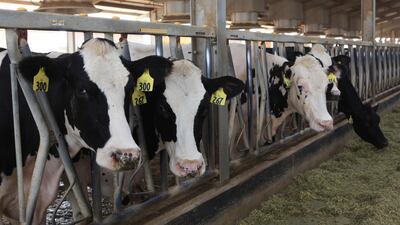
Few consider the improbable beginnings of dairy farming in the harsh climate of the Gulf when they pick up a bottle of milk from the local baqala. Ravindranath K / The National -
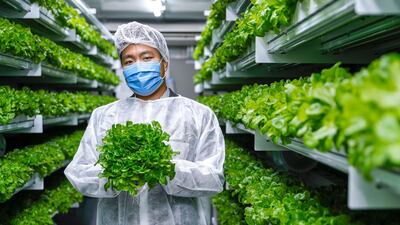
Leafy greens, like the lettuce held here by the director of Smart Acres, Sean Lee, are a favourite at hydroponic farms because they are ready for harvest in as little as 30 days. Hydroponic farming, which is more water and land efficient than conventional farming, may be the future of the industry in the UAE. Victor Besa / The National -
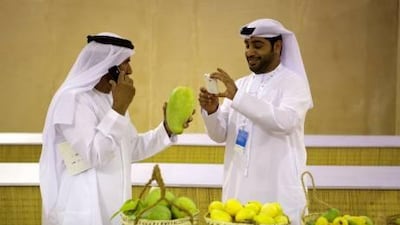
A mango boom hit Fujairah from the 1970s but many farmers are turning away from conventional farming due to water shortages and electricity costs. Pictured: judges inspect lemons and mangoes during the Liwa Date Festival, which awarded a Dh25,000 prize for best mango. -

Sardines, or uma, are a firm favourite of UAE elders as a local protein sources and for their umami flavouring. Pictured: A harvest of sardines dry on a beach in Fujairah city. Alamy -
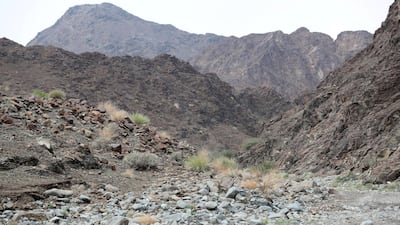
Hardy mountain and desert plants indigenous to the UAE can help heal bones, regulate blood sugar and ease menstrual cramps. Wadis like this one, in South Ras Al Khaimah, are full of healing plants. Chris Whiteoak / The National -
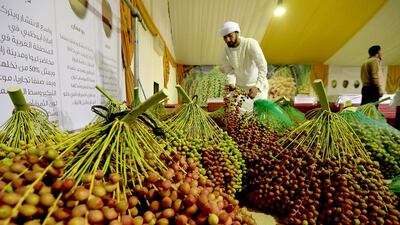
Dibbs, or date molasses, is produced in abundance and is a vitamin-packed natural sweetener that can substitute for imported molasses, syrups and processed sweeteners. Pictured: Abdullah Al Mazrouei, a volunteer at last year’s Liwa Date Festival, checks dates before they are judged. Ravindranath K / The National



