US vice president-elect Kamala Harris and president-elect Joe Biden arrive for victory address after being declared the winner in the 2020 presidential election, in Wilmington, Delaware. EPA
US president-elect Joe Biden and Jill Biden with vice president-elect Kamala Harris are joined by family members after Mr Biden delivered his victory address following the announcement of the winner in the 2020 presidential election, in Wilmington, Delaware. EPA
People watch fireworks after media announced that Democratic US presidential candidate Joe Biden has won the 2020 election, in Wilmington, Delaware. Reuters
US president-elect Joe Biden gestures in celebration after delivering remarks in Wilmington, Delaware. AFP
Democratic presidential nominee Joe Biden and his wife Jill, and Democratic vice presidential nominee Kamala Harris and her husband Doug, react to the confetti at their rally in Wilmington, Delaware. Reuters
Vice president-elect Kamala Harris arrives to deliver remarks before introducing the US president-elect Joe Biden in Wilmington, Delaware. AFP
People gather to watch the speeches in Times Square in New York City. Reuters
Gabriella Ziccarelli, 32, from Arizona, holds a US flag as she watches a speech by vice president-elect Kamala Harris, in Times Square in New York City. Reuters
Vice president-elect Kamala Harris speaks in Wilmington, Delaware, November 7, 2020. Reuters
US president-elect Joe Biden and vice president-elect Kamala Harris gesture during their post-election rally in Wilmington, Delaware. Reuters
A person wearing a protective mask holds a 'Biden Harris' campaign sign outside Trump National Golf Club in Sterling, Virginia. Bloomberg
The presidential motorcade, with US President Donald Trump, travels through Reston, Virginia, after President Trump played golf at his International golf club. AFP
President Donald Trump returns to the White House from playing golf in Washington, after Joe Biden was declared the winner of the 2020 presidential election. AFP
President Donald Trump plays golf at Trump National Golf Club in Sterling, Virginia. AFP
A woman reacts as she watches speeches by Joe Biden and Kamala Harris, in Times Square in New York City. Reuters
People watch the speeches by Joe Biden and Kamala Harris, at Times Square in New York City. Reuters
Confetti falls after US president-elect Joe Biden and vice president-elect Kamala Harris delivered speeches in Wilmington, Delaware. AFP
US president-elect Joe Biden with his wife Jill Biden, salute the crowd on stage after delivering a speech in Wilmington, Delaware. AFP
US president-elect Joe Biden, wife Jill Biden, vice president-elect Kamala Harris and husband Douglas Emhoff hold hands while wearing protective masks during a post-election event in Wilmington, Delaware. Bloomberg
Vice president-elect Kamala Harris and president-elect Joe Biden stand on stage with family members in Wilmington, Delaware. AP Photo
A boy carries a sign with vice president-elect Kamala Harris at Black Lives Matter Plaza in Washington. Reuters
People watch a speech by Democratic vice presidential nominee Kamala Harris, at Times Square in New York City. Reuters
A woman takes selfie photo posing with an extra edition of a newspaper reporting that Democrat Joe Biden is projected to win the 2020 US presidential election, in Tokyo, Japan. Reuters
Saturday in Washington was like nothing I have experienced in 22 years living in this city. Horns honked, cheers resounded, fireworks crackled and people danced in the streets. It felt like a long, painful war was ending with an almost visceral wave of relief.
Four days after the US election, major news organisations finally and unanimously announced that Democrat Joe Biden had won. President Donald Trump and his allies angrily insist that he somehow is the real winner but they have no coherent narrative to explain why.
Against a backdrop of unprecedented anxiety, the 2020 election mainly produced good news. For many, there’s profound satisfaction that Mr Trump was defeated. Many distinguished figures had warned that a second Trump term could pose an existential threat to democratic institutions, accountability and the rule of law. A major counter-argument was that he lacked the ability, but not the instinct, to push for autocracy.
Any such danger has been avoided.
The presidential win is cathartic for Democrats. It is rare and increasingly difficult to unseat a sitting president.
And the numbers are impressive. In 2016, Mr Trump beat Hillary Clinton in the electoral college by securing 306 votes, though she won the popular tally by almost 3 million. Mr Biden is also heading for 306, but is beating Mr Trump by over 4m popular votes, a double mandate.
Democrats reconstructed the mid-western "blue wall" that Mr Trump grabbed in 2016, including Wisconsin, Michigan and Pennsylvania. They scored major breakthroughs in traditionally Republican Arizona and Georgia. Democrats would have salivated over this map 12 months ago, though their hopes became exaggerated more recently.
But there's much to please Republicans, too. They made surprising gains in the House of Representatives and crucial state legislatures. Control of the Senate will be decided by two January run-off elections in Georgia. If Republicans win both, they can effectively wield a veto over most of Mr Biden's domestic agenda.
Mr Trump helped inspire the biggest voter turnout in over a century, which was also due to expanded postal and early voting because of the pandemic.
In what was effectively a Trump referendum, no votes prevailed by 4-5m. But there were over 70m yeses, including most of his 2016 voters and significantly expanded blocs of Latinos and African-Americans, particularly younger men who appear to admire his swagger.
So, while many Republicans may be despondent, their party actually did fairly well.
Republican leaders might quietly welcome the potential end of Mr Trump's party leadership. But their refusal to publicly acknowledge Mr Biden's victory suggests they are still terrified of Mr Trump's base, and unwilling to defy him.
American democratic norms and processes prevailed. None of the well-publicised nightmare scenarios played out.
Though an anti-democratic hazard was soundly rejected, the best news of all was non-partisan, structural and institutional. Political systems functioned admirably despite profound social and partisan polarisation and the raging coronavirus pandemic.
Foreign meddling was contained. There was no violence or intimidation at polling places and no effort to disrupt the election process. Irregularities appear minor at worst.
State and local administrators who oversee American elections generally behaved impeccably. Democratic and Republican officials, and countless volunteers and election officers, worked together across the country without incident or rancour.
Americans in their conduct overwhelmingly upheld cherished democratic norms and traditions. The country may be polarised, but citizens on both the left and right appear sincerely committed to these values and mores. This is profoundly reassuring.
Mr Trump may be hoping that the Supreme Court, now bolstered with his latest conservative appointee, Amy Coney Barrett, will intervene and save him, as he repeatedly predicted it would during the campaign. He is going to be deeply disappointed.
This result is not within what is cynically but accurately called "cheating distance", and no pending case would overturn the outcome. If the court tried to overturn a free and fair election on a technicality, it would create an unprecedented constitutional crisis and do irreversible damage to the institution.
Mr Biden’s challenges will be enormous. He inherits a country still beset by a raging pandemic and struggling economy, and deeply divided along partisan, cultural and ethnic lines.
In his first speech as President-elect, he pledged to end the "grim era of demonisation” under Mr Trump and rebuild a spirit of compromise, co-operation and bipartisanship, but that won't be easy.
Much depends on what happens in the Senate, through both its composition as determined by the two Georgia run-off races, and the strategy adopted by Majority Leader Mitch McConnell. He ground governance to a virtual halt during much of the Barack Obama presidency, and could choose to repeat that strategy.
Mr Trump ought to help matters by at least acknowledging his defeat, but he seems incapable of that. He appears determined to promulgate a classic right-wing "stabbed in the back" theory that insists he is still the legitimate President, and so exacerbate tensions and further divide Americans.
Democratic presidential nominee Joe Biden addresses the nation at the Chase Center in Wilmington, Delaware. AFP
Vice presidential nominee Kamala Harris looks on as US Democratic presidential nominee Joe Biden speaks about election results in Wilmington, Delaware. Reuters
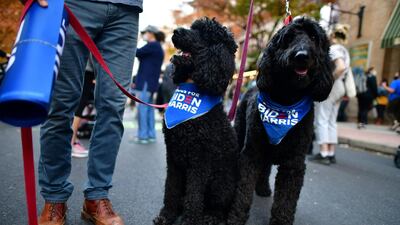
Dogs with bibs supporting Democratic presidential nominee Joe Biden are seen across the street from where ballots are being counted in Philadelphia, Pennsylvania. Reuters
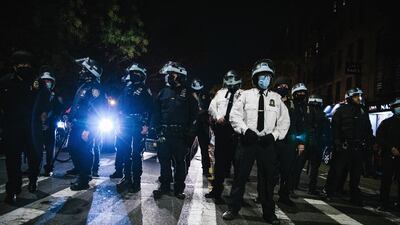
Police stand guard during a demonstration held by supporters of democrat presidential candidate Joe Biden in New York. EPA
People cheer after Democratic presidential nominee Joe Biden overtook President Donald Trump in the Pennsylvania general election vote count. Reuters
Activists celebrate after Democratic presidential nominee Joe Biden overtook President Donald Trump in the Pennsylvania general election vote count, in Philadelphia, Pennsylvania. Reuters
Journalists from all over the world wait for the result of the US Presidential elections on Black Lives Matter Plaza in front of the White House in Washington. AFP
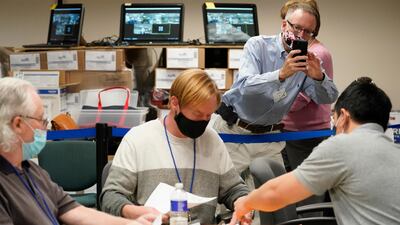
Republican canvas observer Ed White, takes photos with his smart phone as Lehigh County workers count ballots as vote counting continues in Allentown Pennsylvania. AP Photo
Supporters of President Donald Trump demonstrate outside of the TCF Centre in Detroit, Michigan. AFP
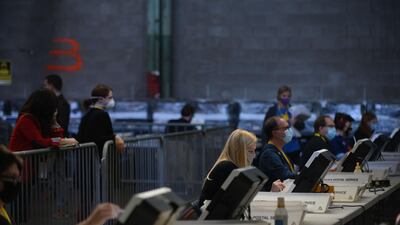
Election officials proceed with the counting of ballots at the Allegheny County elections warehouse in Pittsburgh, Pennsylvania. AFP
House of Representatives Speaker Nancy Pelosi holds a news conference during the presidential election in Washington. Reuters
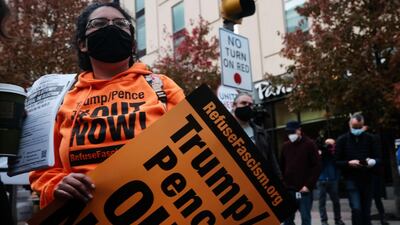
Protesters urge vote counting outside the Pennsylvania Convention Center. AFP
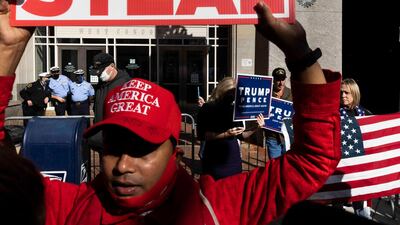
Supporters of President Trump, who are questioning the legitimacy of the state's vote counting, gather outside of the Pennsylvania Convention Centre in Philadelphia. EPA
A police officer stands watch near a stage set up by the campaign of Democratic presidential nominee Joe Biden in Wilmington, Delaware. Reuters
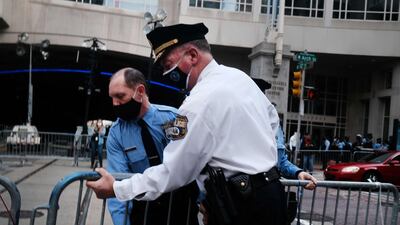
Protesters, police, members of the media and others converge outside of the Convention Centre as the counting of ballots continues in the state in Philadelphia, Pennsylvania. AFP
Protesters gather outside of the Philadelphia Convention Centre. AFP
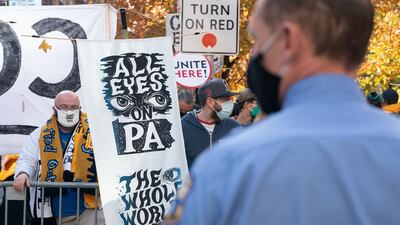
Protesters outside of the Philadelphia Convention Centre. Joe Biden took the lead in the vote count on Friday morning from President Trump, bringing him one step closer to winning the election. AFP
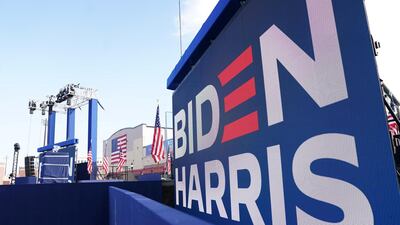
A stage set up by the campaign of Joe Biden sits ready in Wilmington. Reuters
Once he's gone, however unwillingly, much of the country will try to move on. But the willingness and ability of the Republican Party to get past the Trump era remains an open question
Reports suggest he might nonetheless be willing to negotiate a normal transfer of power. His terms are unclear, but he faces significant potential criminal charges at both the federal and state levels, and has reportedly expressed concern he may face prosecution when he loses the protection of the presidency. He could be hoping for salvation through the art of the deal.
Mr Trump will probably be the first modern US President to refuse to concede defeat and participate in his successor’s inauguration. More likely is a new media-centred career of insisting that he’s still the real President and American democracy is a corrupt fraud.
He could inflict significant national damage while he is still formally in office until January 20, but he could also be restrained or even ignored, including by subordinates. His options might be more limited in practice than in theory.
Once he's gone, however unwillingly, much of the country will try to move on. But the willingness and ability of the Republican Party to get past the Trump era remains an open question. The immediate US political future may hang on the answer.
Hussein Ibish is a senior resident scholar at the Arab Gulf States Institute and a US affairs columnist for The National

October 26: Bahrain withdraws from a proposal to create a federation of nine with the seven Trucial States and Qatar.
December: Ahmed Al Suwaidi visits New York to discuss potential UN membership.
1971
March 1: Alex Douglas Hume, Conservative foreign secretary confirms that Britain will leave the Gulf and “strongly supports” the creation of a Union of Arab Emirates.
July 12: Historic meeting at which Sheikh Zayed and Sheikh Rashid make a binding agreement to create what will become the UAE.
July 18: It is announced that the UAE will be formed from six emirates, with a proposed constitution signed. RAK is not yet part of the agreement.
August 6: The fifth anniversary of Sheikh Zayed becoming Ruler of Abu Dhabi, with official celebrations deferred until later in the year.
August 15: Bahrain becomes independent.
September 3: Qatar becomes independent.
November 23-25: Meeting with Sheikh Zayed and Sheikh Rashid and senior British officials to fix December 2 as date of creation of the UAE.
November 29: At 5.30pm Iranian forces seize the Greater and Lesser Tunbs by force.
November 30: Despite a power sharing agreement, Tehran takes full control of Abu Musa.
November 31: UK officials visit all six participating Emirates to formally end the Trucial States treaties
December 2: 11am, Dubai. New Supreme Council formally elects Sheikh Zayed as President. Treaty of Friendship signed with the UK. 11.30am. Flag raising ceremony at Union House and Al Manhal Palace in Abu Dhabi witnessed by Sheikh Khalifa, then Crown Prince of Abu Dhabi.
December 6: Arab League formally admits the UAE. The first British Ambassador presents his credentials to Sheikh Zayed.
Mercer, the investment consulting arm of US services company Marsh & McLennan, expects its wealth division to at least double its assets under management (AUM) in the Middle East as wealth in the region continues to grow despite economic headwinds, a company official said.
Mercer Wealth, which globally has $160 billion in AUM, plans to boost its AUM in the region to $2-$3bn in the next 2-3 years from the present $1bn, said Yasir AbuShaban, a Dubai-based principal with Mercer Wealth.
“Within the next two to three years, we are looking at reaching $2 to $3 billion as a conservative estimate and we do see an opportunity to do so,” said Mr AbuShaban.
Mercer does not directly make investments, but allocates clients’ money they have discretion to, to professional asset managers. They also provide advice to clients.
“We have buying power. We can negotiate on their (client’s) behalf with asset managers to provide them lower fees than they otherwise would have to get on their own,” he added.
Mercer Wealth’s clients include sovereign wealth funds, family offices, and insurance companies among others.
From its office in Dubai, Mercer also looks after Africa, India and Turkey, where they also see opportunity for growth.
Wealth creation in Middle East and Africa (MEA) grew 8.5 per cent to $8.1 trillion last year from $7.5tn in 2015, higher than last year’s global average of 6 per cent and the second-highest growth in a region after Asia-Pacific which grew 9.9 per cent, according to consultancy Boston Consulting Group (BCG). In the region, where wealth grew just 1.9 per cent in 2015 compared with 2014, a pickup in oil prices has helped in wealth generation.
BCG is forecasting MEA wealth will rise to $12tn by 2021, growing at an annual average of 8 per cent.
Drivers of wealth generation in the region will be split evenly between new wealth creation and growth of performance of existing assets, according to BCG.
Another general trend in the region is clients’ looking for a comprehensive approach to investing, according to Mr AbuShaban.
“Institutional investors or some of the families are seeing a slowdown in the available capital they have to invest and in that sense they are looking at optimizing the way they manage their portfolios and making sure they are not investing haphazardly and different parts of their investment are working together,” said Mr AbuShaban.
Some clients also have a higher appetite for risk, given the low interest-rate environment that does not provide enough yield for some institutional investors. These clients are keen to invest in illiquid assets, such as private equity and infrastructure.
“What we have seen is a desire for higher returns in what has been a low-return environment specifically in various fixed income or bonds,” he said.
“In this environment, we have seen a de facto increase in the risk that clients are taking in things like illiquid investments, private equity investments, infrastructure and private debt, those kind of investments were higher illiquidity results in incrementally higher returns.”
The Abu Dhabi Investment Authority, one of the largest sovereign wealth funds, said in its 2016 report that has gradually increased its exposure in direct private equity and private credit transactions, mainly in Asian markets and especially in China and India. The authority’s private equity department focused on structured equities owing to “their defensive characteristics.”
iPhone XS
With a 5.8-inch screen, it will be an advance version of the iPhone X. It will be dual sim and comes with better battery life, a faster processor and better camera. A new gold colour will be available. Price: Dh4,229
iPhone XS Max
It is expected to be a grander version of the iPhone X with a 6.5-inch screen; an inch bigger than the screen of the iPhone 8 Plus. Price: Dh4,649
iPhone XR
A low-cost version of the iPhone X with a 6.1-inch screen, it is expected to attract mass attention. According to industry experts, it is likely to have aluminium edges instead of stainless steel. Price: Dh3,179
Apple Watch Series 4
More comprehensive health device with edge-to-edge displays that are more than 30 per cent bigger than displays on current models.
Gender pay parity on track in the UAE
The UAE has a good record on gender pay parity, according to Mercer's Total Remuneration Study.
"In some of the lower levels of jobs women tend to be paid more than men, primarily because men are employed in blue collar jobs and women tend to be employed in white collar jobs which pay better," said Ted Raffoul, career products leader, Mena at Mercer. "I am yet to see a company in the UAE – particularly when you are looking at a blue chip multinationals or some of the bigger local companies – that actively discriminates when it comes to gender on pay."
Mr Raffoul said most gender issues are actually due to the cultural class, as the population is dominated by Asian and Arab cultures where men are generally expected to work and earn whereas women are meant to start a family.
"For that reason, we see a different gender gap. There are less women in senior roles because women tend to focus less on this but that’s not due to any companies having a policy penalising women for any reasons – it’s a cultural thing," he said.
As a result, Mr Raffoul said many companies in the UAE are coming up with benefit package programmes to help working mothers and the career development of women in general.
George Sainsbury of the supermarket dynasty, sugar magnate William Park Lyle and actress Dame Gracie Fields were residents in the 1930s when the street was only known as ‘Millionaires’ Row’.
Then came the international super rich, including the last king of Greece, Constantine II, the Sultan of Brunei and Indian steel magnate Lakshmi Mittal who was at one point ranked the third richest person in the world.
Turkish tycoon Halis Torprak sold his mansion for £50m in 2008 after spending just two days there. The House of Saud sold 10 properties on the road in 2013 for almost £80m.
Other residents have included Iraqi businessman Nemir Kirdar, singer Ariana Grande, holiday camp impresario Sir Billy Butlin, businessman Asil Nadir, Paul McCartney’s former wife Heather Mills.
Hunting park to luxury living
Land was originally the Bishop of London's hunting park, hence the name
The road was laid out in the mid 19th Century, meandering through woodland and farmland
Its earliest houses at the turn of the 20th Century were substantial detached properties with extensive grounds
Indoor cricket World Cup:
Insportz, Dubai, September 16-23
UAE fixtures:
Men
Saturday, September 16 – 1.45pm, v New Zealand
Sunday, September 17 – 10.30am, v Australia; 3.45pm, v South Africa
Monday, September 18 – 2pm, v England; 7.15pm, v India
Tuesday, September 19 – 12.15pm, v Singapore; 5.30pm, v Sri Lanka
Thursday, September 21 – 2pm v Malaysia
Friday, September 22 – 3.30pm, semi-final
Saturday, September 23 – 3pm, grand final
Women
Saturday, September 16 – 5.15pm, v Australia
Sunday, September 17 – 2pm, v South Africa; 7.15pm, v New Zealand
Monday, September 18 – 5.30pm, v England
Tuesday, September 19 – 10.30am, v New Zealand; 3.45pm, v South Africa
Thursday, September 21 – 12.15pm, v Australia
Friday, September 22 – 1.30pm, semi-final
Saturday, September 23 – 1pm, grand final