People in Fujairah were warned to be "extremely vigilant" on Sunday afternoon after heavy rain hit the Northern Emirates.
The National Centre of Meteorology issued a red alert for the area, cautioning of "hazardous weather events of exceptional severity".
The NCM said rainfall was expected until about 9pm, largely in the Northern Emirates.
Heavy rain was recorded in parts of Ras Al Khaimah and Sharjah between 3.10pm and 4.21pm, with further rainfall in Fujairah.
The weather centre said people should take precautions in case of heavy rain in eastern regions and stay away from flooded areas.
The authorities remain on alert after deadly flash floods hit the eastern region of the UAE last month.
Seven people died and more than 800 were rescued after torrential downpours caused flooding across the northern and eastern coasts.
The NCM said it was the wettest July in decades.
UAE hit by dust storms and rain
A dust alert was issued on Sunday morning, as the UAE braced for several days of heavy rainfall and high winds.
Visibility remained poor across the Emirates until early evening.
A number of flights bound for Dubai International Airport were diverted to neighbouring airports due to the reduced visibility.
The national weather centre said visibility had dropped below 500 metres in many parts of the country, including over Abu Dhabi International Airport, as winds reached 40kmph.
People were asked to take the wet weather into consideration when heading outdoors.
Abu Dhabi Police shared a message on social media shortly before 3pm asking motorists to abide by variable speed limits displayed on electronic road signs while driving during rain.
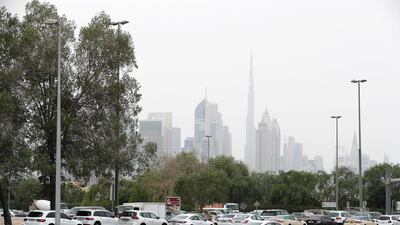
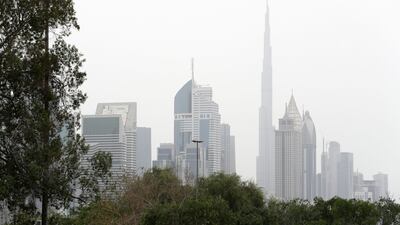
People had woke to thick clouds of dust blanketing the skylines of Abu Dhabi and Dubai, with many large buildings barely visible under the haze.
Members of the public were asked to follow guidance from authorities as the strong winds kicked up sand and dust, greatly reducing visibility.
Abu Dhabi Police cautioned motorists to be vigilant while driving in dusty conditions.
The force called on people to refrain from taking photographs of the unsettled weather while behind the wheel.
Abu Dhabi Media Office on Saturday said people should only drive “if necessary” due to the adverse conditions to come.
It said drivers should turn on their low-beam during bouts of poor visibility.
It said Al Ain and Al Dhafra were likely to be worst affected.
More rain to come
Authorities came together on Friday to discuss response plans for a period of unstable weather.
The National Emergency, Crisis and Disasters Management Authority, better known as Ncema, took part in a meeting with the National Centre of Meteorology, the Ministry of Defence, the Ministry of Interior, the Ministry of Energy and Infrastructure, and police chiefs.
“All local and national teams are highly prepared to ensure an effective and proper response to any risks that may arise as a result of the condition,” Ncema said.
The UAE could be set for more rain until at least Friday, according to the latest forecasts.
Winds of up to 40 kilometres an hour are expected in parts of the country in the days ahead.
These are expected to bring more dust and sand storms. The rain is also expected to cause a drop in temperatures throughout the first part of the week.
“There will be a chance of rain formation in some parts of the east and south on Saturday and Sunday,” a forecaster from the NCM told The National last week.
“There is a low-pressure system with humid air from the Sea of Oman and Arabian Sea coming towards our area,” he said. “We expect some moderate to heavy rain.”
The NCM said rain was most likely to fall in the southern and western parts of the country.
The drop in temperature is in contrast to the hot weather of last week.
Temperatures topped 50°C in Swehain, which was the hottest place on Earth on one June afternoon in 2021.
Rain in the UAE - in pictures
COMPANY%20PROFILE
%3Cp%3E%3Cstrong%3EName%3A%20%3C%2Fstrong%3ETelr%3Cbr%3E%3Cstrong%3EBased%3A%20%3C%2Fstrong%3EDubai%2C%20UAE%3Cbr%3E%3Cstrong%3ELaunch%20year%3A%3C%2Fstrong%3E%202014%3Cbr%3E%3Cstrong%3ENumber%20of%20employees%3A%20%3C%2Fstrong%3E65%3Cbr%3E%3Cstrong%3ESector%3A%20%3C%2Fstrong%3EFinTech%20and%20payments%3Cbr%3E%3Cstrong%3EFunding%3A%20%3C%2Fstrong%3Enearly%20%2430%20million%20so%20far%3C%2Fp%3E%0A
Company%20Profile
%3Cp%3E%3Cstrong%3EName%3A%3C%2Fstrong%3E%20Neo%20Mobility%3Cbr%3E%3Cstrong%3EStarted%3A%3C%2Fstrong%3E%20February%202023%3Cbr%3E%3Cstrong%3ECo-founders%3A%3C%2Fstrong%3E%20Abhishek%20Shah%20and%20Anish%20Garg%3Cbr%3E%3Cstrong%3EBased%3A%3C%2Fstrong%3E%20Dubai%3Cbr%3E%3Cstrong%3EIndustry%3A%3C%2Fstrong%3E%20Logistics%3Cbr%3E%3Cstrong%3EFunding%3A%3C%2Fstrong%3E%20%2410%20million%3Cbr%3E%3Cstrong%3EInvestors%3A%3C%2Fstrong%3E%20Delta%20Corp%2C%20Pyse%20Sustainability%20Fund%2C%20angel%20investors%3C%2Fp%3E%0A
Squid Game season two
Director: Hwang Dong-hyuk
Stars: Lee Jung-jae, Wi Ha-joon and Lee Byung-hun
Rating: 4.5/5
FFP EXPLAINED
What is Financial Fair Play?
Introduced in 2011 by Uefa, European football’s governing body, it demands that clubs live within their means. Chiefly, spend within their income and not make substantial losses.
What the rules dictate?
The second phase of its implementation limits losses to €30 million (Dh136m) over three seasons. Extra expenditure is permitted for investment in sustainable areas (youth academies, stadium development, etc). Money provided by owners is not viewed as income. Revenue from “related parties” to those owners is assessed by Uefa's “financial control body” to be sure it is a fair value, or in line with market prices.
What are the penalties?
There are a number of punishments, including fines, a loss of prize money or having to reduce squad size for European competition – as happened to PSG in 2014. There is even the threat of a competition ban, which could in theory lead to PSG’s suspension from the Uefa Champions League.
Results:
5pm: Maiden (PA) | Dh80,000 | 1,200 metres
Winner: Jabalini, Szczepan Mazur (jockey), Younis Kalbani (trainer)
5.30pm: UAE Arabian Derby (PA) | Prestige | Dh150,000 | 2,200m
Winner: Octave, Gerald Avranche, Abdallah Al Hammadi
6pm: Arabian Triple Crown Round 3 (PA) | Group 3 Dh300,000 | 2,200m
Winner: Harrab, Richard Mullen, Mohamed Ali
6.30pm: Emirates Championship (PA) | Group 1 | Dh1million | 2,200m
Winner: BF Mughader, Szczepan Mazur, Younis Al Kalbani
7pm: Abu Dhabi Championship (TB) | Group 3 | Dh380,000 | 2,200m
Winner: GM Hopkins, Patrick Cosgrave, Jaber Ramadhan
7.30pm: Wathba Stallions Cup (PA) | Conditions | Dh70,000 | 1,600m
Winner: AF La’Asae, Tadhg O’Shea, Ernst Oertel
What can you do?
Document everything immediately; including dates, times, locations and witnesses
Seek professional advice from a legal expert
You can report an incident to HR or an immediate supervisor
You can use the Ministry of Human Resources and Emiratisation’s dedicated hotline
In criminal cases, you can contact the police for additional support
MATCH INFO
Jersey 147 (20 overs)
UAE 112 (19.2 overs)
Jersey win by 35 runs
Who was Alfred Nobel?
The Nobel Prize was created by wealthy Swedish chemist and entrepreneur Alfred Nobel.
- In his will he dictated that the bulk of his estate should be used to fund "prizes to those who, during the preceding year, have conferred the greatest benefit to humankind".
- Nobel is best known as the inventor of dynamite, but also wrote poetry and drama and could speak Russian, French, English and German by the age of 17. The five original prize categories reflect the interests closest to his heart.
- Nobel died in 1896 but it took until 1901, following a legal battle over his will, before the first prizes were awarded.
More from Rashmee Roshan Lall
Mercer, the investment consulting arm of US services company Marsh & McLennan, expects its wealth division to at least double its assets under management (AUM) in the Middle East as wealth in the region continues to grow despite economic headwinds, a company official said.
Mercer Wealth, which globally has $160 billion in AUM, plans to boost its AUM in the region to $2-$3bn in the next 2-3 years from the present $1bn, said Yasir AbuShaban, a Dubai-based principal with Mercer Wealth.
“Within the next two to three years, we are looking at reaching $2 to $3 billion as a conservative estimate and we do see an opportunity to do so,” said Mr AbuShaban.
Mercer does not directly make investments, but allocates clients’ money they have discretion to, to professional asset managers. They also provide advice to clients.
“We have buying power. We can negotiate on their (client’s) behalf with asset managers to provide them lower fees than they otherwise would have to get on their own,” he added.
Mercer Wealth’s clients include sovereign wealth funds, family offices, and insurance companies among others.
From its office in Dubai, Mercer also looks after Africa, India and Turkey, where they also see opportunity for growth.
Wealth creation in Middle East and Africa (MEA) grew 8.5 per cent to $8.1 trillion last year from $7.5tn in 2015, higher than last year’s global average of 6 per cent and the second-highest growth in a region after Asia-Pacific which grew 9.9 per cent, according to consultancy Boston Consulting Group (BCG). In the region, where wealth grew just 1.9 per cent in 2015 compared with 2014, a pickup in oil prices has helped in wealth generation.
BCG is forecasting MEA wealth will rise to $12tn by 2021, growing at an annual average of 8 per cent.
Drivers of wealth generation in the region will be split evenly between new wealth creation and growth of performance of existing assets, according to BCG.
Another general trend in the region is clients’ looking for a comprehensive approach to investing, according to Mr AbuShaban.
“Institutional investors or some of the families are seeing a slowdown in the available capital they have to invest and in that sense they are looking at optimizing the way they manage their portfolios and making sure they are not investing haphazardly and different parts of their investment are working together,” said Mr AbuShaban.
Some clients also have a higher appetite for risk, given the low interest-rate environment that does not provide enough yield for some institutional investors. These clients are keen to invest in illiquid assets, such as private equity and infrastructure.
“What we have seen is a desire for higher returns in what has been a low-return environment specifically in various fixed income or bonds,” he said.
“In this environment, we have seen a de facto increase in the risk that clients are taking in things like illiquid investments, private equity investments, infrastructure and private debt, those kind of investments were higher illiquidity results in incrementally higher returns.”
The Abu Dhabi Investment Authority, one of the largest sovereign wealth funds, said in its 2016 report that has gradually increased its exposure in direct private equity and private credit transactions, mainly in Asian markets and especially in China and India. The authority’s private equity department focused on structured equities owing to “their defensive characteristics.”
Cricket World Cup League 2
UAE squad
Rahul Chopra (captain), Aayan Afzal Khan, Ali Naseer, Aryansh Sharma, Basil Hameed, Dhruv Parashar, Junaid Siddique, Muhammad Farooq, Muhammad Jawadullah, Muhammad Waseem, Omid Rahman, Rahul Bhatia, Tanish Suri, Vishnu Sukumaran, Vriitya Aravind
Fixtures
Friday, November 1 – Oman v UAE
Sunday, November 3 – UAE v Netherlands
Thursday, November 7 – UAE v Oman
Saturday, November 9 – Netherlands v UAE
How to wear a kandura
Dos
- Wear the right fabric for the right season and occasion
- Always ask for the dress code if you don’t know
- Wear a white kandura, white ghutra / shemagh (headwear) and black shoes for work
- Wear 100 per cent cotton under the kandura as most fabrics are polyester
Don’ts
- Wear hamdania for work, always wear a ghutra and agal
- Buy a kandura only based on how it feels; ask questions about the fabric and understand what you are buying