



As the world’s climate changes, experts have said that mangroves have an increasingly important role to play as carbon sinks and as protection against changes to sea levels.
While mangroves are threatened by human activity — Unesco said that they are disappearing up to five times as fast as forests — there are examples from around the world and closer to home that show how they can be protected in the face of development.
The importance of mangroves was highlighted recently by the International Day for the Conservation of the Mangrove Ecosystem, a Unesco event that included a warning about the threats they face.
NYU Abu Dhabi
Audrey Azoulay, Unesco’s director-general, said in a statement that mangroves were “in danger”, with more than three-quarters threatened. And that comes after about half of them were lost over the past four decades.
Nidal Hilal, founding director and principal investigator of New York University Abu Dhabi’s Water Research Centre, described mangroves as “crucial contributors to the well-being of coastal communities”.
The UAE is home to more than a dozen mangrove sites and has plans to expand and develop their presence across the Emirates.

In November, Mariam Al Mheiri, Minister of Climate Change and Environment, announced at Cop26 in Glasgow that the UAE will plant 100 million mangroves by 2030.
Abu Dhabi also announced plans to establish the emirate as a global hub for research and innovation in support of the conservation of mangroves during Prince William's landmark visit to the UAE.
Growing importance
-
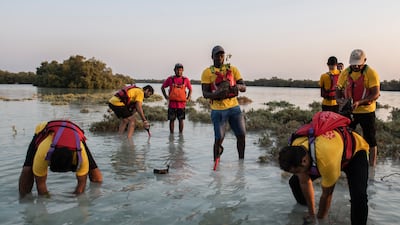
People plant mangroves during an event organised by Companies for Good on Jubail Island, Abu Dhabi. All photos: Vidhyaa Chandramohan -
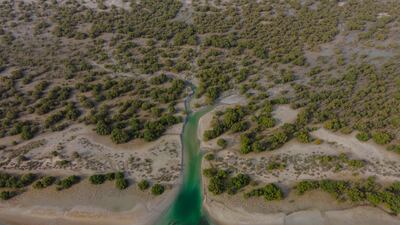
To fight climate change, the UAE is carrying out projects such as reducing emissions and planting mangroves. -
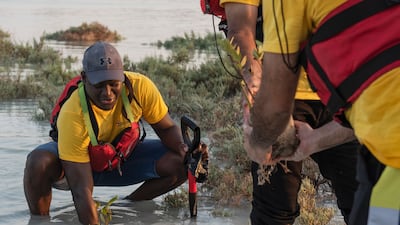
Mangroves, trees that survive in salty water, play an important part in the ecosystem. -
By 2030, the UAE intends to plant 100 million mangroves. -
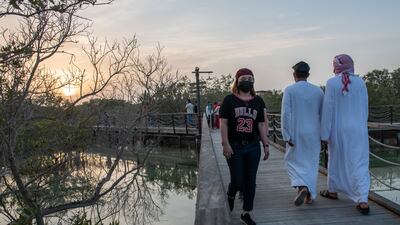
Visitors at Jubail Mangrove Park. Schools and businesses are planting saplings as part of the UAE's campaign. -
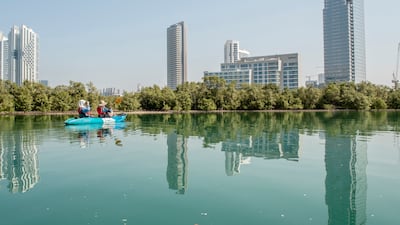
Volunteers during a mangrove clean-up organised by the World Wildlife Fund and Seahawk Abu Dhabi. -
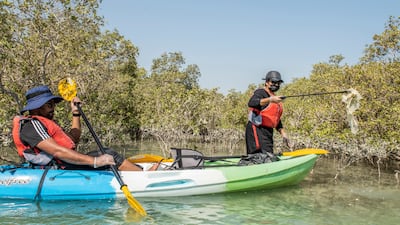
Young mangroves can be damaged by plastic and other waste dumped into the sea. -
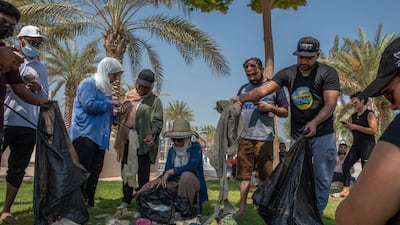
Volunteers sort rubbish gathered during a clean-up of mangroves in Abu Dhabi. -

After collecting debris from the mangroves, volunteers use an app to track their progress. -
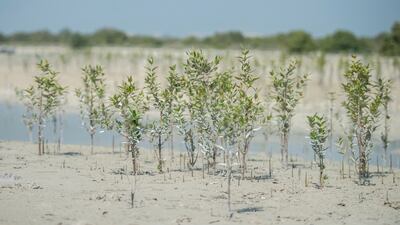
The grey mangrove is the species that grows extensively in UAE. -
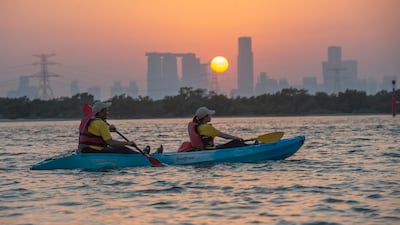
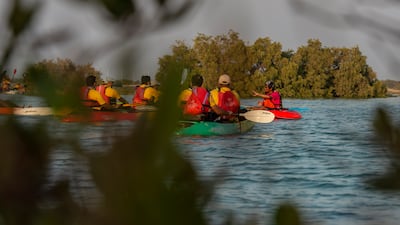
Visitors enjoy an evening paddle by the mangroves and a sunset view of Abu Dhabi.


Mangrove peat absorbs excess water during heavy rain, he said, making flooding less likely, and mangroves reduce coastal erosion, with research showing that mangrove loss has made coasts more vulnerable.
“Waves initially go through mangrove forests before reaching the coast and they carry with them layers of mud and decaying plant matter,” Prof Hilal said.
“Mangroves act somewhat as a filter and trap some of these substances upon waves entering, reducing sedimentary erosion, which would damage the structure of shorelines.”
So, with global warming leading to higher sea levels, greater attention should, he said, be paid to their conservation.
Prof Hilal said mangroves were also important for bacteria and other decomposers, for invertebrates such as oysters and worms, for the fish and shrimp they are consumed by, and for the birds, reptiles and others that, in turn, eat them.
Their actions in filtering water and providing a nutrient-rich habitat are particularly important for fish, whose spawn can be protected by mangroves.
Alongside seagrass beds and saltwater marshes, mangroves make up what is sometimes known as blue forests, a maritime equivalent to land-based green forests.
“These blue forests, like the green forests that we all love and know, have a very important role in terms of carbon sequestration and storage,” said Niko Howai, a researcher at Reading University in the UK who is completing a PhD on mangroves on the Caribbean island of Tobago.
“Unlike their terrestrial counterparts, they don’t just take the carbon out of the atmosphere, but they also sink it into their roots and underground and they store it there. That in itself is a very important global benefit for mangroves, for why we should keep mangroves.”
Counteracting threats
-
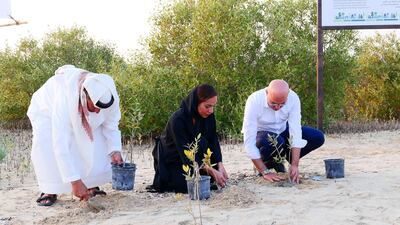
Ali Al Suwaidi, of Emirates Marine Environmental Group; Heba Al Shehi, from Ministry of Climate Change; and Omar Channawi, chief executive of Procter and Gamble in the Middle East, plant saplings at Dubai Mangroves Forest at the Jebel Ali Wildlife Sanctuary. -
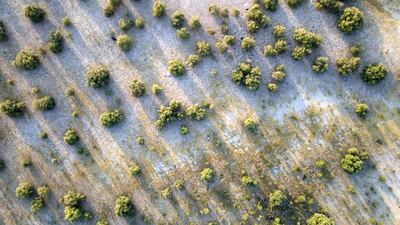
Nearly 1,000 trees were planted at the opening as this drone footage shows -
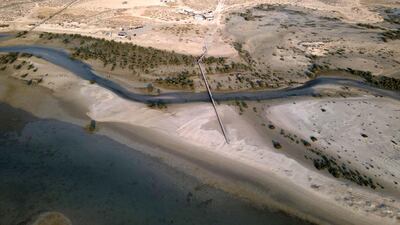
The project by Emirates Marine Environmental Group and Procter & Gamble is in sync with Sheikh Mohammed bin Rashid’s plan for more than half of the city to be transformed into nature reserves by 2040 -

View of the Dubai Mangroves Forest at the Jebel Ali Wildlife Sanctuary -
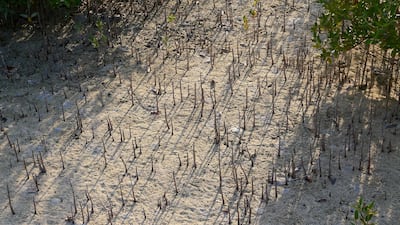
Nature enthusiasts will soon be able to male a booking to plant a mangrove after Eid with details being firmed up with Dubai Municipality -
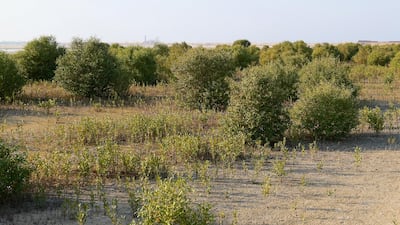
The area now has small clusters of mangroves within the sanctuary situated near the Dubai-Abu Dhabi border -

The stretches of beach are a breeding ground for endangered species including the hawksbill and green turtles -
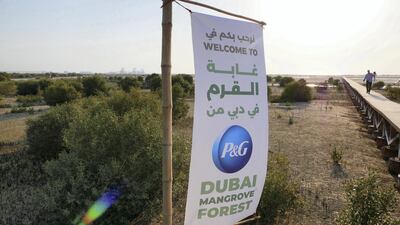
Mr Al Suwaidi says he hopes one million mangroves are planted this year -
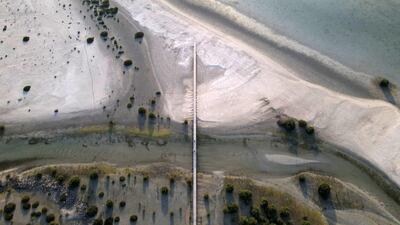
Schools and companies would be encouraged to join in the campaign to tackle climate change -

The group already organises community events so school children and nature enthusiasts can be part of turtle release projects and mangrove planting -

View of the Dubai Mangroves Forest at the Jebel Ali Wildlife Sanctuary -
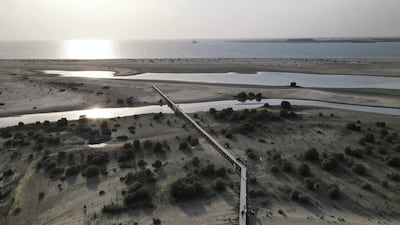
Mangroves, small trees that grow in saltwater, are an important part of the country’s ecosystem


Development of coastal areas, whether for ports, housing, tourism or other uses, can damage or lead to the removal of mangroves, and has been a big factor behind the losses of recent decades.
“Development has been one of the most significant challenges and balancing how development takes place with mangrove conservation,” Mr Howai said.
“The major problem comes from development and the associated things that can come from human activity, such as pollution.”
As coastlines become developed, there may be problems caused by sewage treatment plants discharging material, even if it has already been treated, because an excess of nutrients can prove harmful. Farming may also result in discharges that are damaging to mangroves.
Mr Howai said there were instances, however, of development apparently going hand-in-hand with the conservation of mangroves, such as the PIK Mangrove Nature Park in Jakarta, Indonesia, where huts and boardwalks have been built but the mangroves remain.
Another example of mangrove conservation that has attracted plaudits centres on Gazi Bay in Kenya. There, in a scheme organised through a British charity, the planting of mangrove seedlings is financed by the sale of carbon credits.
Alongside development, mangroves face significant threats from sea-level rises caused by climate change. This is an issue, Mr Howai said, in all areas where mangroves are found, from the tropics to the subtropics and warm temperate regions.
“Mangroves in the Caribbean and small island developing states are at much higher risk of negative impacts because being on a small island, the sea-level rise is likely to have a major impact on the availability of the coastal environment to house mangroves and for them to grow,” Mr Howai said.
Increasing temperatures, changes in rainfall and increases in the frequency of extreme weather events such as hurricanes and cyclones also have negative effects.
Although mangroves thrive in humid conditions and the heat, extreme temperatures, extreme weather and the climate affect how they develop and grow.
Climate change-induced damage to coral reefs, which act as a protective barrier for mangroves, can also harm mangroves.
In 2018, the Environment Agency Abu Dhabi estimated that one-fifth of the emirate’s mangroves were deteriorating or in moderate health.
Prof Hilal said that while urban expansion, pollution, physical damage and other factors continued to threaten mangroves, Abu Dhabi had made “substantial efforts” to minimise habitat losses and restore damaged areas.
“In response to historic losses of mangroves due to coastal developments, large-scale afforestation programmes and establishment of protected areas have increased mangrove cover in the UAE,” he said.
“An example of this is the opening of the Jubail Mangrove Park that helps protect biodiversity and raise awareness on Abu Dhabi’s rich mangrove ecosystem. The mangroves in the UAE are now the largest on the coast of the Arabian Gulf.”
So, as mangroves continue to face threats, case studies show that they can be protected if efforts are made.

