



It is easy to assume that more urban growth means less vegetation. But a study has found that, in the UAE at least, the opposite is true.
Research has found that over the past half a century, as the cities of Dubai, Abu Dhabi and Al Ain have grown, there has been an almost twentyfold increase in the amount of plant cover.
The growth is thought to be a particular feature of desert cities, where gardens, parks, landscaped roads with trees, and agriculture make the land greener.
The research was released earlier this month, by coincidence just before World Day to Combat Desertification and Drought, a UN event held on Friday.
Dr Basam Dahy, the first author of the paper, said it was a surprise when the analysis found that vegetation cover had increased so much.
“There is a common generalisation that urbanisation causes loss of vegetation cover,” said Dr Dahy, a postdoctoral fellow in the Department of Geosciences at UAE University in Al Ain.
“This is derived mainly from studies of the growth of the tropical and boreal [temperate] cities, where expansion is usually at the expense of forests (deforestation). But what we found in desert cities, namely Abu Dhabi, Dubai, and Al Ain, was completely different.”
Greening the desert
Al Ain
Based on analysis of satellite images taken between 1972 and 2021, Dr Dahy and his colleagues identified “constant growth” in the vegetation cover.
The total increase over the five decades was 1,883 per cent — meaning that vegetation cover had grown almost twentyfold.
The drive to green the desert in the country's formative years was led by the UAE's Founding Father, the late Sheikh Zayed bin Sultan Al Nahyan.
The wide-ranging strategy included a huge project of tree planting initiated by Sheikh Zayed, who was building permanent homes for the nomadic Bedouin in the parched desert.
Dubai
Sheikh Zayed hoped the trees would provide shade, improve the appearance of the villages and make them more liveable.
“Research shows that the three desert cities tend to increase vegetation area by expanding urban vegetation while continuing their steady urban growth. The urban vegetation includes parks, gardens, street trees, and other green spaces,” Dr Dahy said.
Aside from the growth in this urban vegetation, other factors have helped to increase plant cover during the past half a century. Dr Dahy said there was more agriculture than before, for example.
“Another driver of vegetation cover change is the environmental protection laws that were introduced during the 80s and 90s to protect and conserve the environment especially the coastal vegetation of the marine environment,” he added.
Some factors that caused vegetation cover in the UAE’s urban areas to increase will not apply to the countryside, but greening has happened there.
Abu Dhabi
“We can still see an increase in vegetation cover in the countryside, which is driven by other factors, like the extensive granting of agricultural farms to civilians as part of the Bedouin settlement governmental policy during the first two decades after independence,” Dr Dahy said.
“The other factor is the building of the artificial forests, which spread throughout the whole emirate of Abu Dhabi and which are seen at the eastern part along the road heading to Abu Dhabi city.”
Titled, “Random forest for classifying and monitoring 50 years of vegetation dynamics in three desert cities of the UAE,” the study has been published in The International Archives of the Photogrammetry, Remote Sensing and Spatial Information Sciences and was presented at a congress in Nice, France, earlier this month.
The other authors are Prof Salem Issa, a professor of remote sensing in the Department of Geosciences, and Dr Nazmi Saleous, an associate professor in the Department of Geography and Urban Planning, both at UAE University.
AI charts change in country
The researchers used artificial intelligence with a specialised algorithm to analyse satellite images of the three city areas from 1972 to 2021 to classify what the land was being used for and to detect changes.
It accurately identified different vegetation cover, including coastal/wetland vegetation, urban vegetation, farms/crops and natural/artificial vegetation.
The research is part of an continuing project funded by UAE University to understand how land use in the UAE is changing. One reason why this is important is to better understand the country’s carbon footprint.
“The study will cover the whole of the UAE to understand the nature of the vegetation expansion trends and other land cover types throughout the five decades since the independence of the country in 1971,” Dr Dahy said.
While the latest study indicates that the growth of the UAE’s urban areas has increased greenery levels, previous studies by other researchers have suggested that development also has potential environmental downsides.
It is thought, for example, that habitat loss from development poses a threat to native reptile species in the Emirates and in neighbouring countries, such as Oman.
-

-
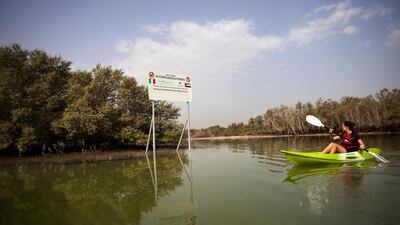
Eastern Mangrove Lagoon National Park, Abu Dhabi. Experience nature at its best with this urban escape extraordinaire. The Eastern Mangroves stretch for about 8 kilometres along Abu Dhabi’s Sheikh Zayed Street (Salam Street) and provides a habitat for numerous bird and aquatic species. Leave the city far behind and venture into this lush, watery wilderness on a kayak, the ideal eco-friendly way to explore the area. Pink flamingoes, herons, terns, egrets, turtles, crabs and dolphins – they can all be seen here in the picturesque waterways. If you’re not overly confident in a kayak, then simply stroll on foot along the promenade and soak up the atmosphere; it takes about 90 minutes to walk the full length. In the midst of all this greenery and wildlife, it’s hard to believe that the bustling city is so close by, and that’s what makes this place truly special. Location: Along Sheikh Zayed Street. Silvia Razgova / The National -
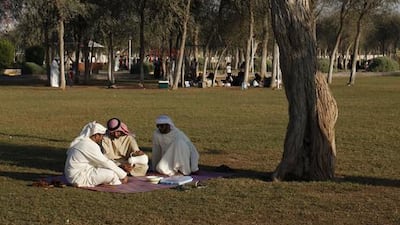
Saqr Park, Ras Al Khaimah. Saqr Park is the emirate’s largest public park – it’s a big hit with anyone who’s looking to kick back and relax while enjoying some lush scenery. Well-maintained and with an emphasis on family fun, there are plenty of kids’ rides, slides and games areas to keep younger members of your party occupied, while the adults get cooking, thanks to an abundance of barbecue facilities. There are also cafes and restaurants dotted around the park. Make the most of this alluring space by taking a boat out on the lake or enjoy the soothing sound of the waterfall. In addition to its vistas of ghaf trees and vibrant gardens planted with petunias, marigolds, vinca and more, the park offers impressive views across to the rugged Hajar Mountains. Location: Al Dhait South Ryan Carter / The National -
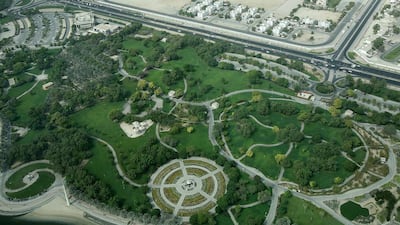
Creek Park, Dubai. Situated on the Bur Dubai-side shore of the Dubai Creek, Creek Park is one of the city’s most picturesque spots. Wide-open green spaces combined with tranquil views over the water make this a favourite spot for barbecues, picnics and other alfresco fun. If you choose not to bring refreshments, there’s a coffee shop in the park. The playground and small maze will keep energetic little ones amused, while Children’s City offers inquisitive youngsters the chance to learn about natural science – don’t miss the planetarium. The park is also home to the Dubai Dolphinarium, as well as camel and horse rides. One of the must-dos here is riding the cable car, which runs lazily along the length of the park and back again, offering superb panoramic views over the creek and city skyline. Afterwards, head to the shoreline of the creek and hunt for seashells. Location: Bur Dubai, between Maktoum and Garhoud bridges. Pawan Singh / The National -
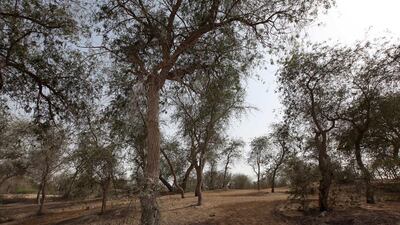
Mushrif Park, Dubai. So vast that you can drive your car through it, Mushrif Park is one of Dubai’s lesser-known gems. In contrast to the city’s meticulously manicured parks, this has a rugged, desert feel about it: there are still plenty of well-maintained lawns to sit on, but the overall effect is less landscaped and more “at one with nature”. Explore the endless walking trails, amid native flora and fauna, or hire a bicycle – the paved cycling track is one of the longest in the city. The park’s International Village is a quirky collection of scale-model houses, just about big enough to walk into, and built in a variety of traditional European, Asian and Arabic designs. Elsewhere, there are basketball, tennis and volleyball courts, barbecue areas, cafes, picnic tables, horse, camel and train rides, as well as separate men’s and women’s swimming pools. Arrive early – this park promises a fun-packed day for the entire family. Location: Khawaneej Road, near Mirdif. Pawan Singh / The National -

Zabeel Park, Dubai. With the construction of the Water Canal Project currently affecting Dubai’s popular Safa Park and Jumeirah Beach Park, now is the time to explore some of the city’s lesser-known urban oases. Zabeel Park is one of Dubai’s newest and largest parks. Bisected by Sheikh Zayed Road, it’s divided into sections connected by pedestrian bridges. The lush paradise boasts thousands of trees, and children’s adventure playgrounds nestle beneath shaded areas along with barbecue facilities, while the huge, grassy spaces are perfect for a kick-about. Take a boat on the lake or perfect your technique on the cricket pitch. The Ripe organic produce and craft market also holds its weekly gathering in the park on Fridays from 9am to 2pm, with vendors selling local honey, cheese, children’s toys and clothes and more. Jog off those excess calories on the running track skirting the park’s perimeter or use the Wi-Fi connectivity, available throughout the area, to catch up on work while perched under a tree. Location: Between Karama and Dubai World Trade Centre. Mike Young / The National -

Helio Park, Ajman. The tiny emirate of Ajman boasts a nature lover’s paradise in the form of the immaculately landscaped Helio Park. It’s a verdant landscape made up of thousands of trees, bushes and shrubs mixed with brightly coloured flower beds, making it perfect for anyone seeking a fix of greenery. Stroll along the tree-lined, shaded walkways listening to the birdsong, or simply sit on the beautiful lawns and indulge in a good book. When you’ve had enough relaxing, it’s time to move on to the sports area for a game of volleyball, basketball or football, make use of the outdoor gym equipment or perhaps hire a bicycle to explore the park further, before heading to the cafe for a refreshing juice. If you’ve come prepared with food, claim one of the barbecues and cook up a treat with friends. Location: Al Helio district. Jeffrey E Biteng / The National -
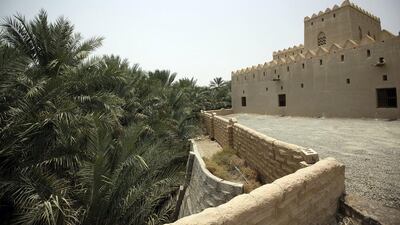
Al Ain oases. Picturesque and laid-back, Al Ain charms visitors with its lush foliage, despite its barren, desert location. The secret lies deep underground: by tapping into wells, locals have been able to cultivate dates for about 3,000 years in isolated pockets of greenery. The city’s best-known oases include Al Ain Oasis, which is thought to contain about 150,000 date palms, as well as other fruit-bearing trees, including fig, orange, banana and mango. The trees are all irrigated via an ingenious and ancient system of narrow water channels known as falaj. Al Mutaredh Oasis is also home to thousands of date palms, along with acacia and lemon trees, while Al Jimi Oasis also has native trees such as sidr and ghaf. Strolling along these shady pathways listening to the leaves rustling in the breeze is an experience not to be missed. Location: Look out for brown road signs in Al Ain indicating the oases. Sammy Dallal / The National -
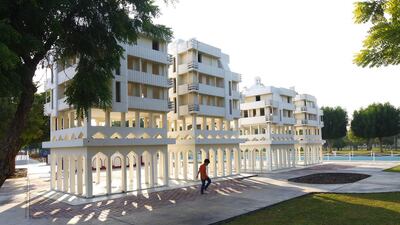
Sharjah National Park. This impressive expanse of greenery draws crowds of families and friends, especially on Fridays, when entrance queues can become quite lengthy. Despite large numbers of visitors, the park rarely feels busy, and its vast size, interspersed with plenty of trees, means it’s easy to find a secluded spot in which to unwind. Bring your own food and make use of the barbecue areas dotted around the park to cook up a feast while the kids let off steam in the playgrounds. A jaunty train chugs around the perimeter or you can rent four-wheeled buggies to explore further. If you’d prefer to simply sit on a bench and relax, this is an attractive spot to be immersed in nature as you watch the world (and the airplanes) go by, thanks to the park’s proximity to Sharjah International Airport. Location: Al Dhaid Road. Jeffrey E Biteng / The National -
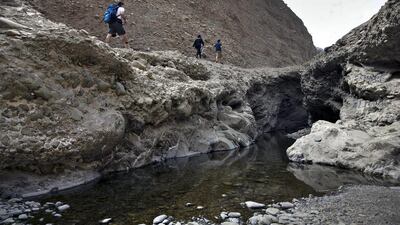
Fujairah’s wadis. What the UAE lacks in permanent rivers, it makes up for in wadis. These dry or intermittently dry (depending on rainfall) riverbeds are common in mountainous areas such as Fujairah. Stark and rugged, the wadis exude a wild, natural beauty – yet the tiniest amount of rain can rapidly transform them into grass- and flower-covered marvels. With some off-road driving you can reach Fujairah’s Wadi Al Hayl, complete with a fort and ancient petroglyphs (rock art). The dam at Wadi Siji, meanwhile, has greenery growing in abundance at the water’s edge – look out for dragonflies and damselflies. Both offer excellent hiking and mountain biking. Take note: winter means more chance of rain and an increased risk of flash flooding in the wadis. Never visit wadis alone, travel in a group with at least two cars and don’t venture into a wadi if it looks like rain is coming. Silvia Razgova / The National



