

The Environment Agency – Abu Dhabi on Tuesday announced it has discovered a new species of eagle ray in the emirate's waters.
The new species (Aetomylaeus wafickii) was discovered from specimens collected in the Arabian Gulf during a survey to assess fish stocks in 2016.
At the time, the specimen was identified as the banded eagle ray, which is very similar in appearance.
However, it was then considered new after thorough examination and the publishing of a scientific paper highlighting its physical description, the EAD said.
The new species can be distinguished from the blue-banded eagle ray and banded eagle ray by having a larger number of pale-blue bands across its dorsal surface (8-10 bands), a larger number of tooth plate rows, and a shorter tail.
This description was published in the Marine Biodiversity journal on February 11.
“It is very exciting for us to discover a new species of eagle ray in Abu Dhabi," said Ahmed Al Hashmi, executive director of terrestrial and marine biodiversity division at the EAD.
"This is a prominent indication that our waters are healthy and that we have an abundance of marine biodiversity."
__________________________________
Abu Dhabi discovers rare 'blue hole' in Arabian Gulf - in pictures
-

The 'blue hole' discovered off Al Dhafra. All photos: Environment Agency - Abu Dhabi -

It provides a unique habitat for fish such as grouper, sweetlips, emperor fish and jackfish. -

The underwater sinkhole is about 12 metres deep, 200 metres wide and has an area of about 45,000 square metres. -

Similar holes can be found across the world, with the deepest reaching 300 metres beneath the seabed.


__________________________________
The ray (batoidea) family is closely related to the shark family and includes rays, skates, guitarfish and sawfish, with more than 630 batoid species altogether.
Eagle rays are demersal and semi-pelagic rays, meaning they feed on the bottom to midwater, and are chiefly found near coastlines. Their body size ranges from medium to large (60 centimetres to more than 200cm disc width) with a wing-like shaped frame.
Eagle rays uses their robust jaws and plate-like teeth to feed on molluscs and crustaceans, as well as worms and small, bony fish.
Like sharks, their skeletons are composed entirely of cartilage rather than bone. They are typically flattish in shape and are generically referred to "flat sharks". Most batoids are bottom feeders, digging up shrimps and crustaceans from the ocean floor, which helps to oxygenate the sediment and maintain a healthy ecosystem.
“Within the past two years, we have discovered a series of species, and I am confident that we can make even more discoveries in the future, as long as we continue adopting accurate scientific methodologies to ensure credibility," said Mr Al Hashemi.
“To ensure longevity and sustainability of our species, at EAD we engage in extensive rehabilitation programmes so that our species can thrive for future generations and enjoy the breadth and beauty of Abu Dhabi’s biodiversity.”
Fisheries surveys in the UAE have made it possible to collect many specimens in the Arabian Gulf, that were then examined and compared to other regional variants of the species.
More than 600 specimens of fish have been collected, with some now forming part of the fish collections at the world's leading academic institutions such as the California Academy of Science; Museum of Comparative Zoology; Harvard; and United States National Museum Smithsonian.
The discovery, meanwhile, also continues to highlight the EAD's work in conserving the environment.
Its 2021 report released this month showcased several projects such as the launch of the largest coral reef rehabilitation project in the region last year, which led to the rehabilitation of one million pieces of coral reef in the capital.
Another 2021 success story was the release of 150 turtles — the largest regionally — back into their natural habitat, and the announcement of a Marine Conservation and Fisheries Research Vessel, which will study fish stocks and marine biodiversity.
How the UAE protects the environment - in pictures
-
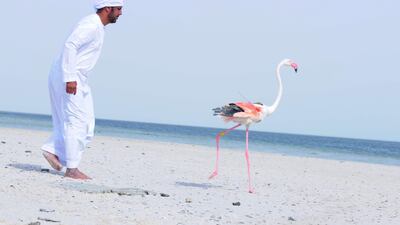
The UAE is known for protecting the environment. Here Environment Agency Abu Dhabi staff release a tagged flamingo as part of Abu Dhabi Birdathon initiative. Courtesy Environment Agency Abu Dhabi -

Umbrella Thorn Acacia trees are among the UAE's rich flora. Silvia Razgova / The National -
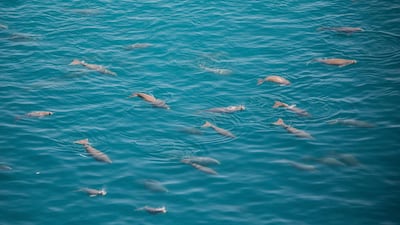
Abu Dhabi has the second-largest dugong population in the world. Environment Agency Abu Dhabi -
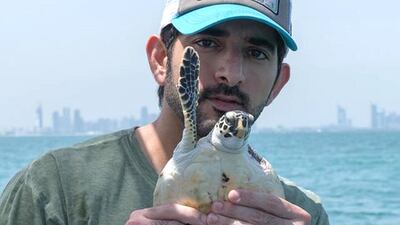
Love of nature is part of life here. Sheikh Hamdan bin Mohammed, Crown Prince of Dubai, with a sea turtles he helped release into the wild. Instagram/ @faz3 -
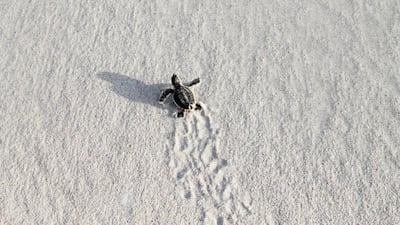
Abu Dhabi's environment agency is working to protect Hawksbill and Green turtles which live in the emirate's waters. Courtesy TDIC -
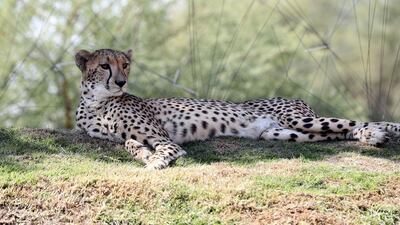
A cheetah at Al Ain Zoo, Al Ain. The zoo was founded by the Late President, Sheikh Zayed. Chris Whiteoak / The National -
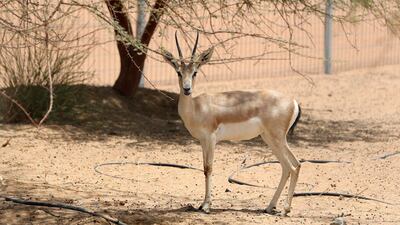
An Arabian sand gazelle at the Mleiha Archaeological Centre in Sharjah. Chris Whiteoak / The National -

The UAE is also embracing clean energy. This computer-generated image shows what phase four of Dubai's Mohammed Bin Rashid Solar Park, currently under construction in Dubai. Image courtesy of Acwa Power -

Nuclear energy is also important. The first reactor at Barakah nuclear plant reached 100 per cent power in December 2020. -

Abu Dhabi's new Midfield Terminal has won a coveted three-pearl rating under Abu Dhabi's Estidama, Arabic for sustainability, system. Courtesy KPF -
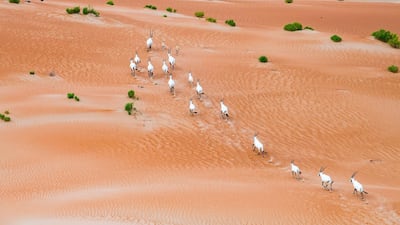
A breeding programme run by Environment Agency Abu Dhabi helped bring Arabian Oryx back from the brink of extinction. Courtesy: EAD



