


In Iceland, a plant that takes carbon dioxide from the air and turns it into stone could offer a glimpse of what a net-zero world might look like.
A facility called Orca, near Reykjavik, has been described as the largest plant of its kind in the world, although its activities come at a high price.
Operational since last September, it can remove about 4,000 tonnes of carbon dioxide from the atmosphere and inject it underground, where it turns into rock in a process said to take less than two years.
This equates to the annual emissions of fewer than 1,000 cars a year, which may seem a modest number for a plant that cost more than $10 million and requires large amounts of energy, in this case, supplied by Iceland’s geothermal activity.
Orca, created by Swiss-based Climeworks and Iceland’s Carbfix, illustrates the way that carbon capture and storage technology, in this case in its direct air capture (DAC) form, is costly, at least for the moment.
CCS can also capture CO2 emissions from bioenergy plants (such as those burning wood pellets) and from other industrial facilities and power plants, but costs remain high and introduction has yet to take place on a large scale globally.
A recent report by the Intergovernmental Panel on Climate Change (IPCC), Climate Change 2022: Mitigation of Climate Change, said it was “currently more expensive than most other forms of mitigation”.
But while describing DAC with carbon storage as one of several “more speculative technologies” being developed, the report said it had the potential to “draw down atmospheric CO2 much faster than the Earth’s natural carbon cycle” and reduce reliance on other approaches.

Also, the report stated that CCS would be “required to mitigate remaining CO2 emissions” from the industry if the world’s climate targets were to be met.
According to Bob Ward, policy and communications director at the Grantham Research Institute on Climate Change and the Environment, part of the London School of Economics and Political Science, temperature increases above pre-industrial levels are likely to exceed the 1.5°C target “within the next few decades”.
"We will have to bring the temperature back down to below 1.5°C,” Mr Ward said.
“The only way to do that is a huge investment in so-called negative emissions. [DAC] is something we’re going to have to do even though we don’t know how to do it at scale or how expensive it will be.”
It will also be important, he said, to look at CCS with bioenergy facilities and with natural gas plants “as a back-up to renewables”.
“We haven’t been making as much progress with CCS as we need given its importance,” he said.
“Governments have been reluctant to invest in it on the scale it needs. Oil and gas companies, which have a vested interest in trying to get the technology to work, have also not been investing on the scale.“
Governments need to provide more incentives and regulations to force these industries to invest much more heavily.
“The danger is, if we don’t invest, it will remain expensive, like nuclear. That’s what needs to happen – a massive step up in scale and investment.”
CCS typically involves fitting filters to the chimneys of industrial or power plants to capture the carbon emissions from flue gases.
DAC plants have been compared to giant vacuum cleaners that draw in air and remove carbon dioxide.
The CO2 be compressed and taken to a storage location, where they are injected underground, perhaps into an aquifer or an oil or gas reservoir that has been depleted, typically more than 1 kilometre down.
A variation, termed carbon capture, use and storage, sees the carbon turned into matter ranging from plastics to concrete.
Although the first industrial carbon capture is often said to have taken place as far back as 1972, at a Texas gas plant, the technology has yet to achieve widescale adoption, with a modest 26 plants in operation in 2020, a handful under construction and more than 30 under development.

Reports have indicated that, in total, active plants can capture about 40 million tonnes of CO2 each year, which is little more than 0.1 per cent of total emissions.
Some that are operational have faced difficulties. For example, a liquid natural gas plant in Western Australia, operated by America’s Chevron, has not collected the 80 per cent of its CO2 emissions as it was supposed to, reportedly because of technical hurdles linked to injecting the carbon underground.
On a more positive note, a pilot project linked to a scheme to install CCS at the Fortum Oslo Varme waste incinerator just outside Oslo in Norway achieved 90 to 95 per cent CO2 capture.
The scheme, which could cut Oslo’s emissions by 14 per cent, was rejected for EU funding in late 2021, but has reapplied this year.
Prof Niklas Hohne, the founding partner of the NewClimate Institute, a German think tank, said with most emissions scenarios, CCS is “unavoidable”, but using it was always worse than reducing emissions.
“You’re talking about cleaning up a mess. It’s always better not to make a mess,” Prof Hohne said.
“We have the technologies not to make a mess — to save energy, use renewables, which are now cheap.
"It’s a trade-off. Are we fast enough with deploying renewables, or are we so late that even if we go as fast as we can, we also need to apply CO2 removal?”
Environmental groups have had an indifferent relationship with the technology, concerned that it may be a smokescreen used to avoid investments in the emissions reductions they argue are necessary.
If CCS is factored in, it may deflect the need to impose the most stringent emissions cuts.

There is a risk, said Asher Minns, executive director of the Tyndall Centre for Climate Change Research at the University of East Anglia in the UK, of “sweeping so much of the CO2 emissions under the CCS carpet”.
“We don’t know that it works, we don’t know that it works at scale, we don’t really know the cost,” he said.
“It’s really a black box used to explain away emissions that can’t be explained away.”
Another issue that has made environmentalists doubtful of CCS, said Dr Phillip Williamson of the UEA's School of Environmental Sciences and co-author of IPCC reports, is that oil and gas companies have looked to the technology to extract more fossil fuels from depleted wells.
Dr Williamson has looked into CCS in great detail, as from 2017 to 2021 he was science co-ordinator for the UK Greenhouse Gas Removal programme, a British government initiative to investigate issues such as cost and scalability in relation to negative emissions technologies.
He said progress on using CCS in power plants appears to have stalled in recent years, as it lacks the required “impetus and investment”.
“It can make some contribution but you have to feel now it might be somewhat niche,” he said.
“The alternatives of renewable energy are so much cheaper. Why build a conventional power plant and have CCS, which would add to the cost, rather than switching to renewables right from the start?”
But when it comes to extracting CO2 from the air, he said, “it’s not surprising it’s expensive at this stage” and he sees “good opportunities for costs to come down”.
“We do have to have a mechanism where there’s removal – taking it out of the atmosphere,” he said.
“The cost of doing it by this chemical means, that might be at present £1,000 per tonne. If that can be brought it down to £500 or £200 or £100 … this base rate can be made a lot cheaper.”
Over the coming decades, as the technology becomes more competitive, Dr Williamson envisages a system in which industries that continue to produce CO2 are made responsible for removing the same amount of carbon emissions – or even larger amounts.“
"That would have the incentive to drive down the cost, by having that linkage," he said.
"You cannot instantly jump to that system – the industry would be bankrupt.
"In 20 to 30 years’ time if you produce the CO2, not only do you have to remove what you produce, but two times or three times or five times the amount.”
Governments have yet to take serious action, he said, because they are “reluctant to face the reality of what will almost have to come about”.
“It’s taken time to come to terms with what net zero means. In order to keep to these temperature targets, we have to have a balance between the emissions and removals.”
Sheikh Mohamed bin Zayed at the launch of UAE Net Zero 2050 initiative - in pictures
-

President Sheikh Mohamed, who was Crown Prince of Abu Dhabi and Deputy Supreme Commander of the Armed Forces at the time, at the launch of the UAE’s Net Zero 2050 Strategic Initiative at Expo 2020 Dubai. With him are Sheikh Maktoum bin Mohammed, Deputy Prime Minister and Minister of Finance, right, Mariam Al Mheiri, Minister for Climate Change and Environment, left, and Dr Sultan Al Jaber, Minister of Industry and Advanced Technology, chairman of Masdar and chief executive of Adnoc, second left. All photos: Ministry of Presidential Affairs -

A display about the UAE’s Net Zero 2050 Strategic Initiative in the UAE pavilion at Expo 2020 Dubai. -
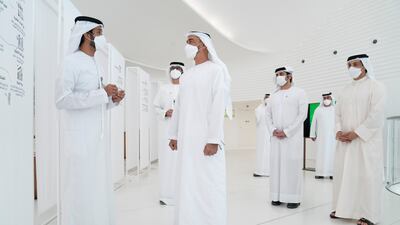
President Sheikh Mohamed, centre, in the UAE pavilion at Expo 2020 Dubai. With him are Sheikh Mansour bin Zayed, Deputy Prime Minister and Minister of Presidential Affairs, right, Sheikh Maktoum bin Mohammed, Deputy Prime Minister and Minister of Finance, second right, Dr Sultan Al Jaber, Minister of Industry and Advanced Technology, fourth right, and Abdullah Al Marri, Minister of Economy, left. -
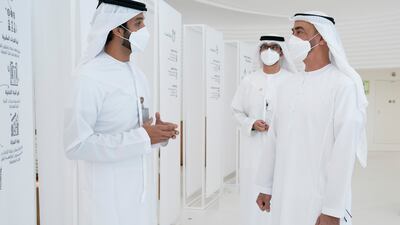
President Sheikh Mohamed, right, with Dr Sultan Al Jaber and Abdullah Al Marri, left. -

President Sheikh Mohamed, centre, at Expo 2020 Dubai with Sheikh Mansour bin Zayed, Deputy Prime Minister and Minister of Presidential Affairs, right, and Dr Sultan Al Jaber. -
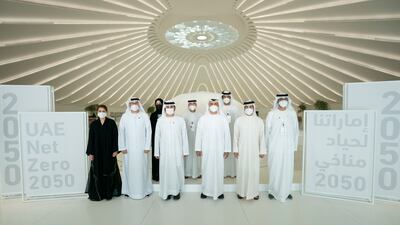
President Sheikh Mohamed, front row, third right, with: Sheikh Mansour bin Zayed, Deputy Prime Minister and Minister of Presidential Affairs, second right; Sheikh Maktoum bin Mohammed Al Maktoum, Deputy Prime Minister and Minister of Finance, fourth right; Dr Sultan Al Jaber, Minister of Industry and Advanced Technology, right; Mohamed Al Gergawi, Minister of Cabinet Affairs, fifth right; and Mariam Al Mheiri, Minister for Climate Change and Environment, left. Back row, from right to left: Abdullah Al Marri, Minister of Economy; Suhail bin Mohamed Al Mazrouei, Minister of Energy and Infrastructure; and Reem Al Hashimi, Minister of State for International Co-operation and Director General of Expo 2020 Dubai. -

President Sheikh Mohamed with Mariam Al Mheiri and Suhail bin Mohamed Al Mazrouei.



