
As schools in the UAE get ready to welcome pupils back into classrooms, The National takes a tour of a Dubai school to give you a first-hand glimpse of what life will look like for thousands of children when they return to the campus.
Schools across the country are busy putting in place on-campus precautionary measures to ensure the safety of pupils and staff.
Officials at education provider Taaleem in Dubai have identified Jumeira Baccalaureate School as its pilot institute for testing the efficacy and viability of safety checks before they can be extended to its other schools.
Thermal gates and QR codes
The first signs of the new normal are evident right at the entrance of the school campus where a thermal gate has been installed with the capability to swiftly check the temperatures of hundreds of children walking through it.
There are separate stations to check body temperatures of the faculty and other members of the staff.
The school, officials said, is in the process of studying the viability of assigning a quick-response code to each pupil.
“It is the quickest way to keep a tab on pupils when they enter the school and when they are on the campus,” said Gavin Hyatt, head of operations at Taaleem Group.
The QR will be colour-coded, indicating the health status of the pupil using it. “The codes could possibly be installed on the ID cards of the pupils but that’s still an exploration,” he said.
Separate entry and exit points
Clear demarcation signs for designated entrances and exits for different cohorts are visible all across the school.
“The school has divided pupils into cohorts – the senior pupils, for example, will have no contact with those in the primary,” Mr Hyatt said.
-

The first thermal gate has been installed at the school that can measure the temperature of hundreds of children passing through it quickly. Courtesy: Jumeira Baccalaureate School -
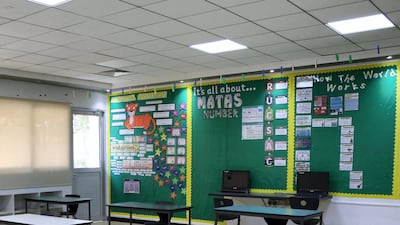
All desks in the classrooms have a distance of two metres. Courtesy: Jumeira Baccalaureate School -
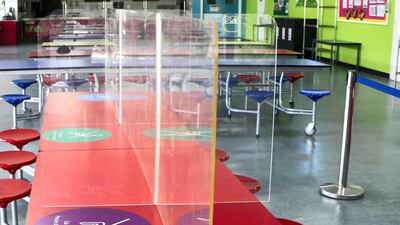
Plastic screens have been installed in the cafetaria to separate pupils. Courtesy: Jumeira Baccalaureate School -
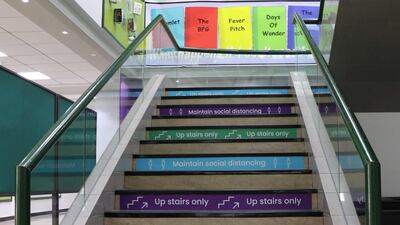
Markings on each step will help pupils remember not to get close to each other. Courtesy: Jumeira Baccalaureate School -
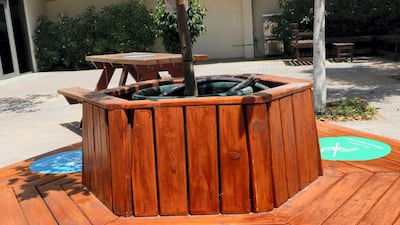
There are marking all around the school to remind pupils to maintain social distancing. Courtesy: Jumeira Baccalaureate School -

Several basketball hoops have been installed for pupils.Courtesy: Jumeira Baccalaureate School -
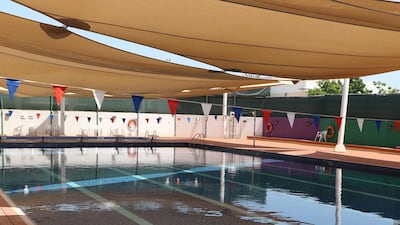
Lane markings will help pupils avoid coming in close contact with each other. Courtesy: Jumeira Baccalaureate School -
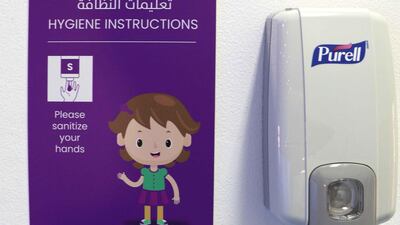
There are hand sanitiser stations at regular intervals so that pupils can clean their hands more often. Courtesy: Jumeira Baccalaureate School -
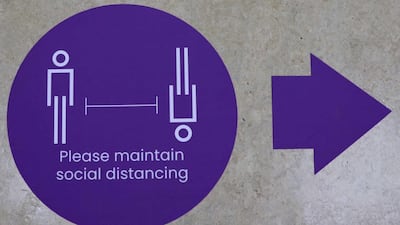
Markings show separate exit and entry points. Courtesy: Jumeira Baccalaureate School -
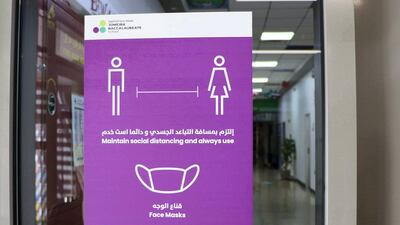
Markings to remind pupils the importance of precautionary measures. Courtesy: Jumeira Baccalaureate School -
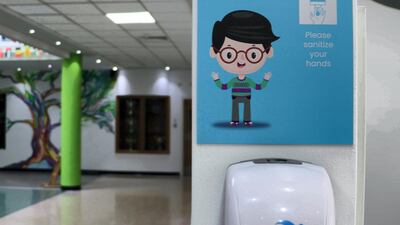
There are hand sanitiser stations at regular intervals so that pupils can clean their hands more often. Courtesy: Jumeira Baccalaureate School -
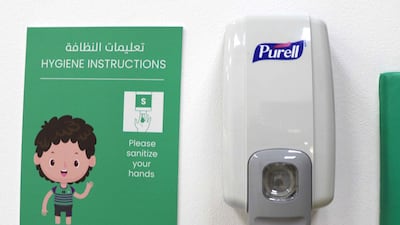
A hand sanitiser station outside a classroom. Courtesy: Jumeira Baccalaureate School -
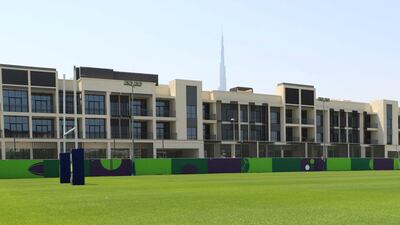
Marking to follow social distancing at the school. Courtesy: Jumeira Baccalaureate School -

Markings to show separate entry and exit points. Courtesy: Jumeira Baccalaureate School -

Floor markings at the school. Courtesy: Jumeira Baccalaureate School


Barricades and conspicuous floor markings are in place to prevent pupils from the same cohort coming face to face at a close distance.
There are two swimming pools and gyms, enabling older and younger children to exercise apart from one another.
Plastic screens in cafés; food delivered to classrooms
Inside the cafeteria, plastic screens or isolators have been installed to keep pupils insulated.
Children will not be allowed to share food and there will be no queues to buy lunch at school.
“Pupils will be able to order their meals in advance and these will be delivered to them in the class. The younger children will be eating on their desks,” Mr Hyatt said.
Distancing between the desks
Adhering to official guidelines, all desks in the classrooms have a distance of a minimum of two metres.
“There will be about 15 pupils in a class in this particular school and our rooms are big enough to accommodate them,” said Alan Williamson, chief executive officer at Taaleem.
“We have arranged the desks in such a way that all pupils can clearly see their teacher. We have capacity for 1,500 children in the school; therefore we can do this and it is both manageable and practical.
“We will be adhering to official guidelines and all desks in the classrooms will have a minimum distance of two metres.
“The authorities have given schools some flexibility within specific parameters. As each school site is different in terms of enrolment and size, all schools will submit their own individual plans for approval."
Planning, organising, reminding
Children will be constantly reminded to main social distancing and wear face masks at all times.
“Markings on each step will help pupils remember not to get close to each other,” Mr Hyatt said.
Hand sanitiser stations are at regular intervals to encourage pupils to disinfect their hands more often.
Making sport non-contact – even football
The school is tweaking the rules of the game – literally – to turn even team sports like football and basketball into a non-contact format.
“It’s not good to stop team sports, but yes, these will be different given the circumstances,” Mr Hyatt said.
There will be no attacking or defensive midfielders in football, for instance, and pupils will not be allowed to take direct free kicks.
Instead, there will be markings where players will stand and kick the ball to others from a safe distance.
Basketball, again, is a team sport but players will have their own hoops as they will learn new ways to score.
Isolation rooms, PPE gears, medics trained to handle Covid-19 cases
There is a separate isolation room which can be used in case there is a suspected case in the school.
“If we suspect a child or a staff member to be infected, we will isolate them immediately. Our two nurses will always be in full protective gear,” Mr Hyatt said.
“In such a situation, we have been asked to notify the Knowledge and Development Authority, the emirate’s private school regulator, and Dubai Health Authority. For example, if the case happens in grade 1, we will completely isolate them from the rest of the school.
“Since we are already planning to segregate all age groups, there will be no need to panic and shut down the entire school.”
At the same time, all school medics have been trained to deal with suspected cases of Covid-19.
“In these past months, our doctors and nurses have volunteered to handle coronavirus cases in different facilities across the country. They are fully trained to handle such cases,” Mr Williamson said.

