


Latest: How would parents and employers manage e-learning until 2021?
Schools across the UAE are preparing for e-learning to continue in September and potentially into next year.
Headteachers said they anticipated a mix of in-school classes and home learning in the first term of the 2020-21 academic year, but await an official decision from the government.
Taaleem and Gems Education, the country's two largest private school groups, have begun preparing for a "blended" model that would see groups of pupils study at home and in school at different times of day.
On Sunday, the Ministry of Education said the end of e-learning and reopening of schools was "still under review" and would depend on ongoing efforts to combat the coronavirus.
Earlier, a senior official told an audience that authorities were looking at three scenarios for future schooling nationwide.
Speaking at a majlis event on Friday, Fawzia Gharib, assistant undersecretary at the ministry, said one scenario was that e-learning from home would continue to account for 100 per cent of lessons.
The other two scenarios were based on a gradual return to classes - but neither had pupils in school classrooms 100 per cent of the time.
Under the best case scenario, and with the Covid-19 outbreak under control, pupils would do 70 per cent of their study in school and 30 per cent at home.
She anticipated about six months of this "transitional stage" before classes return to normal.
The ministry later stressed that "any decision for the academic year 2020-2021 is still under review and will be taken based on the health situation and precautionary measures".
Since March, schools have used a combination of home assignments and live, online lessons with teachers to keep pupils up to date with their curriculum.
Last week, the government said all schools would be inspected this month to determine if e-learning was working and where their strengths and weaknesses lay.
Many headteachers said the exercise was a chance to step back and evaluate the past few months, but urged inspectors to understand the pressure that pupils, parents and teachers were under.
Temperature checks, masks and classes in gym halls
Alan Williamson, chief executive officer of Taaleem, which operates 13 schools in the UAE, said online learning would continue in some form into the 2020-2021 academic year.
"We will open in September but blended learning is likely to continue. A majority of schools will open to a majority of pupils," Mr Williamson told The National on Sunday.
"Schools have been discussing the 70/30 option where schools will be open to 70 per cent of pupils at any point of time,"
"Everyone is looking to the totality of the curriculum reappearing in January 2021."
Another possibility is that pupils will spend 70 per cent of their time at school, and 30 per cent of their time studying online.
"This will look different in different year groups as senior pupils will social distance automatically but kindergarten pupils may find that more difficult," he said.
One of the scenarios Taaleem is considering looks at different grades attending schools at different times of the day.
Senior pupils would likely need to be in school for fewer hours than primary school pupils.
“We could shorten the school day and open in September to Ramadan timings for a few months until we know what is happening. It’s all about flattening the curve. By August, we will have a clear position on where the UAE stands," said Mr Williamson.
When schools reopen, extracurricular activities may be restricted.
"It would be good if authorities allow private schools to set the parameters," he said.
If schools are open with reduced timings, this would allow parents to have a few hours a day to resume work.
“We are conscious of the impact on parents which is why we took an early decision to discount fees. Parents need to go back to work," he said.
“The rest of the world is opening schools and I would be surprised if the Ministry of Education takes a line that is different.
"I am looking at reducing class sizes and we could spread out classes in gym halls if required."
He said Taaleem schools were planning to check the temperature of pupils and teachers each day, and that face masks would be worn in class, if required by the education ministry.
Staggered start times and half days for pupils
Jodh Singh Dhesi, deputy chief education officer at Gems Education, which runs 45 schools in UAE, said the school day could look quite different in the short-term.
“Our planning is looking at two areas: health and safety, and provision of learning," he said.
"In terms of the former, we are modelling scenarios involving start times, staggering, social distancing and health monitoring, while also ensuring that our facilities meet the highest standards from an infrastructure, maintenance and hygiene perspective.
"In terms of the latter, we are looking at models for modifying our current remote learning provision to a more blended approach, with groups of students studying both at home and in school at different times."
He said Gems had set up a task force to review a range of scenarios and monitor international research on how schools have re-opened elsewhere
"We look forward to receiving advice from the regulator around what the situation will look like in four months’ time," he added.
Indian repatriation flights - in pictures
-
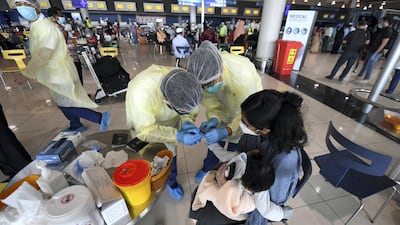
Medics test a child at the Dubai International Airport before boarding a flight to Kerala. AFP -

Passengers queue for check-in on Thursday for the first of ten flights between the UAE and India in the next week. AFP -

A mother carries a sleeping child through terminal 2. AFP -

Stranded tourists and pregnant women were among those given priority for the first of 10 planned flights. AFP -
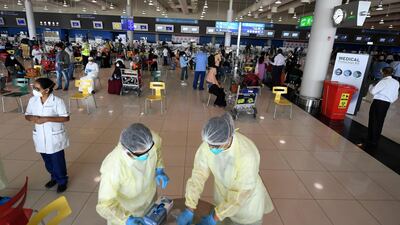
Health workers conduct temperature and blood tests as passengers arrive at the terminal. AFP -

Passengers wait for flights at Dubai International Airport as India continues a massive exercise to take home people stranded after the nation imposed a stringent lockdown amid the coronavirus pandemic. Courtesy: Indian Consulate -
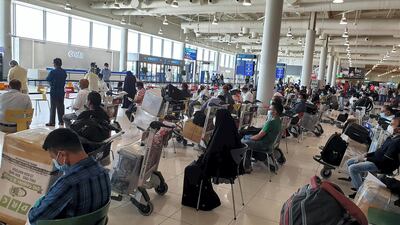
Passengers wait for flights at Dubai International Airport on Thursday afternoon. Indian Consulate -

Relatives and friends of Indian passengers outside the Terminal 2 departure gate as India stages it largest repatriation mission. Pawan Singh / The National -

First flights took off from Abu Dhabi and Dubai on Thursday. Pawan Singh / The National -
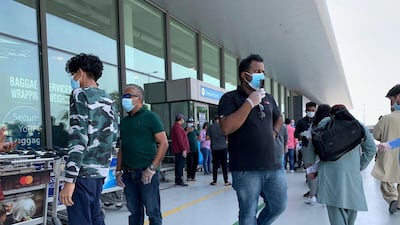
Relatives and friends of Indian passengers. Pawan Singh / The National -
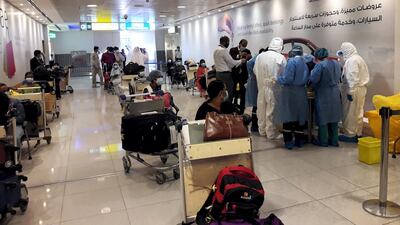
Medical staff were present to test all individuals before they boarded their flights. Indian Consulate -
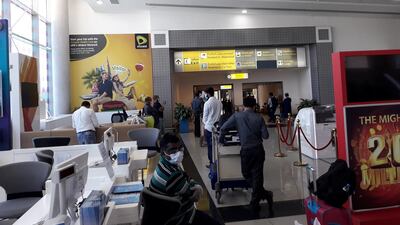
Passengers were tested before boarding the flights. Indian Consulate -

Passengers wait for the flights at Dubai International Airport on Thursday. Indian Consulate -
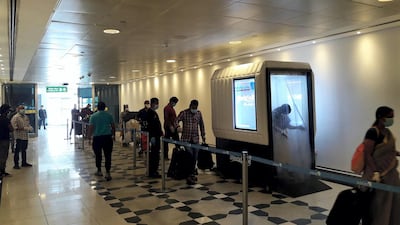
The first repatriation flight went to southern India's Kerala state. Indian Consulate



