


Dubai Police have helped a young woman overcome her addiction to illegal painkillers after her family sought their assistance.
The 20-year-old woman admitted to her family members that she had become a drug addict four years ago after being introduced to a man on social media by a friend.
She started a relationship with the man, who was an addict, and she forced her family to allow her to marry him, said Col Khalid bin Muwaiza, deputy director of the Dubai Police Anti-Narcotics Department.
Dubai Police Anti-Narcotics Department
Police said the father provided his daughter with a house and income after her marriage.
The couple divorced a short time later and soon after, she started a relationship with another man, who had a criminal record.
“At that point, her father discovered that she was a drug addict,” said Col bin Muwaiza.
“She told her family that she consumed drugs whenever she had a problem with the second man. Her brothers convinced the father to alert Dubai Police to help her.”
The woman's father and brother then approached the Hemaya International Centre, an affiliate of Dubai Police Anti-Narcotics Department, for help.
“The family knew about the new UAE’s drug law that spares addicts from legal punishment if they voluntarily give themselves up to the police. They brought the girl to Hemaya Centre asking to help her from addiction,” Col bin Muwaiza said.
He said the woman went through a recovery and rehabilitation programme at a centre in Dubai.
“We know it is not easy for parents to communicate with police to report their addict family members, but the new law treats the addict as a patient not a suspect,” Col bin Muwaiza added.
He urged parents to watch over their children and reach out to authorities for help to safeguard family cohesion and public safety.
In addition to sparing addicts looking to reform from punishment, Article 89 of the New Anti-Narcotics Law makes it binding on addicts to hand over all drugs they have in their possession and receive treatment. Addicts face legal charges if they refuse to be treated.
The Hemaya International Centre carries out several educational programmes for young people that aim to raise awareness of the hazards of drug abuse.
Crystal meth, hash, Lyrica and Captagon are among the most commonly seized drugs in the Emirates.
Gulf's war on Captagon: in pictures
-
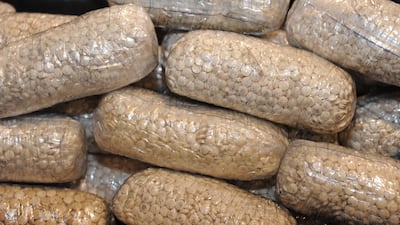
According to the United Nations Office on Drugs and Crime, trafficking in amphetamines has increased in the Middle East in recent years. Photo: Dubai Customs -
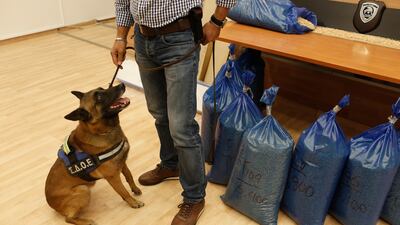
Specially trained K-9 units are often used by border forces to intercept shipments. EPA -
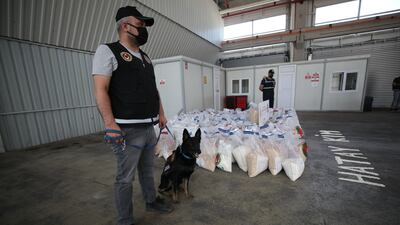
Experts believe the amount intercepted accounts for only around a tenth of the total quantity of pills being smuggled out of places like Syria and Jordan. EPA -
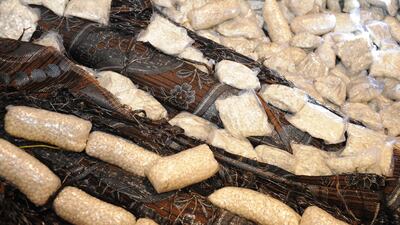
Dubai Customs thwarted 398 attempts to smuggle drugs into the city in the first three months of this year. Photo: Dubai Customs -
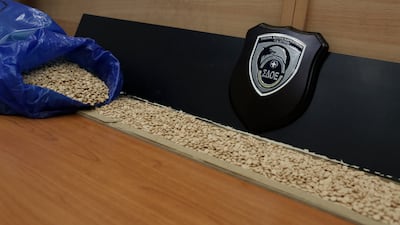
Captagon pills on display after being seized in Greece in 2019. EPA -
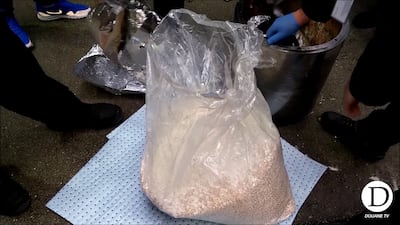
Captagon became synonymous with the Syrian Civil War. AFP -
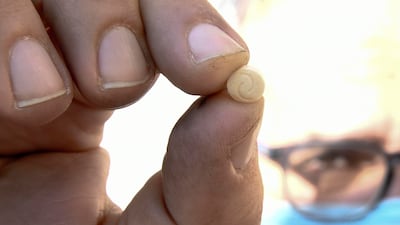
The small, off-white pills have quickly become one of the most widely consumed drugs in the Middle East. EPA -

Millions of Captagon pills are seized around the world each year. EPA -
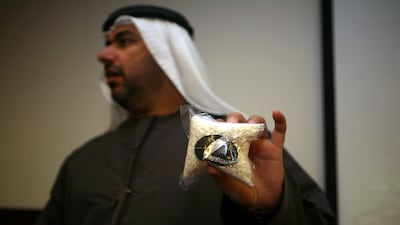
Captagon pills on display after a major interception of a shipment in 2009. Nicole Hill / The National -
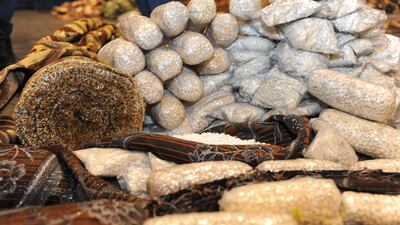
Customs officers say Captagon smugglers prefer to use sea ports rather than airports because of the size of shipping containers, enabling them to conceal larger quantities of drugs. Photo: Dubai Customs



