

Abu Dhabi has completed a pioneering study of the UAE's national tree to help get to the root of its ability to thrive in arid conditions – and boost efforts to protect nature from the effects of climate change.
The Environment Agency in Abu Dhabi joined forces with healthtech company M42 to carry out a groundbreaking genome sequencing of the ghaf to better understand the genetic traits that make it so resilient.
Declared the UAE's national tree in 2008, the ghaf plays a key role in stabilising desert soil, while also providing sanctuary for wildlife.
The ghaf – scientific name prosopis cineraria – typically lives for 120 years. It was traditionally used to feed livestock and was revered for its purported medicinal properties.
M42's team of environmental scientists, led by medical director Dr Wael Elamin, harnessed cutting-edge sequencing platforms from Oxford Nanopore Technologies to achieve high-quality whole-genome sequencing of the tree.
“Human health is intricately intertwined with environmental health, and this has become increasingly clear to the world at large,” said Dr Fahed Al Marzooqi, deputy group chief operating officer at M42.
“Our groundbreaking sequencing initiative aims to enhance the understanding of the ghaf tree's genetic adaptations for thriving in arid conditions, which safeguards and champions the UAE’s natural legacy.
“The research also assumes critical significance as the world seeks to tackle the environment warming effects of climate change.”
Ahmed Al Hashmi, executive director of the terrestrial and marine biodiversity sector at the agency, said the research will further efforts to promote sustainability.
“We are pleased to partner with M42 on this pioneering project analysing and sequencing the genome of the ghaf tree in line with our mission of monitoring and conserving plant species in the emirate of Abu Dhabi," he said.
“Our main goal is to have a better understanding through scientific research of the ghaf tree to develop policies and a conservation framework to assure sustainability of the species for the future generations and to preserve the natural heritage of the UAE.”
The innovative project was announced on the first day of the Arab Health exhibition at the Dubai World Trade Centre, on Monday.
Embrace technology
The forward-thinking ghaf tree project is the latest example of the UAE's drive to embrace technology to safeguard the environment.
In June 2022, a plan to develop plant varieties and animal breeds better suited to the UAE’s environmental conditions was unveiled by Abu Dhabi's government.
The Abu Dhabi Agricultural Genome Programme involves scientific research centres carrying out work to create the new varieties and breeds.
This strategy also included the establishment of a database of genetic resources and a store of material. Elsewhere, this approach has often resulted in the creation of seed banks.
The initiative was launched by the Abu Dhabi Authority for Agriculture and Food Safety as part of its 2022 to 2025 strategic plan to enhance food security.
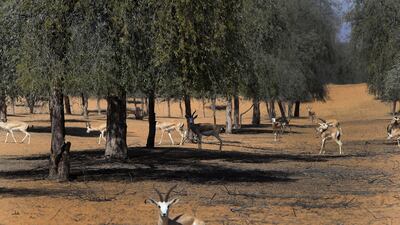
Ghaf trees in the UAE - in pictures
-
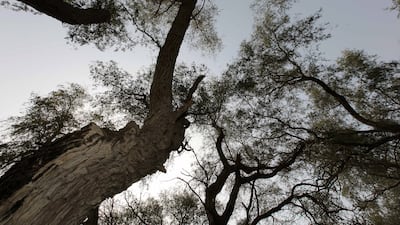
The Ghaf tree, native to the Emirates, is a potential source of biochar, which helps in soil rejuvenation and carbon capture. Pawan Singh / The National -
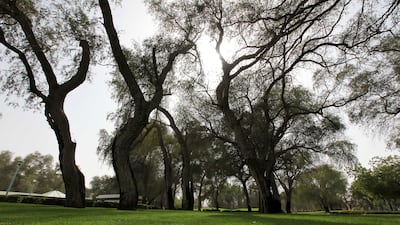
Famed for its ability to live in harsh conditions, the Ghaf tree is found in the deserts of Arabia and in the Indian subcontinent. Photo: Pawan Singh / The National -
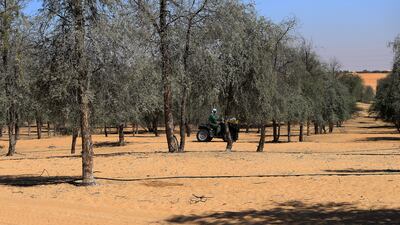
Ghaf trees in Khab Al Dahs forest, near Madinat Zayed, in Al Dhafra. Photo: Ravindranath K / The National -
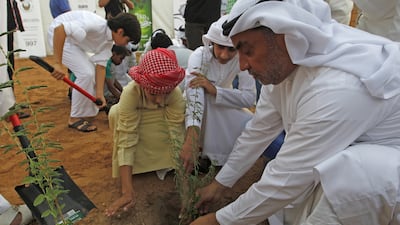
Orphans plant saplings of Ghaf trees at the heritage village in Al Shindagha to commemorate Zayed Humanitarian Day. Jeffrey E Biteng / The National -
Researchers have found that some Ghaf tree biochar is better at absorbing carbon dioxide than other types of biochar derived from sources such as rice husks, coconut shells, carrot peel or wheat flour. Ravindranath K / The National



