
The UAE is set for a dip in temperatures and a chance of rain over the Union Day long weekend.
The National Centre of Meteorology forecast slightly cooler weather across the Emirates on Saturday, with some cloud cover and an increase in humidity by the evening.
Temperatures on Saturday are set to reach highs of 31°C and drop as low as 17°C in the mountains.
The centre also warned the public to expect some fog or mist in some internal areas on Saturday and Sunday.
Union Day, previously known as National Day, will be marked on Saturday, when citizens and residents are encouraged to come together and celebrate 52 years since the founding of the country.
Several official celebrations are set to take place to mark the occasion, with the main event at Expo City Dubai, where the country is hosting the Cop28 climate change conference until December 12.
The weather centre said the country could expect a cloudy day with humidity rising at night, while the Arabian Gulf and Sea of Oman are expected to have calm conditions at the weekend.
It is also a busy time for sport, with thousands expected to attend the Rugby Sevens tournament in Dubai from Friday to Sunday.
It will be partly cloudy in general, with light to moderate winds reaching speeds of up to 35kph, the centre said. Temperatures on Saturday will reach highs of 31°C in Abu Dhabi and 30°C in Dubai, with lows of 21°C and 22°C, respectively.
The same conditions are expected on Sunday, with a chance of fog over eastern and coastal areas and islands. There is a possibility of rain.
On Monday, clouds are forecast over coastal and northern areas, with temperatures set to increase slightly in Abu Dhabi and Dubai to 31°C.
Humid conditions will continue through the night into Tuesday morning, before public and private sector employees return to work.
"The sea will be slight in the Arabian Gulf and [Sea of] Oman," the centre said.
Rain in Dubai – in pictures
-
Buildings in Downtown Dubai loom from the gloom amid stormy skies and rain. Chris Whiteoak / The National -
Low cloud and rain in Downtown Dubai. Chris Whiteoak / The National -
The rain comes down in Al Qudra, Dubai. Chris Whiteoak / The National -

Cars drive through puddles in Dubai. Antonie Robertson / The National -

The heavy rain left standing water on some roads. Antonie Robertson / The National -
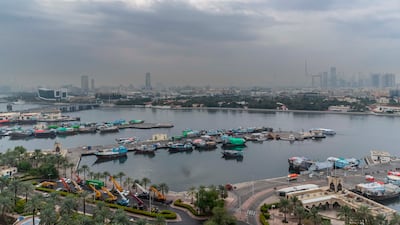
Dark skies over Dubai. Antonie Robertson / The National -
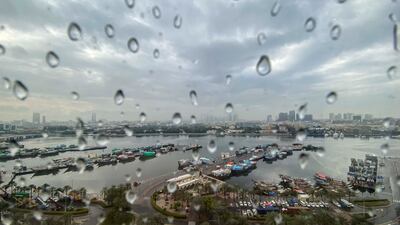
Rainy weather in Dubai. Antonie Robertson / The National -
A man takes shelter under an umbrella during rain in Al Quoz, Dubai. Chris Whiteoak / The National -
The rain comes down at the beach in Dubai. Chris Whiteoak / The National -
More rainfall and cloudy weather is forecast for much of the country on Tuesday and Wednesday. Chris Whiteoak / The National -
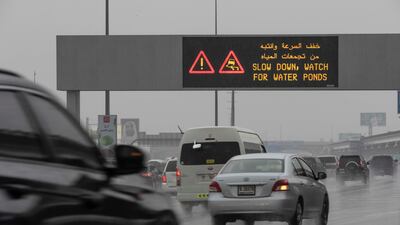
A road sign warning of the hazardous driving conditions. Antonie Robertson / The National -
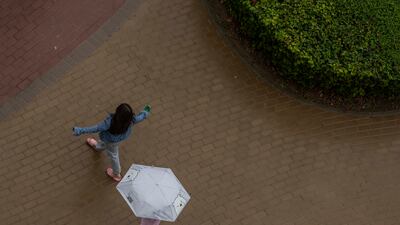
Umbrella weather in Dubai. Antonie Robertson / The National -
Drenched delivery drivers in Umm Suqeim, Dubai. Chris Whiteoak / The National -
Wet windscreens in Al Quoz. Chris Whiteoak / The National -
Wood sellers cover their stock to protect it from the rain in Al Qudra. Chris Whiteoak / The National -
Residents take impromptu shelter from the rain in Al Quoz, Dubai. Chris Whiteoak / The National -
Studio City, Dubai. Chris Whiteoak / The National -
Al Qudra, Dubai. Chris Whiteoak / The National -
Rain on the 611 in Dubai. Chris Whiteoak / The National -
The rain coming down in Studio City, Dubai. Chris Whiteoak / The National -
Al Qudra, Dubai. Chris Whiteoak / The National -
People wait out a downpour in Al Quoz. Chris Whiteoak / The National -
The rain slows traffic in Al Quoz. Chris Whiteoak / The National -
Pedestrians getting wet in Al Quoz. Chris Whiteoak / The National -
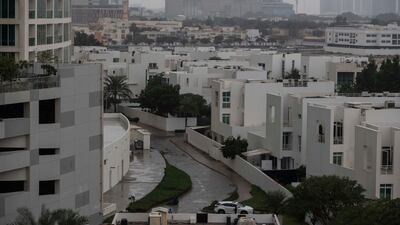
The wet streets of Dubai. Antonie Robertson / The National -
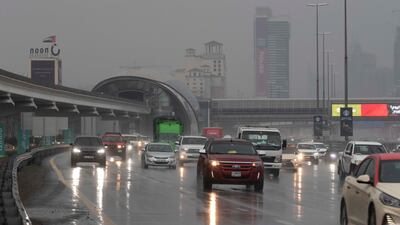
Gloomy wet weather. Antonie Robertson / The National
SPEC%20SHEET%3A%20APPLE%20IPHONE%2015%20PRO%20MAX
One in nine do not have enough to eat
Created in 1961, the World Food Programme is pledged to fight hunger worldwide as well as providing emergency food assistance in a crisis.
One of the organisation’s goals is the Zero Hunger Pledge, adopted by the international community in 2015 as one of the 17 Sustainable Goals for Sustainable Development, to end world hunger by 2030.
The WFP, a branch of the United Nations, is funded by voluntary donations from governments, businesses and private donations.
Almost two thirds of its operations currently take place in conflict zones, where it is calculated that people are more than three times likely to suffer from malnutrition than in peaceful countries.
It is currently estimated that one in nine people globally do not have enough to eat.
On any one day, the WFP estimates that it has 5,000 lorries, 20 ships and 70 aircraft on the move.
Outside emergencies, the WFP provides school meals to up to 25 million children in 63 countries, while working with communities to improve nutrition. Where possible, it buys supplies from developing countries to cut down transport cost and boost local economies.
Real estate tokenisation project
Dubai launched the pilot phase of its real estate tokenisation project last month.
The initiative focuses on converting real estate assets into digital tokens recorded on blockchain technology and helps in streamlining the process of buying, selling and investing, the Dubai Land Department said.
Dubai’s real estate tokenisation market is projected to reach Dh60 billion ($16.33 billion) by 2033, representing 7 per cent of the emirate’s total property transactions, according to the DLD.
The specs: McLaren 600LT
Price, base: Dh914,000
Engine: 3.8-litre twin-turbo V8
Transmission: Seven-speed automatic
Power: 600hp @ 7,500rpm
Torque: 620Nm @ 5,500rpm
Fuel economy 12.2.L / 100km
Infiniti QX80 specs
Engine: twin-turbocharged 3.5-liter V6
Power: 450hp
Torque: 700Nm
Price: From Dh450,000, Autograph model from Dh510,000
Available: Now
While you're here
Damien McElroy: It's too early to say who will win the vaccine hurdle race
Mustafa Alrawi: To get the 'jab' done, governments must show patience and empathy
Editorial: The fight against Covid-19 should be guided by science
Mercer, the investment consulting arm of US services company Marsh & McLennan, expects its wealth division to at least double its assets under management (AUM) in the Middle East as wealth in the region continues to grow despite economic headwinds, a company official said.
Mercer Wealth, which globally has $160 billion in AUM, plans to boost its AUM in the region to $2-$3bn in the next 2-3 years from the present $1bn, said Yasir AbuShaban, a Dubai-based principal with Mercer Wealth.
“Within the next two to three years, we are looking at reaching $2 to $3 billion as a conservative estimate and we do see an opportunity to do so,” said Mr AbuShaban.
Mercer does not directly make investments, but allocates clients’ money they have discretion to, to professional asset managers. They also provide advice to clients.
“We have buying power. We can negotiate on their (client’s) behalf with asset managers to provide them lower fees than they otherwise would have to get on their own,” he added.
Mercer Wealth’s clients include sovereign wealth funds, family offices, and insurance companies among others.
From its office in Dubai, Mercer also looks after Africa, India and Turkey, where they also see opportunity for growth.
Wealth creation in Middle East and Africa (MEA) grew 8.5 per cent to $8.1 trillion last year from $7.5tn in 2015, higher than last year’s global average of 6 per cent and the second-highest growth in a region after Asia-Pacific which grew 9.9 per cent, according to consultancy Boston Consulting Group (BCG). In the region, where wealth grew just 1.9 per cent in 2015 compared with 2014, a pickup in oil prices has helped in wealth generation.
BCG is forecasting MEA wealth will rise to $12tn by 2021, growing at an annual average of 8 per cent.
Drivers of wealth generation in the region will be split evenly between new wealth creation and growth of performance of existing assets, according to BCG.
Another general trend in the region is clients’ looking for a comprehensive approach to investing, according to Mr AbuShaban.
“Institutional investors or some of the families are seeing a slowdown in the available capital they have to invest and in that sense they are looking at optimizing the way they manage their portfolios and making sure they are not investing haphazardly and different parts of their investment are working together,” said Mr AbuShaban.
Some clients also have a higher appetite for risk, given the low interest-rate environment that does not provide enough yield for some institutional investors. These clients are keen to invest in illiquid assets, such as private equity and infrastructure.
“What we have seen is a desire for higher returns in what has been a low-return environment specifically in various fixed income or bonds,” he said.
“In this environment, we have seen a de facto increase in the risk that clients are taking in things like illiquid investments, private equity investments, infrastructure and private debt, those kind of investments were higher illiquidity results in incrementally higher returns.”
The Abu Dhabi Investment Authority, one of the largest sovereign wealth funds, said in its 2016 report that has gradually increased its exposure in direct private equity and private credit transactions, mainly in Asian markets and especially in China and India. The authority’s private equity department focused on structured equities owing to “their defensive characteristics.”
The Year Earth Changed
Directed by:Tom Beard
Narrated by: Sir David Attenborough
Stars: 4
Zayed Sustainability Prize
RESULTS
1.30pm Handicap (PA) Dh 50,000 (Dirt) 1,400m
Winner AF Almomayaz, Hugo Lebouc (jockey), Ali Rashid Al Raihe (trainer)
2pm Handicap (TB) Dh 84,000 (D) 1,400m
Winner Karaginsky, Tadhg O’Shea, Satish Seemar.
2.30pm Maiden (TB) Dh 60,000 (D) 1,200m
Winner Sadeedd, Ryan Curatolo, Nicholas Bachalard.
3pm Conditions (TB) Dh 100,000 (D) 1,950m
Winner Blue Sovereign, Clement Lecoeuvre, Erwan Charpy.
3.30pm Handicap (TB) Dh 76,000 (D) 1,800m
Winner Tailor’s Row, Royston Ffrench, Salem bin Ghadayer.
4pm Maiden (TB) Dh 60,000 (D) 1,600m
Winner Bladesmith, Tadhg O’Shea, Satish Seemar.
4.30pm Handicap (TB) Dh 68,000 (D) 1,000m
Winner Shanaghai City, Fabrice Veron, Rashed Bouresly.
TECH%20SPECS%3A%20APPLE%20WATCH%20SERIES%208
Ten tax points to be aware of in 2026
1. Domestic VAT refund amendments: request your refund within five years
If a business does not apply for the refund on time, they lose their credit.
2. E-invoicing in the UAE
Businesses should continue preparing for the implementation of e-invoicing in the UAE, with 2026 a preparation and transition period ahead of phased mandatory adoption.
3. More tax audits
Tax authorities are increasingly using data already available across multiple filings to identify audit risks.
4. More beneficial VAT and excise tax penalty regime
Tax disputes are expected to become more frequent and more structured, with clearer administrative objection and appeal processes. The UAE has adopted a new penalty regime for VAT and excise disputes, which now mirrors the penalty regime for corporate tax.
5. Greater emphasis on statutory audit
There is a greater need for the accuracy of financial statements. The International Financial Reporting Standards standards need to be strictly adhered to and, as a result, the quality of the audits will need to increase.
6. Further transfer pricing enforcement
Transfer pricing enforcement, which refers to the practice of establishing prices for internal transactions between related entities, is expected to broaden in scope. The UAE will shortly open the possibility to negotiate advance pricing agreements, or essentially rulings for transfer pricing purposes.
7. Limited time periods for audits
Recent amendments also introduce a default five-year limitation period for tax audits and assessments, subject to specific statutory exceptions. While the standard audit and assessment period is five years, this may be extended to up to 15 years in cases involving fraud or tax evasion.
8. Pillar 2 implementation
Many multinational groups will begin to feel the practical effect of the Domestic Minimum Top-Up Tax (DMTT), the UAE's implementation of the OECD’s global minimum tax under Pillar 2. While the rules apply for financial years starting on or after January 1, 2025, it is 2026 that marks the transition to an operational phase.
9. Reduced compliance obligations for imported goods and services
Businesses that apply the reverse-charge mechanism for VAT purposes in the UAE may benefit from reduced compliance obligations.
10. Substance and CbC reporting focus
Tax authorities are expected to continue strengthening the enforcement of economic substance and Country-by-Country (CbC) reporting frameworks. In the UAE, these regimes are increasingly being used as risk-assessment tools, providing tax authorities with a comprehensive view of multinational groups’ global footprints and enabling them to assess whether profits are aligned with real economic activity.
Contributed by Thomas Vanhee and Hend Rashwan, Aurifer


