Etihad Rail's first Emirati female train driver shares passenger line dream


  • English
  • Arabic

An Emirati train driver has told of her dream of being at the helm of the UAE's landmark rail passenger service – with President Sheikh Mohamed on board.

Sara Al Mazrouei, 24, is one of four forward-thinking citizens steering Etihad Rail's impressive freight fleet, which is already helping to connect the country's centres of trade and industry.

The first Emirati female train captain is eager to be a driving force behind the nationwide mega project and inspire other women to get on the fast-track to success.

"I feel proud that I've paved the way for other women who desire to explore a unique sector.

"I hope to do my first passenger trip with President Sheikh Mohamed on board."

Both Ms Al Mazrouei and fellow Emirati train driver Ibrahim Al Hammadi, 25, graduated from the Abu Dhabi Vocational Education and Training Institute railways diploma programme.

Ms Al Mazrouei says she relishes the chance to embark on long journeys which allow her to see new parts of the UAE's sprawling landscape.

“I love every part of this job, but this must be my favourite part ... the night trips," Ms Al Mazrouei says of her twilight train rides.

“The train allows me to see areas in the UAE that I would never have seen before and would never have experienced if not for this job.

Sara Al Mazrouei and fellow Emirati train driver Ibrahim Al Hammadi. Victor Besa / The National

"I do sometimes feel like a tourist and wonder how, as an Emirati, I never knew these places existed. Going through the farms at night and seeing the animals grazing in the fields is beautiful. You feel like you are all alone in the world, and it is just you and nature.”

Right on track

Etihad Rail announced in February that its vast freight network was fully operational.

Sheikh Mohammed bin Rashid, Vice President and Ruler of Dubai, officially opened the freight line in February.

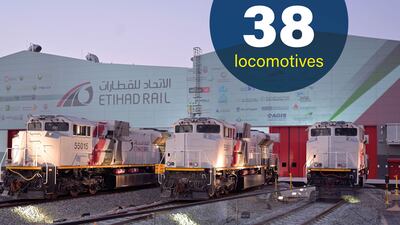
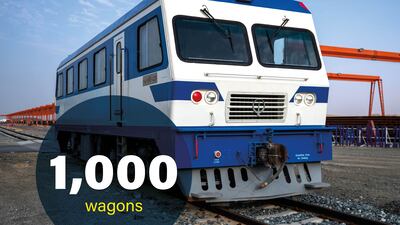
It consists of a fleet of 38 locomotives and more than 1,000 wagons.

A launch date for passenger services is still to be confirmed.

The rail network stretches about 900 kilometres across the country – extending to Oman – and is expected to reduce carbon emissions by up to 21 per cent.

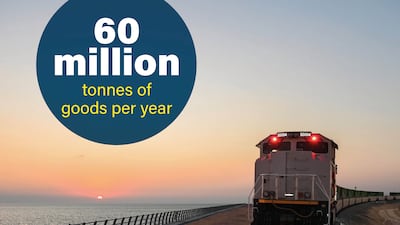
  • Etihad Rail's freight network is now operational. It can transport 60 million tonnes of goods a year. All photos: Etihad Rail
    Etihad Rail's freight network is now operational. It can transport 60 million tonnes of goods a year. All photos: Etihad Rail
  • The new freight service has 38 locomotives
    The new freight service has 38 locomotives
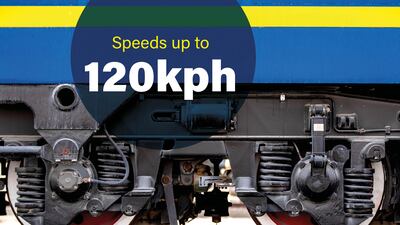
  • The freight trains will run up to 120kph, with each locomotive operating at 4,500 horsepower
    The freight trains will run up to 120kph, with each locomotive operating at 4,500 horsepower
  • The locomotives pull a total of 1,000 wagons, transporting goods ranging from shipping containers to industrial material
    The locomotives pull a total of 1,000 wagons, transporting goods ranging from shipping containers to industrial material
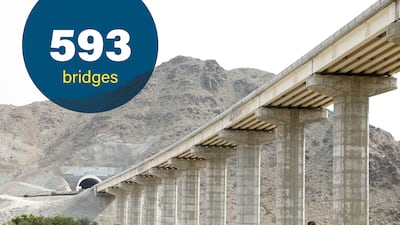
  • The tracks cross the UAE and feature 593 bridges
    The tracks cross the UAE and feature 593 bridges
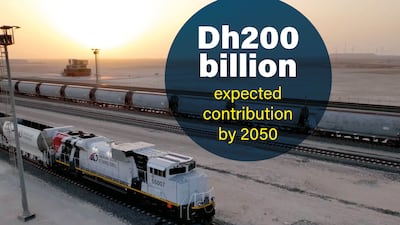
  • The network will contribute Dh200 billion ($54.4 billion) to the UAE economy and save Dh8 billion in road maintenance costs
    The network will contribute Dh200 billion ($54.4 billion) to the UAE economy and save Dh8 billion in road maintenance costs
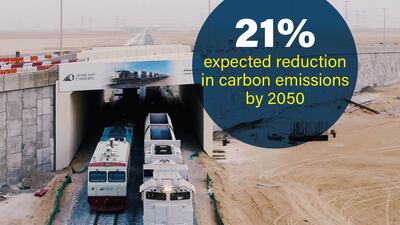
  • The project also aims to reduce carbon emissions from the road transport sector by 21 per cent by 2050, boosting the country's efforts to become net zero
    The project also aims to reduce carbon emissions from the road transport sector by 21 per cent by 2050, boosting the country's efforts to become net zero

The drivers work in 10-hour shifts depending on the cargo they have to move, with an average working day starting at about 4am.

“I would be up an hour earlier, at around 3am and head to the control room to pick up my bag, which has my protective gear,” says Ms Al Mazrouei.

A typical journey will take her from Mirfa to Shah in the Al Dhafra region of Abu Dhabi.

Before boarding the train, she has to ensure that all security checks have been conducted and the cargo is loaded.

Paving the way for future generations

Mr Al Hammadi, who began driving freight trains in 2020, is eager for other Emiratis to follow in his path and help drive a "groundbreaking national project".

“Without the Adveti programme, I wouldn’t be here today, and if not for support from leadership, none of this would have been possible," he says.

"I do hope to train future generations to be part of Etihad Rail.

"It does give you an immense feeling of national pride to be part of a new and ground-breaking national project.”

Both Mr Al Hammadi and Ms Al Mazrouei hope to drive Etihad Rail's passenger trains when they are up and running.

Exciting times ahead

Adhraa Al Mansoori, director of public policy and sustainability at Etihad Rail, is excited for the future of the mega project. Khushnum Bhandari / The National

Adhraa Al Mansoori, director of public policy and sustainability at Etihad Rail, says the huge infrastructure project is in keeping with the UAE leadership's long-term goals to unite the nation.

“This was our founding father’s dream,” says Ms Al Mansoori, referring to UAE Founding Father, the late Sheikh Zayed bin Sultan Al Nahyan.

“To connect the seven emirates and later connect to the GCC and beyond.

"This vision was supported by our wise leadership, which established Etihad Rail.”

She said Etihad Rail, established in 2009, has made significant progress since becoming operational seven years ago.

Phase one – encompassing freight operations – is complete.

Since 2016, two tracks spanning 264 kilometres have been in operation – with trains transporting granulated sulphur from gas fields in Shah and Habshan to an export point in Ruwais.

The aim is to transport 60 million tonnes of freight goods by 2030, while there is much anticipation for the passenger routes still to come.

“This is the exciting part. Right now we are in the business of moving goods but soon we will be in the business of moving people," she says.

"Luckily we have the infrastructure for the passenger trains already in place. We anticipate connecting eleven cities starting from Al Sila and all the way to Fujairah.

"We anticipate that our passengers will have an amazing experience in terms of comfort and convenience, and we are also tapping into the social aspect of the project where we will be connecting rural or remote cities with the main cities.”

She spoke of another notable achievement, in linking the vast network to Oman, helping to further bolster economic and social ties between the Gulf neighbours.

She says Etihad Rail hopes to welcome tens of millions of passengers on board by 2030.

“We anticipate moving around 36.5 million passengers by 2030. Every train will seat over 400 passengers and will run up to 200kph,”

The economic impact of the network is estimated to be around Dh200 billion over the next 50 years.

“My personal dream is to ride on the train, not only myself but my grandparents, my parents, and the entire family," she says.

"There are a lot of hopes and dreams for the network. Trains are a very simple concept. People love trains, and everybody in the UAE is looking forward to it."

Ms Al Mansoori spoke of her pride at the achievements of Mr Al Hammadi and Ms Al Mazrouei.

“The two Emiratis who are the first captains are truly an inspiration. We are proud of them. These kinds of careers did not exist before in the UAE, so seeing them is an inspiration to a lot of the youth.

“Etihad Rail in itself is a literal representation of the UAE’s union. A project that connects the seven emirates – linking cities, people, business – it embodies the spirit of the union and is the reason why we as Emiratis are so proud of it and look forward to the future ahead."


The Vile

Starring: Bdoor Mohammad, Jasem Alkharraz, Iman Tarik, Sarah Taibah

Director: Majid Al Ansari

Rating: 4/5

UAE squad to face Ireland

Ahmed Raza (captain), Chirag Suri (vice-captain), Rohan Mustafa, Mohammed Usman, Mohammed Boota, Zahoor Khan, Junaid Siddique, Waheed Ahmad, Zawar Farid, CP Rizwaan, Aryan Lakra, Karthik Meiyappan, Alishan Sharafu, Basil Hameed, Kashif Daud, Adithya Shetty, Vriitya Aravind

In numbers: PKK’s money network in Europe

Germany: PKK collectors typically bring in $18 million in cash a year – amount has trebled since 2010

Revolutionary tax: Investigators say about $2 million a year raised from ‘tax collection’ around Marseille

Extortion: Gunman convicted in 2023 of demanding $10,000 from Kurdish businessman in Stockholm

Drug trade: PKK income claimed by Turkish anti-drugs force in 2024 to be as high as $500 million a year

Denmark: PKK one of two terrorist groups along with Iranian separatists ASMLA to raise “two-digit million amounts”

Contributions: Hundreds of euros expected from typical Kurdish families and thousands from business owners

TV channel: Kurdish Roj TV accounts frozen and went bankrupt after Denmark fined it more than $1 million over PKK links in 2013 

%20Ramez%20Gab%20Min%20El%20Akher
%3Cp%3E%3Cstrong%3ECreator%3A%3C%2Fstrong%3E%20Ramez%20Galal%3C%2Fp%3E%0A%3Cp%3E%3Cstrong%3EStarring%3A%3C%2Fstrong%3E%20Ramez%20Galal%3C%2Fp%3E%0A%3Cp%3E%3Cstrong%3EStreaming%20on%3A%20%3C%2Fstrong%3EMBC%20Shahid%3C%2Fp%3E%0A%3Cp%3E%3Cstrong%3ERating%3A%20%3C%2Fstrong%3E2.5%2F5%3C%2Fp%3E%0A
Company Profile

Name: Thndr
Started: 2019
Co-founders: Ahmad Hammouda and Seif Amr
Sector: FinTech
Headquarters: Egypt
UAE base: Hub71, Abu Dhabi
Current number of staff: More than 150
Funds raised: $22 million

Dengue%20fever%20symptoms
%3Cul%3E%0A%3Cli%3EHigh%20fever%3C%2Fli%3E%0A%3Cli%3EIntense%20pain%20behind%20your%20eyes%3C%2Fli%3E%0A%3Cli%3ESevere%20headache%3C%2Fli%3E%0A%3Cli%3EMuscle%20and%20joint%20pains%3C%2Fli%3E%0A%3Cli%3ENausea%3C%2Fli%3E%0A%3Cli%3EVomiting%3C%2Fli%3E%0A%3Cli%3ESwollen%20glands%3C%2Fli%3E%0A%3Cli%3ERash%3C%2Fli%3E%0A%3C%2Ful%3E%0A%3Cp%3EIf%20symptoms%20occur%2C%20they%20usually%20last%20for%20two-seven%20days%3C%2Fp%3E%0A

Mercer, the investment consulting arm of US services company Marsh & McLennan, expects its wealth division to at least double its assets under management (AUM) in the Middle East as wealth in the region continues to grow despite economic headwinds, a company official said.

Mercer Wealth, which globally has $160 billion in AUM, plans to boost its AUM in the region to $2-$3bn in the next 2-3 years from the present $1bn, said Yasir AbuShaban, a Dubai-based principal with Mercer Wealth.

Within the next two to three years, we are looking at reaching $2 to $3 billion as a conservative estimate and we do see an opportunity to do so,” said Mr AbuShaban.

Mercer does not directly make investments, but allocates clients’ money they have discretion to, to professional asset managers. They also provide advice to clients.

“We have buying power. We can negotiate on their (client’s) behalf with asset managers to provide them lower fees than they otherwise would have to get on their own,” he added.

Mercer Wealth’s clients include sovereign wealth funds, family offices, and insurance companies among others.

From its office in Dubai, Mercer also looks after Africa, India and Turkey, where they also see opportunity for growth.

Wealth creation in Middle East and Africa (MEA) grew 8.5 per cent to $8.1 trillion last year from $7.5tn in 2015, higher than last year’s global average of 6 per cent and the second-highest growth in a region after Asia-Pacific which grew 9.9 per cent, according to consultancy Boston Consulting Group (BCG). In the region, where wealth grew just 1.9 per cent in 2015 compared with 2014, a pickup in oil prices has helped in wealth generation.

BCG is forecasting MEA wealth will rise to $12tn by 2021, growing at an annual average of 8 per cent.

Drivers of wealth generation in the region will be split evenly between new wealth creation and growth of performance of existing assets, according to BCG.

Another general trend in the region is clients’ looking for a comprehensive approach to investing, according to Mr AbuShaban.

“Institutional investors or some of the families are seeing a slowdown in the available capital they have to invest and in that sense they are looking at optimizing the way they manage their portfolios and making sure they are not investing haphazardly and different parts of their investment are working together,” said Mr AbuShaban.

Some clients also have a higher appetite for risk, given the low interest-rate environment that does not provide enough yield for some institutional investors. These clients are keen to invest in illiquid assets, such as private equity and infrastructure.

“What we have seen is a desire for higher returns in what has been a low-return environment specifically in various fixed income or bonds,” he said.

“In this environment, we have seen a de facto increase in the risk that clients are taking in things like illiquid investments, private equity investments, infrastructure and private debt, those kind of investments were higher illiquidity results in incrementally higher returns.”

The Abu Dhabi Investment Authority, one of the largest sovereign wealth funds, said in its 2016 report that has gradually increased its exposure in direct private equity and private credit transactions, mainly in Asian markets and especially in China and India. The authority’s private equity department focused on structured equities owing to “their defensive characteristics.”

Updated: January 17, 2024, 12:15 PM