• A woman shields herself from the sun in Abu Dhabi. All photos taken on June 6, 2021.
    A woman shields herself from the sun in Abu Dhabi. All photos taken on June 6, 2021.
  • Camels graze close to the solar park in Sweihan, where temperatures rose above 50°C. Courtesy: Noor Abu Dhabi
    Camels graze close to the solar park in Sweihan, where temperatures rose above 50°C. Courtesy: Noor Abu Dhabi
  • The Gulf has had a hot start to the summer with temperatures hitting 45C daily in early June. Pawan Singh / The National
    The Gulf has had a hot start to the summer with temperatures hitting 45C daily in early June. Pawan Singh / The National
  • Hazy weather across Dubai. Chris Whiteoak / The National
    Hazy weather across Dubai. Chris Whiteoak / The National
  • Downtown Dubai's skyscrapers obscured by the humid haze. Antonie Robertson / The National
    Downtown Dubai's skyscrapers obscured by the humid haze. Antonie Robertson / The National

UAE weather: Temperatures approach 50°C with humidity to hit 100%


  • English
  • Arabic

The UAE is gearing up for another scorching summer as the mercury is set to hit nearly 50°C this week.

The National Centre of Meteorology has forecast an increase in temperatures across the Emirates, with more fog to roll in.

The forecaster issued an alert over low visibility, in place until 9am, over low visibility in parts of the county caused by the morning fog.

The weather bureau, in its latest five-day bulletin, said temperatures would hover around the mid to late 40s in Abu Dhabi and Dubai for much of the week, peaking at 48°C in the capital on Sunday.

Temperatures are expected to reach 47°C in Al Ain on Wednesday, and will top 40°C in both Abu Dhabi and Dubai.

Humidity on the rise

The NCM said humidity could hit 100 per cent in Sweihan, in Al Ain, on Wednesday.

A 100 per cent reading means the air is totally saturated and is no longer able to absorb moisture, even human sweat, and this disrupts our cooling process.

These sticky conditions are largely caused by warmer seas, which increases evaporation, while hotter temperatures on land means the air absorbs more water.

Humidity levels could reach 95% in Abu Dhabi on Saturday, but are expected to be lower in Dubai.

Thursday's temperatures are set to reach highs of 44°C in Abu Dhabi and 43°C in Dubai.

Fog and mist are expected, while light to moderate winds will blow dust during the day with a speed of 40kph.

  • A plane takes off through a haze of humidity blanketing Dubai Marina in June. All photos: Pawan Singh / The National
    A plane takes off through a haze of humidity blanketing Dubai Marina in June. All photos: Pawan Singh / The National
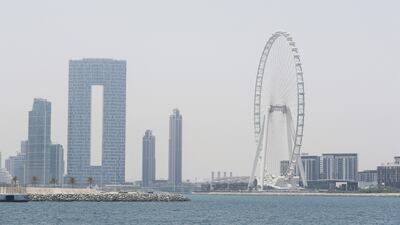
  • Towers in Dubai Marina and Ain Dubai during the hot and humid weather.
    Towers in Dubai Marina and Ain Dubai during the hot and humid weather.
  • Hot and humid weather in Dubai.
    Hot and humid weather in Dubai.
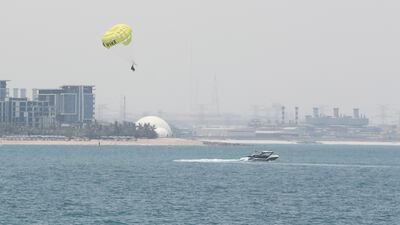
  • Parasailing is a good way to keep cool in Dubai Marina during the hot and humid spell in Dubai.
    Parasailing is a good way to keep cool in Dubai Marina during the hot and humid spell in Dubai.
  • Dubai Marina during the hot and humid weather in the emirate on Friday.
    Dubai Marina during the hot and humid weather in the emirate on Friday.
  • Dubai Marina shrouded in a haze of humidity.
    Dubai Marina shrouded in a haze of humidity.

On the coast, temperatures will rise up to 44°C with lows of 26°C. Winds will reach up to 40kph.

There will be some humidity on Friday with a possibility of fog and mist, as well as dust. The sea will be moderate in the Arabian Gulf and rough by morning.

Temperatures will reach 47°C in Abu Dhabi on Friday, while in Dubai it will peak at 46°C.

The mercury is set to reach 48°C in Al Quaa, in the western region of Abu Dhabi, on Saturday.

However, some respite is due in Dubai as temperatures drop to 30°C and to 32°C in Abu Dhabi on Saturday evening.

It is not the first time the UAE has experienced scorching temperatures as it approaches the summer months.

Last year, temperatures approached 50°C in Abu Dhabi's western region of Al Dhafra. It was one of five areas in the country where temperatures reached at least 49°C during the day.


Ten tax points to be aware of in 2026

1. Domestic VAT refund amendments: request your refund within five years

If a business does not apply for the refund on time, they lose their credit.

2. E-invoicing in the UAE

Businesses should continue preparing for the implementation of e-invoicing in the UAE, with 2026 a preparation and transition period ahead of phased mandatory adoption. 

3. More tax audits

Tax authorities are increasingly using data already available across multiple filings to identify audit risks. 

4. More beneficial VAT and excise tax penalty regime

Tax disputes are expected to become more frequent and more structured, with clearer administrative objection and appeal processes. The UAE has adopted a new penalty regime for VAT and excise disputes, which now mirrors the penalty regime for corporate tax.

5. Greater emphasis on statutory audit

There is a greater need for the accuracy of financial statements. The International Financial Reporting Standards standards need to be strictly adhered to and, as a result, the quality of the audits will need to increase.

6. Further transfer pricing enforcement

Transfer pricing enforcement, which refers to the practice of establishing prices for internal transactions between related entities, is expected to broaden in scope. The UAE will shortly open the possibility to negotiate advance pricing agreements, or essentially rulings for transfer pricing purposes. 

7. Limited time periods for audits

Recent amendments also introduce a default five-year limitation period for tax audits and assessments, subject to specific statutory exceptions. While the standard audit and assessment period is five years, this may be extended to up to 15 years in cases involving fraud or tax evasion. 

8. Pillar 2 implementation 

Many multinational groups will begin to feel the practical effect of the Domestic Minimum Top-Up Tax (DMTT), the UAE's implementation of the OECD’s global minimum tax under Pillar 2. While the rules apply for financial years starting on or after January 1, 2025, it is 2026 that marks the transition to an operational phase.

9. Reduced compliance obligations for imported goods and services

Businesses that apply the reverse-charge mechanism for VAT purposes in the UAE may benefit from reduced compliance obligations. 

10. Substance and CbC reporting focus

Tax authorities are expected to continue strengthening the enforcement of economic substance and Country-by-Country (CbC) reporting frameworks. In the UAE, these regimes are increasingly being used as risk-assessment tools, providing tax authorities with a comprehensive view of multinational groups’ global footprints and enabling them to assess whether profits are aligned with real economic activity. 

Contributed by Thomas Vanhee and Hend Rashwan, Aurifer

Updated: August 15, 2023, 12:37 PM