

A new study supported by the UAE suggests that drones could make cloud seeding more effective.
It shows how unmanned aircraft can be used to identify fruitful areas within clouds for seeding – a process that attempts to coax more rain from a cloud – leading to more precise efforts.
The UAE's National Centre of Meteorology (NCM) typically uses piloted planes to seed clouds and it is thought drones could help to improve the efficiency of the programme by delivering seeding material to clouds at the right time and to the right location in challenging conditions.
The research paper, Modern and Prospective Technologies for Weather Modification Activities: A First Demonstration of Integrating Autonomous Uncrewed Aircraft Systems, was published in the journal Atmospheric Research and described a three-week-long field test in the US in 2021.
This research was led by Prof Eric Frew, who in 2018 won a UAE grant for his work in drones and cloud seeding, and it was supported by the NCM as part of a project to observe seeding by drones.
Nine flights on eight days were conducted, involving more than eight hours of flight time. During the tests, the paper said, a drone successfully flew to a “region of interest” that was located from remote sensing data and then identified a seedable region, “initiated the seeding manoeuvre” and continued seeding while measuring conditions for more attempts.
The paper also showed how drones can simultaneously incorporate sensors, algorithms, operators and observers from around the world to search, identify, carry out, monitor and evaluate cloud-seeding operations to improve precipitation and rainfall.
According to the research paper, the technology is at a “readiness level between prototype and near-operational environments”.
Cloud seeding is an complex process and involves shooting salt flares or other small materials into clouds to try to generate extra rain. Research is pouring into the field to assess its effectiveness and how much, if any, extra rainfall is generated through a seeding mission.
The potential of Prof Frew’s field research was first revealed in October, 2021, a few months after the field test. “Eric Frew’s research campaign marks an important technology demonstration that could fundamentally change the way we conduct rain enhancement operations in the future using autonomous unmanned aircraft systems,” said Abdulla Al Mandous, director general of the NCM, at the time.
Cloud seeding in the UAE – in pictures
-
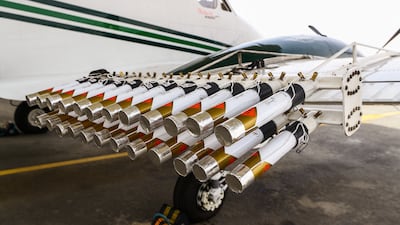
Hygroscopic (water-attracting) salt flares are attached to an aircraft at Al Ain International Airport before a cloud-seeding flight operated by the National Centre of Meteorology. The UAE has been leading the effort to seed clouds and increase precipitation, which remains at less than 100 millimetres a year on average. All photos by Reuters -
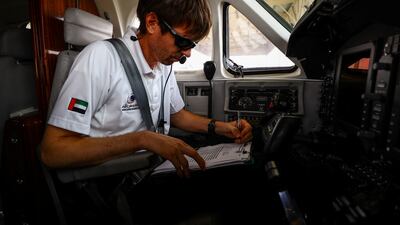
Pilot Michael Anstis writes a weather report before the cloud-seeding flight from Al Ain. -

An airport employee closes an aircraft door, with hygroscopic salt flares seen in the background, before the cloud-seeding flight. -
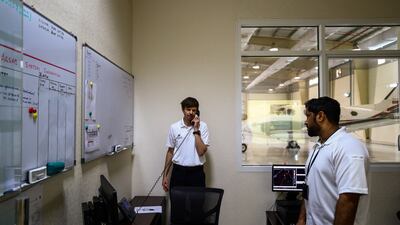
Pilots Michael Anstis and Ahmed Al Jaberi receive instructions before the flight. -

The control room at the National Centre of Meteorology in Abu Dhabi. -
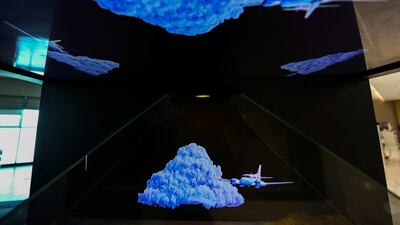
An explanatory hologram of the cloud-seeding process in the National Centre of Meteorology control room in Abu Dhabi. -
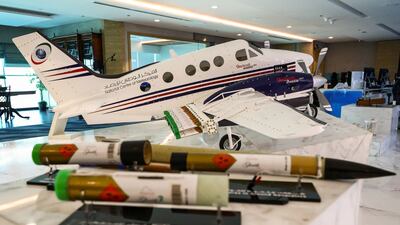
Cloud-seeding flares in the National Centre of Meteorology control room. -
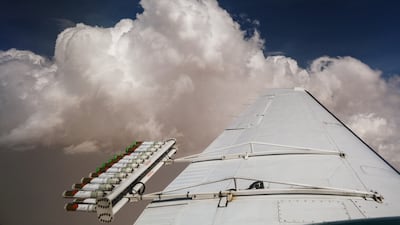
Hygroscopic salt flares are attached to an aircraft during a cloud-seeding flight between Al Ain and Al Hayer. At 9,000 feet above sea level, the plane releases the flares into the most promising white clouds, hoping to trigger rainfall. -

Hygroscopic salt flares are attached to an aircraft during a cloud-seeding flight. Scientists in Abu Dhabi combine shooting the flares with releasing salt nanoparticles, a newer technology, into the clouds to stimulate and accelerate the condensation process and hopefully produce droplets big enough to then fall as rain. -
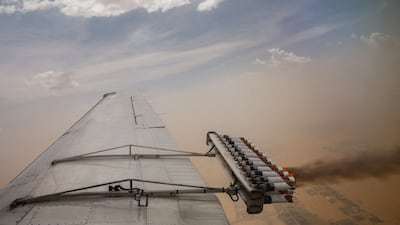
Flares are released during a cloud-seeding flight between Al Ain and Al Hayer. -
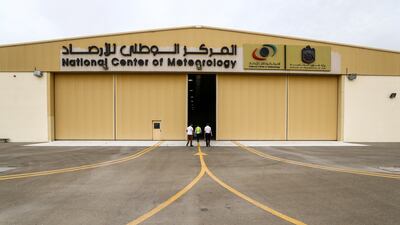
Employees walk towards a hangar at Al Ain International Airport after a cloud-seeding flight.


“The deployment of such advanced technologies will allow our scientists to improve their understanding of cloud formation processes in the UAE and other arid and semi-arid regions and carry out more reliable and efficient rain enhancement operations.”
Now this paper further cements just how unmanned systems could boost the seeding programme.
“Another benefit compared to the current standard practice is the potential for improved targeting efficiency and therefore improved results with higher confidence of the seeding effect,” the paper said.
Field tests of the systems in the UAE are expected, and the NCM said the technology transfer of the unmanned systems were completed in the first three months of the year.
The UAE’s seeding programme, which was established in the 1990s, continues to develop and modernise with the NCM in April announcing it was to add more advanced cloud seeding aircraft to its fleet.
The NCM is also responsible for running the UAE Research Programme for Rain Enhancement Science.
It offers each winning research proposal in the field of rain enhancement a grant of up to, $1.5 million, distributed over three years with a maximum annual amount of $550,000.
Prof Frew, along with two other experts, won in 2018. The last grants were awarded in 2022 with the next scheduled for 2024.


