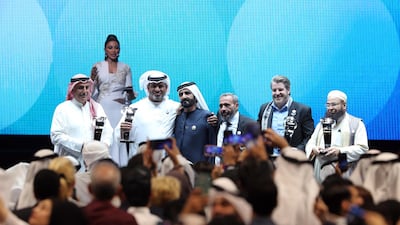
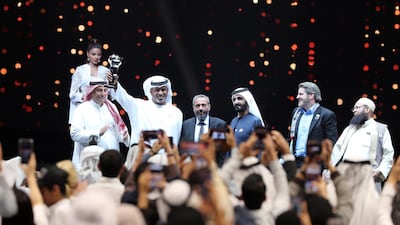
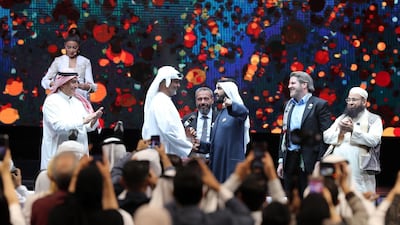
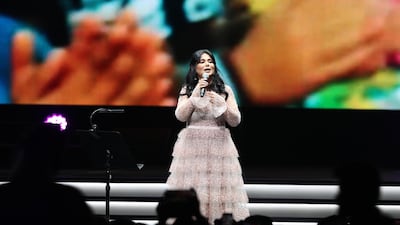
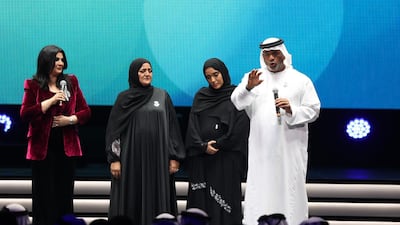
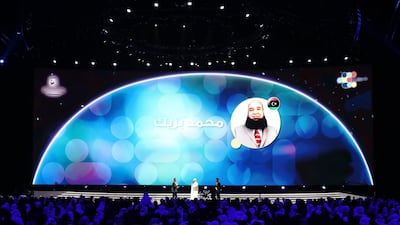
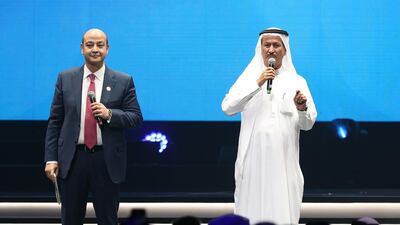
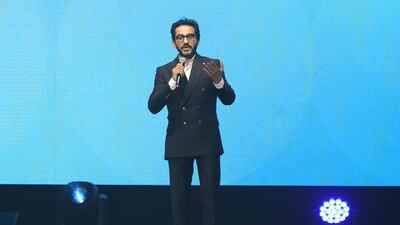
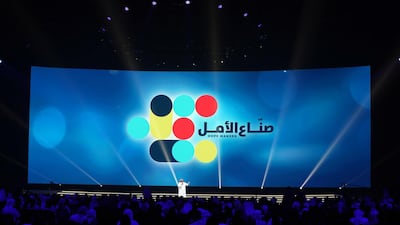
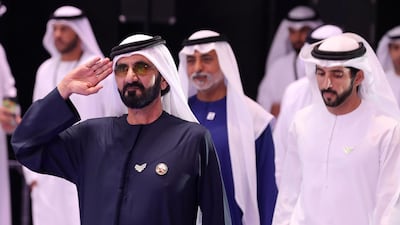
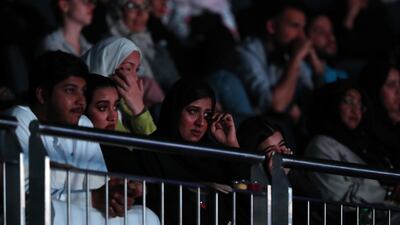
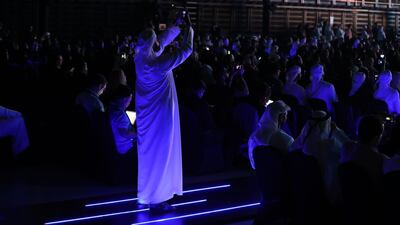
Sheikh Mohammed bin Rashid, Vice President and Ruler of Dubai, on Monday announced the return of Arab Hope Makers, a major initiative shining a light on humanitarianism and philanthropy across the region.
Sheikh Mohammed, who established the Arab Hope Makers award in 2017, said the fourth round of the Dh1 million programme would seek to honour those bringing about “positive change in our societies”.
In a message shared on social media, Sheikh Mohammed spoke of the importance of acknowledging the efforts of “thousands of hope makers” aiming to make a difference all over the region and beyond.
“Today marks the launch of the fourth edition of Hope Makers,” Sheikh Mohammed wrote on Twitter.
“We extend our search to all segments of society, aiming to celebrate these inspiring individuals, rejoice in their endeavours, and highlight their remarkable accomplishments.
“Anyone who recognises goodness within themselves is encouraged to self-nominate or nominate others through our website.”
He underlined the need to showcase the goodness of humanity against a narrative of “pessimism and negativity” in the region.
“Hope embodies strength, propels change and holds the key to rejuvenation,” Sheikh Mohammed wrote.
“It represents the anticipation of the future, an ongoing act of giving, seizing opportunities, and an infinite wellspring of human kindness.
“We actively seek individuals who embody hope and contribute to its cultivation, in order to honour and showcase their exemplary role in our communities.
“While conversations may often revolve around conflicts, despair, pessimism, and negativity in our region, we prioritise discussions on hope, acts of kindness, and positive transformations within our societies. Countless hope instigators can be found in every city and village.”
Charitable endeavours rewarded
An Emirati man who helped transform a hospital in Kenya into one of the most advanced facilities in the country was named the winner of the most recent Arab Hope Makers award in 2020.
Sheikh Mohammed presented Ahmed Al Falasi with the Dh1 million award after he was chosen from a list of five people shortlisted for their humanitarian work in education, health care and the environment.
Mr Al Falasi was chosen by popular vote from all who attended the event but Sheikh Mohammed also gave the four other contenders Dh1 million each in prize money.
More than 92,000 participants from 38 countries applied for the 2020 programme, with the final ceremony held at Dubai’s Coca-Cola Arena.
People can apply for this year's award by visiting https://arabhopemakers.com/

Company%20profile
%3Cp%3EName%3A%20Cashew%0D%3Cbr%3EStarted%3A%202020%0D%3Cbr%3EFounders%3A%20Ibtissam%20Ouassif%20and%20Ammar%20Afif%0D%3Cbr%3EBased%3A%20Dubai%2C%20UAE%0D%3Cbr%3EIndustry%3A%20FinTech%0D%3Cbr%3EFunding%20size%3A%20%2410m%0D%3Cbr%3EInvestors%3A%20Mashreq%2C%20others%0D%3C%2Fp%3E%0A
Mercer, the investment consulting arm of US services company Marsh & McLennan, expects its wealth division to at least double its assets under management (AUM) in the Middle East as wealth in the region continues to grow despite economic headwinds, a company official said.
Mercer Wealth, which globally has $160 billion in AUM, plans to boost its AUM in the region to $2-$3bn in the next 2-3 years from the present $1bn, said Yasir AbuShaban, a Dubai-based principal with Mercer Wealth.
“Within the next two to three years, we are looking at reaching $2 to $3 billion as a conservative estimate and we do see an opportunity to do so,” said Mr AbuShaban.
Mercer does not directly make investments, but allocates clients’ money they have discretion to, to professional asset managers. They also provide advice to clients.
“We have buying power. We can negotiate on their (client’s) behalf with asset managers to provide them lower fees than they otherwise would have to get on their own,” he added.
Mercer Wealth’s clients include sovereign wealth funds, family offices, and insurance companies among others.
From its office in Dubai, Mercer also looks after Africa, India and Turkey, where they also see opportunity for growth.
Wealth creation in Middle East and Africa (MEA) grew 8.5 per cent to $8.1 trillion last year from $7.5tn in 2015, higher than last year’s global average of 6 per cent and the second-highest growth in a region after Asia-Pacific which grew 9.9 per cent, according to consultancy Boston Consulting Group (BCG). In the region, where wealth grew just 1.9 per cent in 2015 compared with 2014, a pickup in oil prices has helped in wealth generation.
BCG is forecasting MEA wealth will rise to $12tn by 2021, growing at an annual average of 8 per cent.
Drivers of wealth generation in the region will be split evenly between new wealth creation and growth of performance of existing assets, according to BCG.
Another general trend in the region is clients’ looking for a comprehensive approach to investing, according to Mr AbuShaban.
“Institutional investors or some of the families are seeing a slowdown in the available capital they have to invest and in that sense they are looking at optimizing the way they manage their portfolios and making sure they are not investing haphazardly and different parts of their investment are working together,” said Mr AbuShaban.
Some clients also have a higher appetite for risk, given the low interest-rate environment that does not provide enough yield for some institutional investors. These clients are keen to invest in illiquid assets, such as private equity and infrastructure.
“What we have seen is a desire for higher returns in what has been a low-return environment specifically in various fixed income or bonds,” he said.
“In this environment, we have seen a de facto increase in the risk that clients are taking in things like illiquid investments, private equity investments, infrastructure and private debt, those kind of investments were higher illiquidity results in incrementally higher returns.”
The Abu Dhabi Investment Authority, one of the largest sovereign wealth funds, said in its 2016 report that has gradually increased its exposure in direct private equity and private credit transactions, mainly in Asian markets and especially in China and India. The authority’s private equity department focused on structured equities owing to “their defensive characteristics.”
ESSENTIALS
The flights
Fly Etihad or Emirates from the UAE to Moscow from 2,763 return per person return including taxes.
Where to stay
Trips on the Golden Eagle Trans-Siberian cost from US$16,995 (Dh62,414) per person, based on two sharing.
Jetour T1 specs
Engine: 2-litre turbocharged
Power: 254hp
Torque: 390Nm
Price: From Dh126,000
Available: Now
Our family matters legal consultant
Name: Hassan Mohsen Elhais
Position: legal consultant with Al Rowaad Advocates and Legal Consultants.
The specs
Engine: 1.5-litre, 4-cylinder turbo
Transmission: CVT
Power: 170bhp
Torque: 220Nm
Price: Dh98,900
The past Palme d'Or winners
2018 Shoplifters, Hirokazu Kore-eda
2017 The Square, Ruben Ostlund
2016 I, Daniel Blake, Ken Loach
2015 Dheepan, Jacques Audiard
2014 Winter Sleep (Kış Uykusu), Nuri Bilge Ceylan
2013 Blue is the Warmest Colour (La Vie d'Adèle: Chapitres 1 et 2), Abdellatif Kechiche, Adele Exarchopoulos and Lea Seydoux
2012 Amour, Michael Haneke
2011 The Tree of Life, Terrence Malick
2010 Uncle Boonmee Who Can Recall His Past Lives (Lung Bunmi Raluek Chat), Apichatpong Weerasethakul
2009 The White Ribbon (Eine deutsche Kindergeschichte), Michael Haneke
2008 The Class (Entre les murs), Laurent Cantet
Emergency phone numbers in the UAE
Estijaba – 8001717 – number to call to request coronavirus testing
Ministry of Health and Prevention – 80011111
Dubai Health Authority – 800342 – The number to book a free video or voice consultation with a doctor or connect to a local health centre
Emirates airline – 600555555
Etihad Airways – 600555666
Ambulance – 998
Knowledge and Human Development Authority – 8005432 ext. 4 for Covid-19 queries