Watch: Footage of Abu Dhabi in the 1990s shows it in all its nostalgic glory


John Dennehy
  • English
  • Arabic

A home-made film showing Abu Dhabi's Corniche in 1993 is making many past and present residents of the city smile.

The footage was posted to a popular social media group called "Abu Dhabi – The Good Old Days" – and it has generated a warm-hearted and nostalgia-filled conversation about life in the city back then.

The video was shot by Michael Oakes and it shows a much quieter Corniche and many fondly-remembered landmarks, including some that have vanished from the city’s skyline.

Mr Oakes, who is from the UK, shot the footage when he was a teenager, using a Panasonic video recorder while a passenger in his father's car with a visiting friend in the back. They travel along the old Corniche road on an early August afternoon that year.

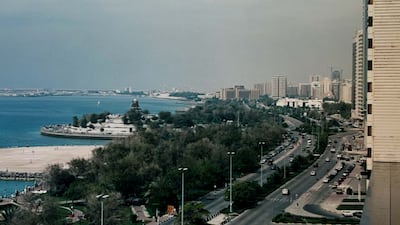
Large trees sway in the central median and far fewer cars pass down the road than do today. Along the route can be seen landmarks such as the Abu Dhabi Chamber of Commerce building; the Clock Tower; Hilton Abu Dhabi (now Radisson Blu); and the old headquarters of Adnoc.

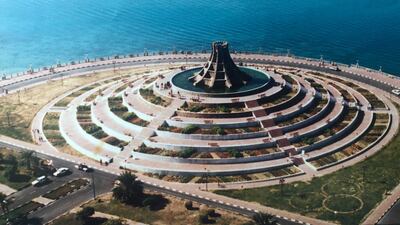
  • Abu Dhabi Corniche taken between 1990 and 1993. The Volcano Fountain can be seen on left. This landmark was demolished in 2004 as part of the Corniche upgrade project. Photo: Michael Oakes
    Abu Dhabi Corniche taken between 1990 and 1993. The Volcano Fountain can be seen on left. This landmark was demolished in 2004 as part of the Corniche upgrade project. Photo: Michael Oakes
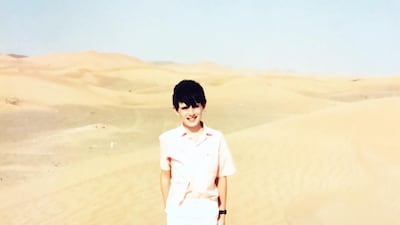
  • Michael Oakes as a boy in Al Ain. Photo: Michael Oakes
    Michael Oakes as a boy in Al Ain. Photo: Michael Oakes
  • Abu Dhabi Corniche in the early 1990s. Photo: Michael Oakes
    Abu Dhabi Corniche in the early 1990s. Photo: Michael Oakes
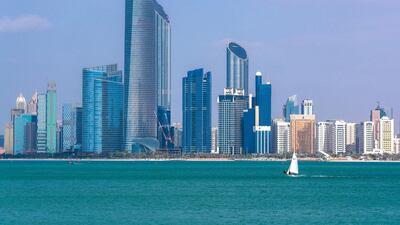
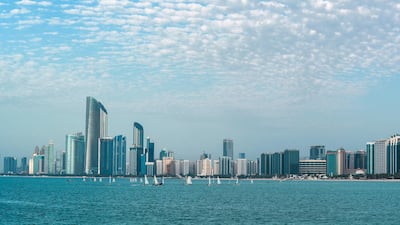
  • Abu Dhabi Corniche today. The Corniche branch of Union National Bank as seen in the video is just to the left of the boat. It was once one of the Corniche's tallest towers but today is surrounded by skyscrapers. Victor Besa / The National.
    Abu Dhabi Corniche today. The Corniche branch of Union National Bank as seen in the video is just to the left of the boat. It was once one of the Corniche's tallest towers but today is surrounded by skyscrapers. Victor Besa / The National.

“As a kid it felt pretty developed then,” said Mr Oakes, who lived in Abu Dhabi with his parents from 1978 to 1991 and then returned most years for summer holidays. “Abu Dhabi was modernising. It had a slower [and] conservative ... growth strategy. It was totally different to Dubai.”

The footage shows the glass-fronted office building that is now home to the Corniche branch of Union National Bank. When it was built, it was one of the UAE capital’s most distinctive landmarks and a sign of the city's growing internationalism. Construction of the Baynunah Tower can be seen beside it.

The car then turns left around the Intercontinental hotel roundabout and the film shows a glimpse of the old Adnoc residential buildings. The famed white-and-gold Abu Dhabi taxis also make an appearance.

The Abu Dhabi of 1993 was a smaller city. Islands such as Saadiyat and Yas had yet to be developed, Khalifa City was not the suburb we know today and life was very much centred on the island. Mr Oakes said social life revolved around four hotels: Le Meridien; Hilton Abu Dhabi; Sheraton Abu Dhabi and the Intercontinental. The Tourist Club, a long demolished entertainment centre beside Le Meridien, was also open, which Mr Oakes described as similar to British seaside holiday camps such as Butlins.

The video also speaks of a time when analogue was king. This was an era before the widespread use of the internet and no one had smart phones. Videos had to be shot on a clunky hand-held camera and then hope the tape didn’t get damaged. Mr Oakes remembers people bringing over taped versions of British TV staples such as Top of the Pops , which were then watched in Abu Dhabi weeks after they were broadcast.

For Mr Oakes, the reaction to the video on social media has been heart warming. “I love it. What really strikes me is that we are a much bigger community than we thought," he said, referring to the numbers of expatriates who lived and worked in Abu Dhabi over the years. "I just didn’t realise there were so many of us.”

Thirty years on, some of the buildings, such as the Union National Bank and Chamber of Commerce, look practically the same. But the skyline is full of glittering new towers and the Corniche has changed beyond all recognition. A major land reclamation project a few years after the video was shot pushed the Corniche farther out, led to the construction of a new road and added pristine new beaches. Some of the landmarks, such as the Clock Tower, were demolished to make way for the project.

The video has also generated lively debate between different generations of residents who feel their time was the best. Some feel the 1970s trumped them all, others the 1980s, while some believe the “good old days” were gone by the time Mr Oakes shot the video. “A lot of people look back with such fond nostalgia but there is a competitiveness with people who were there,” Mr Oakes said with a chuckle. “People of the 1960s and 1970s say the old days were gone by the 1990s,” he said.

“But I love the feeling of community. Abu Dhabi really had that.”

Abu Dhabi Corniche through the years - in pictures

  • Abu Dhabi's Corniche in the 1950s. Some boats could unload goods on the beach, while larger vessels docked farther out. Photo: Tim Hillyard
    Abu Dhabi's Corniche in the 1950s. Some boats could unload goods on the beach, while larger vessels docked farther out. Photo: Tim Hillyard
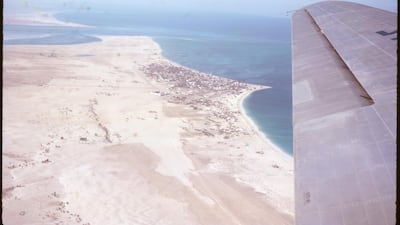
  • An aerial shot of Abu Dhabi from the early 1960s. Oil was discovered in 1958 and the city expanded quickly. Photo: David Riley
    An aerial shot of Abu Dhabi from the early 1960s. Oil was discovered in 1958 and the city expanded quickly. Photo: David Riley
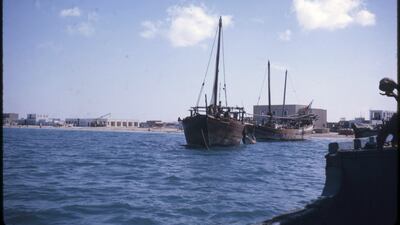
  • Two dhows are anchored off Abu Dhabi in about 1963. The building behind the dhows is the Abu Dhabi branch of the British Bank of the Middle East, which is now part of the HSBC Group. Photo: David Riley
    Two dhows are anchored off Abu Dhabi in about 1963. The building behind the dhows is the Abu Dhabi branch of the British Bank of the Middle East, which is now part of the HSBC Group. Photo: David Riley
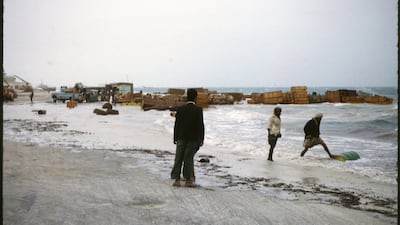
  • Flooding at Abu Dhabi's Corniche in the early 1960s. Sea defences were improved in the years after. Photo: David Riley
    Flooding at Abu Dhabi's Corniche in the early 1960s. Sea defences were improved in the years after. Photo: David Riley
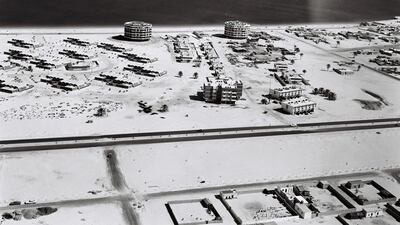
  • An aerial shot of Abu Dhabi from the 1970s shows the early days of the Corniche. Photo: Ron McCulloch
    An aerial shot of Abu Dhabi from the 1970s shows the early days of the Corniche. Photo: Ron McCulloch
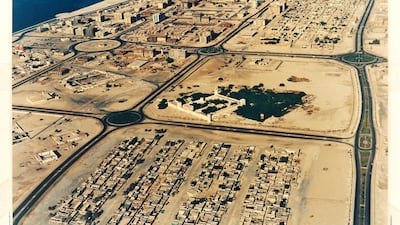
  • A view of Abu Dhabi in 1974, with land reclamation visible on the Corniche, top left. Photo: Ron McCulloch
    A view of Abu Dhabi in 1974, with land reclamation visible on the Corniche, top left. Photo: Ron McCulloch
  • The Corniche developed rapidly and new structures were built, such as the Volcano Fountain. This picture of the fountain is point from between 1998 and 2000. Photo: Sarwat Nasir
    The Corniche developed rapidly and new structures were built, such as the Volcano Fountain. This picture of the fountain is point from between 1998 and 2000. Photo: Sarwat Nasir
  • Abu Dhabi's Corniche and soaring skyline in 2021. Victor Besa / The National
    Abu Dhabi's Corniche and soaring skyline in 2021. Victor Besa / The National
UAE currency: the story behind the money in your pockets
Company profile

Company: Eighty6 

Date started: October 2021 

Founders: Abdul Kader Saadi and Anwar Nusseibeh 

Based: Dubai, UAE 

Sector: Hospitality 

Size: 25 employees 

Funding stage: Pre-series A 

Investment: $1 million 

Investors: Seed funding, angel investors  

About Housecall

Date started: July 2020

Founders: Omar and Humaid Alzaabi

Based: Abu Dhabi

Sector: HealthTech

# of staff: 10

Funding to date: Self-funded

COMPANY PROFILE

Name: Lamsa

Founder: Badr Ward

Launched: 2014

Employees: 60

Based: Abu Dhabi

Sector: EdTech

Funding to date: $15 million

UAE central contracts

Full time contracts

Rohan Mustafa, Ahmed Raza, Mohammed Usman, Chirag Suri, Mohammed Boota, Sultan Ahmed, Zahoor Khan, Junaid Siddique, Waheed Ahmed, Zawar Farid

Part time contracts

Aryan Lakra, Ansh Tandon, Karthik Meiyappan, Rahul Bhatia, Alishan Sharafu, CP Rizwaan, Basil Hameed, Matiullah, Fahad Nawaz, Sanchit Sharma

The specs

Engine: 2.0-litre 4-cylinder turbo

Power: 240hp at 5,500rpm

Torque: 390Nm at 3,000rpm

Transmission: eight-speed auto

Price: from Dh122,745

On sale: now

Company%20profile
%3Cp%3E%3Cstrong%3EName%3A%3C%2Fstrong%3E%20WonderTree%3Cbr%3E%3Cstrong%3EStarted%3A%3C%2Fstrong%3E%20April%202016%3Cbr%3E%3Cstrong%3ECo-founders%3A%3C%2Fstrong%3E%20Muhammad%20Waqas%20and%20Muhammad%20Usman%3Cbr%3E%3Cstrong%3EBased%3A%3C%2Fstrong%3E%20Karachi%2C%20Pakistan%2C%20Abu%20Dhabi%2C%20UAE%2C%20and%20Delaware%2C%20US%3Cbr%3E%3Cstrong%3ESector%3A%3C%2Fstrong%3E%20Special%20education%2C%20education%20technology%2C%20assistive%20technology%2C%20augmented%20reality%3Cbr%3EN%3Cstrong%3Eumber%20of%20staff%3A%20%3C%2Fstrong%3E16%3Cbr%3E%3Cstrong%3EInvestment%20stage%3A%20%3C%2Fstrong%3EGrowth%3Cbr%3E%3Cstrong%3EInvestors%3A%3C%2Fstrong%3E%20Grants%20from%20the%20Lego%20Foundation%2C%20UAE's%20Anjal%20Z%2C%20Unicef%2C%20Pakistan's%20Ignite%20National%20Technology%20Fund%3C%2Fp%3E%0A
Who are the Sacklers?

The Sackler family is a transatlantic dynasty that owns Purdue Pharma, which manufactures and markets OxyContin, one of the drugs at the centre of America's opioids crisis. The family is well known for their generous philanthropy towards the world's top cultural institutions, including Guggenheim Museum, the National Portrait Gallery, Tate in Britain, Yale University and the Serpentine Gallery, to name a few. Two branches of the family control Purdue Pharma.

Isaac Sackler and Sophie Greenberg were Jewish immigrants who arrived in New York before the First World War. They had three sons. The first, Arthur, died before OxyContin was invented. The second, Mortimer, who died aged 93 in 2010, was a former chief executive of Purdue Pharma. The third, Raymond, died aged 97 in 2017 and was also a former chief executive of Purdue Pharma. 

It was Arthur, a psychiatrist and pharmaceutical marketeer, who started the family business dynasty. He and his brothers bought a small company called Purdue Frederick; among their first products were laxatives and prescription earwax remover.

Arthur's branch of the family has not been involved in Purdue for many years and his daughter, Elizabeth, has spoken out against it, saying the company's role in America's drugs crisis is "morally abhorrent".

The lawsuits that were brought by the attorneys general of New York and Massachussetts named eight Sacklers. This includes Kathe, Mortimer, Richard, Jonathan and Ilene Sackler Lefcourt, who are all the children of either Mortimer or Raymond. Then there's Theresa Sackler, who is Mortimer senior's widow; Beverly, Raymond's widow; and David Sackler, Raymond's grandson.

Members of the Sackler family are rarely seen in public.

The bio

Favourite vegetable: Broccoli

Favourite food: Seafood

Favourite thing to cook: Duck l'orange

Favourite book: Give and Take by Adam Grant, one of his professors at University of Pennsylvania

Favourite place to travel: Home in Kuwait.

Favourite place in the UAE: Al Qudra lakes

The Orwell Prize for Political Writing

Twelve books were longlisted for The Orwell Prize for Political Writing. The non-fiction works cover various themes from education, gender bias, and the environment to surveillance and political power. Some of the books that made it to the non-fiction longlist include: 

  • Appeasing Hitler: Chamberlain, Churchill and the Road to War by Tim Bouverie
  • Some Kids I Taught and What They Taught Me by Kate Clanchy
  • Invisible Women: Exposing Data Bias in a World Designed for Men by Caroline Criado Perez
  • Follow Me, Akhi: The Online World of British Muslims by Hussein Kesvani
  • Guest House for Young Widows: Among the Women of ISIS by Azadeh Moaveni
UAE currency: the story behind the money in your pockets
AI traffic lights to ease congestion at seven points to Sheikh Zayed bin Sultan Street

The seven points are:

Shakhbout bin Sultan Street

Dhafeer Street

Hadbat Al Ghubainah Street (outbound)

Salama bint Butti Street

Al Dhafra Street

Rabdan Street

Umm Yifina Street exit (inbound)

Ten tax points to be aware of in 2026

1. Domestic VAT refund amendments: request your refund within five years

If a business does not apply for the refund on time, they lose their credit.

2. E-invoicing in the UAE

Businesses should continue preparing for the implementation of e-invoicing in the UAE, with 2026 a preparation and transition period ahead of phased mandatory adoption. 

3. More tax audits

Tax authorities are increasingly using data already available across multiple filings to identify audit risks. 

4. More beneficial VAT and excise tax penalty regime

Tax disputes are expected to become more frequent and more structured, with clearer administrative objection and appeal processes. The UAE has adopted a new penalty regime for VAT and excise disputes, which now mirrors the penalty regime for corporate tax.

5. Greater emphasis on statutory audit

There is a greater need for the accuracy of financial statements. The International Financial Reporting Standards standards need to be strictly adhered to and, as a result, the quality of the audits will need to increase.

6. Further transfer pricing enforcement

Transfer pricing enforcement, which refers to the practice of establishing prices for internal transactions between related entities, is expected to broaden in scope. The UAE will shortly open the possibility to negotiate advance pricing agreements, or essentially rulings for transfer pricing purposes. 

7. Limited time periods for audits

Recent amendments also introduce a default five-year limitation period for tax audits and assessments, subject to specific statutory exceptions. While the standard audit and assessment period is five years, this may be extended to up to 15 years in cases involving fraud or tax evasion. 

8. Pillar 2 implementation 

Many multinational groups will begin to feel the practical effect of the Domestic Minimum Top-Up Tax (DMTT), the UAE's implementation of the OECD’s global minimum tax under Pillar 2. While the rules apply for financial years starting on or after January 1, 2025, it is 2026 that marks the transition to an operational phase.

9. Reduced compliance obligations for imported goods and services

Businesses that apply the reverse-charge mechanism for VAT purposes in the UAE may benefit from reduced compliance obligations. 

10. Substance and CbC reporting focus

Tax authorities are expected to continue strengthening the enforcement of economic substance and Country-by-Country (CbC) reporting frameworks. In the UAE, these regimes are increasingly being used as risk-assessment tools, providing tax authorities with a comprehensive view of multinational groups’ global footprints and enabling them to assess whether profits are aligned with real economic activity. 

Contributed by Thomas Vanhee and Hend Rashwan, Aurifer

Mercer, the investment consulting arm of US services company Marsh & McLennan, expects its wealth division to at least double its assets under management (AUM) in the Middle East as wealth in the region continues to grow despite economic headwinds, a company official said.

Mercer Wealth, which globally has $160 billion in AUM, plans to boost its AUM in the region to $2-$3bn in the next 2-3 years from the present $1bn, said Yasir AbuShaban, a Dubai-based principal with Mercer Wealth.

Within the next two to three years, we are looking at reaching $2 to $3 billion as a conservative estimate and we do see an opportunity to do so,” said Mr AbuShaban.

Mercer does not directly make investments, but allocates clients’ money they have discretion to, to professional asset managers. They also provide advice to clients.

“We have buying power. We can negotiate on their (client’s) behalf with asset managers to provide them lower fees than they otherwise would have to get on their own,” he added.

Mercer Wealth’s clients include sovereign wealth funds, family offices, and insurance companies among others.

From its office in Dubai, Mercer also looks after Africa, India and Turkey, where they also see opportunity for growth.

Wealth creation in Middle East and Africa (MEA) grew 8.5 per cent to $8.1 trillion last year from $7.5tn in 2015, higher than last year’s global average of 6 per cent and the second-highest growth in a region after Asia-Pacific which grew 9.9 per cent, according to consultancy Boston Consulting Group (BCG). In the region, where wealth grew just 1.9 per cent in 2015 compared with 2014, a pickup in oil prices has helped in wealth generation.

BCG is forecasting MEA wealth will rise to $12tn by 2021, growing at an annual average of 8 per cent.

Drivers of wealth generation in the region will be split evenly between new wealth creation and growth of performance of existing assets, according to BCG.

Another general trend in the region is clients’ looking for a comprehensive approach to investing, according to Mr AbuShaban.

“Institutional investors or some of the families are seeing a slowdown in the available capital they have to invest and in that sense they are looking at optimizing the way they manage their portfolios and making sure they are not investing haphazardly and different parts of their investment are working together,” said Mr AbuShaban.

Some clients also have a higher appetite for risk, given the low interest-rate environment that does not provide enough yield for some institutional investors. These clients are keen to invest in illiquid assets, such as private equity and infrastructure.

“What we have seen is a desire for higher returns in what has been a low-return environment specifically in various fixed income or bonds,” he said.

“In this environment, we have seen a de facto increase in the risk that clients are taking in things like illiquid investments, private equity investments, infrastructure and private debt, those kind of investments were higher illiquidity results in incrementally higher returns.”

The Abu Dhabi Investment Authority, one of the largest sovereign wealth funds, said in its 2016 report that has gradually increased its exposure in direct private equity and private credit transactions, mainly in Asian markets and especially in China and India. The authority’s private equity department focused on structured equities owing to “their defensive characteristics.”

Updated: April 20, 2023, 12:00 AM