



Iraq can restore many of the heritage sites destroyed during decades of conflict and put the focus back on rebuilding communities, a conference in Abu Dhabi has heard.
With the help of international funding, many of its ancient sites will over the next five to six years be restored to their former glory.
The work will help put the spotlight back on culture and communities, experts said.
Abrahamic Path Initiative
Dr Laith M Hussein, head of the State Board of Antiquities and Heritage Iraq, told the Aliph 2023 Forum that projects such as the $50 million restoration of the 12th century Al Nuri Mosque in Mosul — undertaken by the UAE in co-operation with Unesco — is scheduled to be completed by next year.
The mosque and its famous leaning minaret were destroyed by ISIS in 2017 as government forces closed in on the last fighters from the terrorist group that once held much of north-west Iraq.
“That was a very generous contribution by the UAE,” Dr Hussein said. "The destruction is huge and there is a lot of work still to be done. But we hope Al Nuri Mosque can be completed by 2024."
With the help of the international community, Iraq has rebuilt several monuments and retrieved thousands of stolen artefacts.
Al Nuri Mosque renovations in Mosul
The forum in Abu Dhabi was organised by the International Alliance for the Protection of Heritage in Conflict Areas (Aliph) and the Department of Culture and Tourism Abu Dhabi.
Aliph was co-founded by the UAE and France in 2017 in response to the massive destruction of cultural heritage over the past two decades, predominantly in the Middle East and the Sahel.
Based in Geneva, Aliph has supported nearly 200 projects in 31 countries on four continents.
It supports the restoration and reconstruction of many buildings in Iraq, including the sixth-century Arch of Ctesiphon, or Taq Kasra, 40km south of Baghdad.
Part of the Sasanian Palace complex, it is the world’s largest brick-built arch at 37 metres high and 26 metres wide.
“Part of the arch collapsed because of bad conservation work done earlier,” Dr Hussein said.
“Aliph sent an expert team and now the first phase of the work is over and the arch is stabilised.”
Iraq is home to more than 15,000 cultural and heritage sites dating back to the 5,500-year-old city of Sumer and archaeological remains of the Babylonia, Assyrian and Abbasid cultures.
He said there are plans to convert Saddam Hussein’s palace in the ancient city of Babylon into a public museum.
“We are hopeful that we will have enough funds,” he said.
-
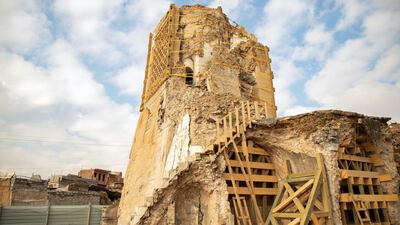
The UAE, in co-operation with Unesco, is helping to rebuild Al Nuri Mosque in Mosul. -
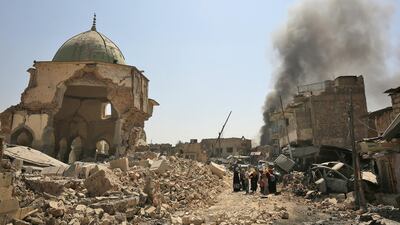
The mosque and its famous leaning minaret were destroyed by ISIS in 2017 as government forces closed in on the last fighters from the terrorist group that once held much of north-west Iraq. AFP -
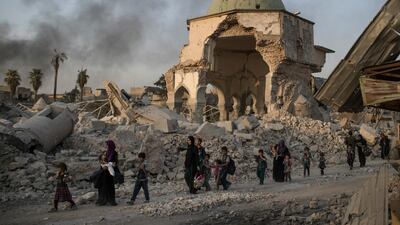
The mosque was left largely destroyed after the defeat of ISIS. AP -
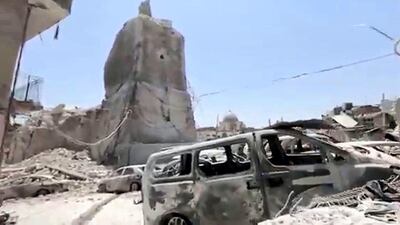
The minaret was also wrecked by the terrorists. AFP -
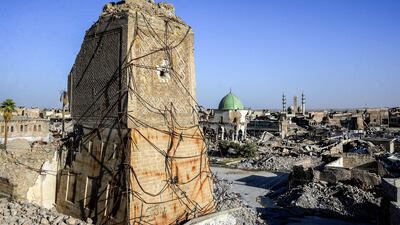
The 45-metre Al Hadba minaret was built 840 years ago. AFP -
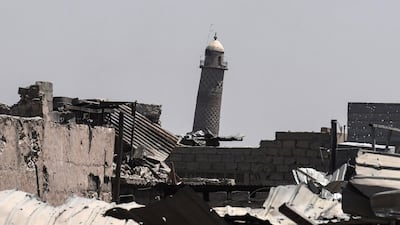
Before its destruction, its distinctive lean gave it its name, which translates as 'the hunchback' in Arabic. AFP -
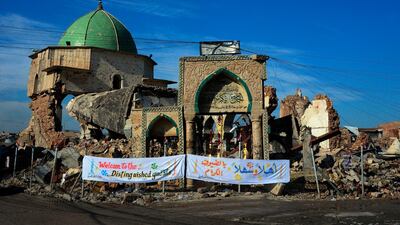
The UAE pledged $50.4 million (Dh185m) to restore Al Nuri Mosque and the minaret, in addition to providing expertise and support to co-ordinate the reconstruction. AFP -
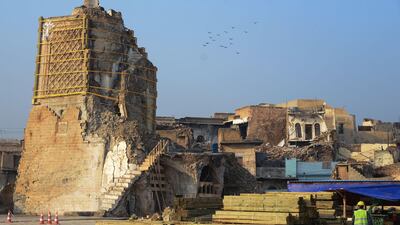
Work on the reconstruction of Al Hadba in December, 2019. AFP -
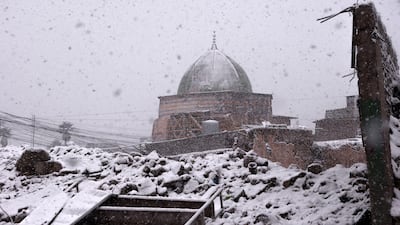
Al Nuri Mosque dome during a snowstorm in Mosul in February 2020. AFP -
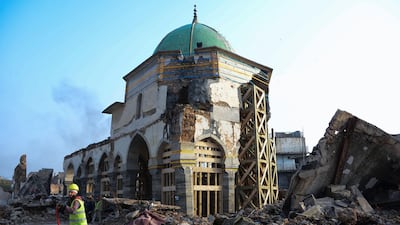
An Iraqi worker clears rubble during reconstruction work in December 2019. AFP -
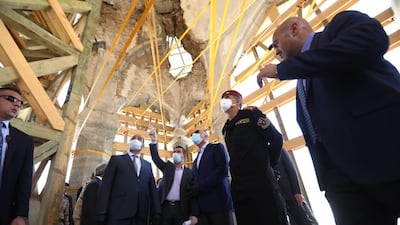
Iraqi prime minister at the time, Mustafa Al Khadimi, tours Al Nuri in 2020. Photo: Iraqi PM Media Office -
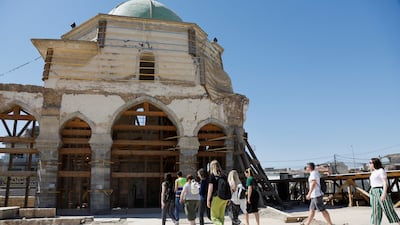
Tourists visit Al Nuri in April 2022. Reuters -
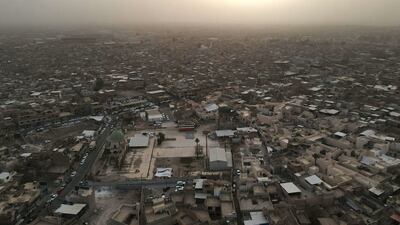
An aerial view of the Al Nuri mosque complex during a dust storm in June 2022. AFP -
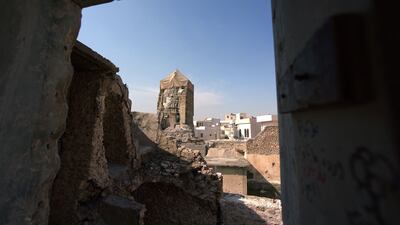
Renovation work on the mosque as seen through a doorway. AFP -
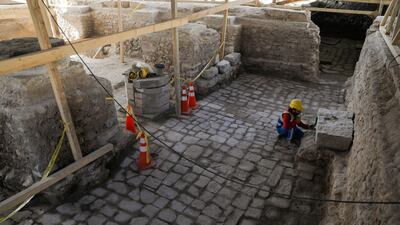
A labourer working on the monuments of Al Nuri in January 2022. Reuters -
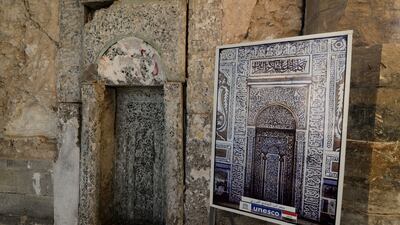
Restoration work at the mosque. AFP -
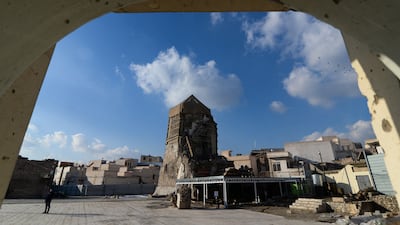
Excavations around Al Nuri. AFP


Building communities
Anisa Mehdi, president of the Abrahamic Path Initiative, a US-based international NGO that strives to develop walking trails to promote cultural connections, said building communities went hand-in-hand with heritage conservation.
In Mosul and Sinjar — areas ravaged by ISIS — Ms Mehdi said the group was reviving heritage through embroidery.
The project organises workshops with displaced Iraqis to help them protect their heritage by passing on stories, songs and recipes.
“After ISIS, the designs have become narratives of the city as it was before it was destroyed," Ms Mehdi said.
“Women are celebrating embroidery as their heritage and these works are a living library of life that is lost.”
Alessandra Peruzzetto, regional director of the Middle East and North Africa at the World Monuments Fund, said it was encouraging to see how the youth in Iraq were engaging with heritage preservation.
“Building capacities locally is important as the community involvement is crucial long term,” she said.
Baptiste Violi of the French NGO La Guilde Europeenne du Raid, which is involved in several restoration projects in Iraq, said communities rediscover pride in their own heritage when they are engaged in conservation.
“We are currently restoring two mosques and two churches in old Mosul,” Mr Violi said.
"The areas around these sites were heavily shelled and many private houses were destroyed.
"We think it is important to speak to the local authority and rebuild these houses so that people can live in Old Mosul and there is a community around the heritage sites we are rebuilding."
Daniele Morandi Bonacossi, a professor of Near Eastern archaeology at the University of Udine in Italy, who is involved in the Land of Nineveh Archaeological Project, said one of the main challenges in Iraq was vandalism.
“There are several challenges but vandalism is one big problem,” said Mr Bonacossi.
"After we restore and conserve a site, within two months, somebody comes and vandalises it with a spray of black paint or scribblings."

