
Tickets: Here's how you book a visit
The UAE's Abrahamic Family House is now open to the public.
Entry to the multi-faith place of worship, which houses a mosque, synagogue and church, will be free of charge, but bookings must be made in advance.
The attraction's official website states that booking will be available online soon.
Last month, President Sheikh Mohamed said the establishment of the Abrahamic Family House, on Saadiyat Island, was in line with the nation's celebration of diversity and tolerance.
“The UAE has a proud history of people from diverse communities working together to create new possibilities,” wrote Sheikh Mohamed on Twitter.
“As the Abrahamic Family House in Abu Dhabi is inaugurated, we remain committed to harnessing the power of mutual respect, understanding and diversity to achieve shared progress.”
On Friday, Sheikh Saif bin Zayed, Deputy Prime Minister and Minister of Interior, said the religious gathering place “embodies the UAE's values of mutual respect and peaceful co-existence”.
Sheikh Saif and Sheikh Nahyan bin Mubarak, Minister of Tolerance and Coexistence, officially inaugurated the new faith centre on February 17.
Spreading message of peace and prosperity
Sheikh Nahyan bin Mubarak, Minister of Tolerance and Coexistence, spoke about the importance of sending out a message of harmony and hope to the world.
“We recognise that our contemporary world, even after centuries of civilisation, is plagued by seemingly intolerable societal problems. We are of the view that our world needs to hear our dialogue,” said Sheikh Nahyan at the first Abrahamic House Forum held at the venue on Friday.
“Our world needs to see our commitment to peace and prosperity. Our world needs to observe our respect for each other and our world needs to be aware of the impact of our own action in the face of misunderstanding, conflict, and discrimination as we celebrate together the unity of the Abrahamic family members.”

He said the UAE had always strived to serve as a catalyst for peace, tolerance and understanding and stability in the world.
“We recognise that the only strategy that will reduce and eventually eliminate conflict emerging from religious or cultural differences is direct action to find common ground among people of all nations,” said Sheikh Nahyan.
The UAE has sought to build alliances with nations across the world in line with this vision, including forging diplomatic ties with Israel through the Abraham Accords in September, 2020.
The two nations have strengthened partnerships in a variety of fields — from the economy and trade to security and tourism — in the years since.
The Emirates opened an embassy in Tel Aviv in July 2021, months after naming its first envoy to the country.
Last month, Dubai's Crossroads of Civilisations Museum put on display a Torah scroll that survived the Holocaust.
It was unveiled during an event to mark the International Holocaust Remembrance Day.
The names of the three houses of worship are Imam Al Tayeb Mosque, St Francis Church and Moses ben Maimon Synagogue.
The Abrahamic Family House's design, by Ghanaian-British architect Sir David Adjaye, captures the values shared between Judaism, Christianity and Islam.
Visitors of all faiths are being invited to come together and take part in public worship services and education programmes.
“The Abrahamic Family House welcomes visitors and offers a range of experiences, from tours to immersive journeys of understanding,” the venue's website states.
“Visitors are invited to experience each of the three houses of worship and discover the key tenets of each Abrahamic faith.
“The Abrahamic Family House welcomes people to connect, explore, and reflect.
“We serve to deepen understanding of our common humanity through mutual dialogue, exchange of knowledge, and the practice of faith.”
A house where all are welcome

The place of worship was built in tribute to the Abrahamic religions, drawn from the prophet Abraham, revered in Islam, Judaism and Christianity.
The three pillars of the Abrahamic religions are honoured in the form of three striking structures — a mosque, a church and a synagogue — all leading to a central garden under which will sit a museum and centre for education.
The complex “recounts the history and builds bridges between human civilisations and heavenly messages”, Abu Dhabi's government said previously.
It is set to be a physical manifestation of the Document on Human Fraternity signed by Pope Francis and Dr Ahmed Al Tayeb, the Grand Imam of Al Azhar, during the pontiff's milestone visit to the UAE in 2019.
The project was first announced on February 5, 2019, by Sheikh Mohamed, who was Crown Prince of Abu Dhabi at the time.
Opening of Abrahamic Family House - in pictures
-
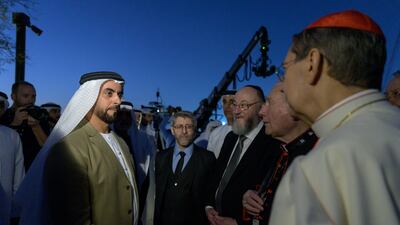
The Abrahamic Family House, a new centre for learning, dialogue and the practice of faith in Abu Dhabi, was officially opened on Thursday by Sheikh Saif bin Zayed, Deputy Prime Minister and Minister of Interior, and Sheikh Nahyan bin Mubarak, Minister of Tolerance and Coexistence. All photos: Wam -
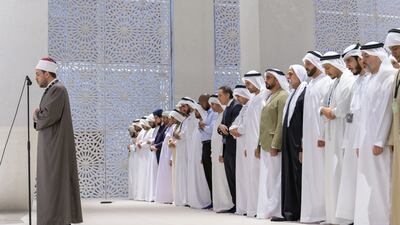
Encompassing three separate houses of worship – a mosque, a church and a synagogue – it will welcome visitors from March 1 -
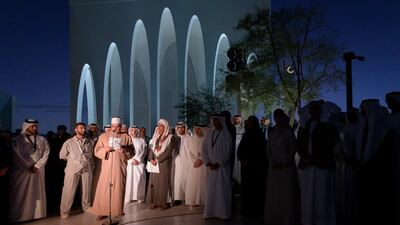
The Abrahamic Family House embodies the diversity of Abu Dhabi and the wider UAE, home to vibrant multicultural communities of various faiths -
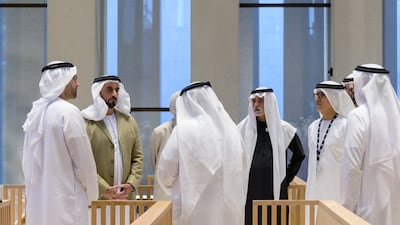
The project was inspired by the principles in the Document on Human Fraternity, signed by Pope Francis and Grand Imam Ahmed El Tayeb in Abu Dhabi in 2019 -
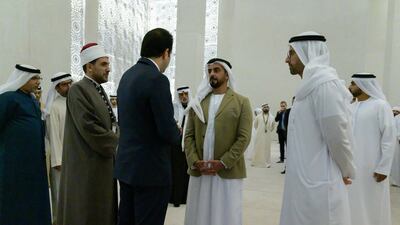
At the Abrahamic Family House, visitors are invited to participate in religious services, guided tours, celebrations and opportunities to explore faith -

The complex’s central forum functions as a visitor experience centre, where an immersive exhibition will introduce visitors to the Abrahamic Family House and invite reflection on the three faiths -
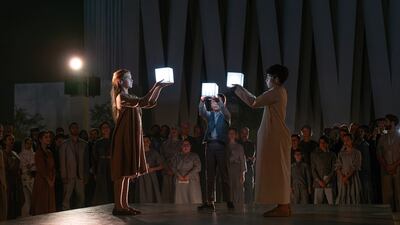
The three houses of worship are of equal stature and share external dimensions, and were designed by Sir David Adjaye



