
Farmers and engineers at a Sharjah farm are getting ready to welcome the first harvest of an enterprising wheat project.
Harvesting machines will assemble at the fields in March, collecting the matured crops.
The National visited the 400-hectare complex, about the size of 500 football pitches, in Mleiha. The project is being handled by the department of agriculture and livestock in Sharjah.
Chairman of the Department of Agriculture and Livestock
The first phase of the farm was opened in November by Sheikh Dr Sultan bin Muhammad Al Qasimi, Ruler of Sharjah, as machine operators drove on the fields disseminating seeds. In four months, the desert land at the base of rocky mountains has been transformed into a green oasis, ready to yield up to 1,700 tonnes of wheat.
“We are expecting the harvesting date to be any time between March 15 and 20,” said Dr Khalifa Musabeh Ahmed Alteneiji, Chairman of the Department of Agriculture and Livestock.
“The wheat will be going to the local market here in Sharjah and UAE.”
The crop has been grown without the use of pesticides, chemicals or genetically modified seeds. After harvest, it will be sent to mills for processing to make the wheat edible.
“We are expecting that the products will be available in the market in May or June,” Dr Alteneiji said.
The aim is to reach a total area of 1,900 hectares in phases.
Dr Alteneiji explained the importance of growing the crop in a country that imports 1.7 million tonnes of wheat.
“Wheat is a strategic commodity with high nutritional value that can be stored for a long time,” he said.
“During the Covid-19 pandemic and the war between Russia and Ukraine, the world faced some problems in the provision of wheat and food supply chains. From that perspective, we received directives from Sheikh Dr Sultan bin Muhammad Al Qasimi, the Ruler of Sharjah, to start this farm.”
When teams collected the soil sample for analysis, they realised that the land in Mleiha provided the most suitable conditions in the emirate to grow wheat, he added.
-

The wheat farm project in Mleiha, which was opened in November by Sheikh Dr Sultan bin Muhammad Al Qasimi, Ruler of Sharjah, is getting ready to produce its first harvest. Chris Whiteoak / The National -
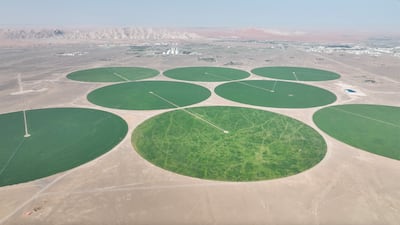
Drone images show the vast green patches. The farm covers 400 hectares, about the size of 500 football pitches. Photo: Supplied -

The irrigation system at the farm. Chris Whiteoak / The National -

Dr Khalifa Musabeh Ahmed Alteneiji, Chairman of the Department of Agriculture and Livestock, says the harvest should begin within weeks. Chris Whiteoak / The National -

The crop has been grown without the use of pesticides, chemicals or genetically modified seeds. Chris Whiteoak / The National -

The plan is to reach a total area of 1,900 hectares. Chris Whiteoak / The National -

An on-site weather station can predict temperature, wind speed and humidity up to 48 hours ahead. If rain is forecast, the farm cuts down on irrigation. Chris Whiteoak / The National -

The fields are irrigated using a reservoir with a capacity of 16,000 cubic metres. Chris Whiteoak / The National -

The irrigation system in action. Chris Whiteoak / The National -

In four months, the desert land has been transformed into a green oasis, ready to yield up to 1,700 tonnes of wheat. Chris Whiteoak / The National


AI-based systems
The farm is equipped with state-of-the-art technology, which includes soil sensors as well as satellites that perform thermal imaging of the site. The sensors can measure the quantity of water in the soil to avoid wastage.
The farm also has an on-site weather station that can predict temperature, wind speed and humidity for up to 48 hours. If rain is forecast, the farm cuts down on irrigation.
The fields are irrigated using a reservoir with a capacity of 16,000 cubic metres. In one day, up to 60,000 cubic metres of water can be generated out using six large suction pumps.
The farm uses pivot irrigation consisting of mechanised sprinkler systems which can be moved using motors. The satellite monitoring and sprinkler systems can be accessed remotely by using apps.
From seeding to irrigation to harvest, all agricultural practices are automated and mechanised, reducing the dependence on humans. Currently, the farm operates with the help of only two engineers and six to seven workers.
Research for future
As part of the project, experts also test and identify wheat varieties suited to environments such as the UAE.
“We have a small experimental farm, in which we sow about 30 varieties of wheat,” Dr Alteneiji said.
“The crops are studied, monitored and measured every day by experts. Based on these experiments, we select the best variety of wheat for the project and work on developing them in the future.”
The crop’s production is an agricultural milestone for the UAE, as the country prepares to host the Cop28 climate summit and strives to increase food security amid concerns over climate change.

