How house calls from the Abu Dhabi Ruler helped bring Christmas spirit to the desert


John Dennehy
  • English
  • Arabic

Abu Dhabi, 1955 — a small town consisting of a stone fort and palm-frond huts on the shores of the Arabian Gulf.

For foreign residents of the emirate, Christmas traditions such as carols and trees seemed very far away.

But on December 25 that year, a carol service and a speech from Britain's Queen Elizabeth II crackled through the wireless from London to the Abu Dhabi desert, bringing Christmas cheer and a sense of home to the handful of British residents listening in from very far away.

“I have spent … many a strange Christmas overseas,” wrote Roderic Owen in his book, The Golden Bubble, about the 1955 celebration. “But … nothing would compare with Christmastide in Abu Dhabi.”

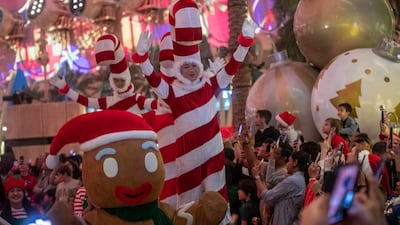
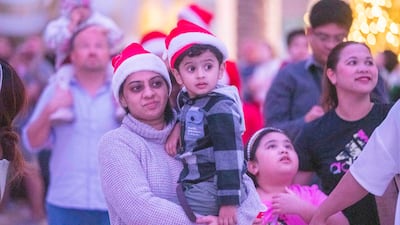
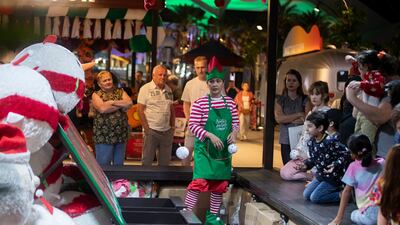
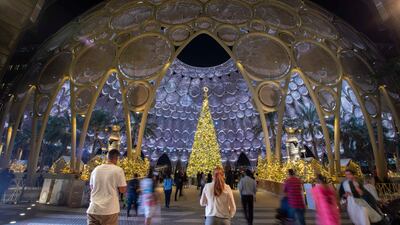
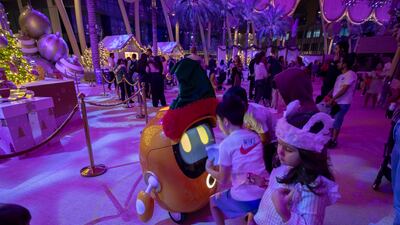
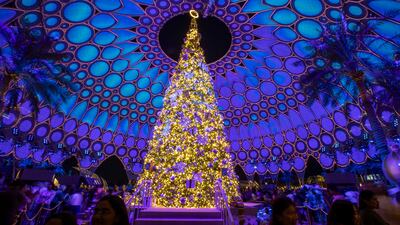
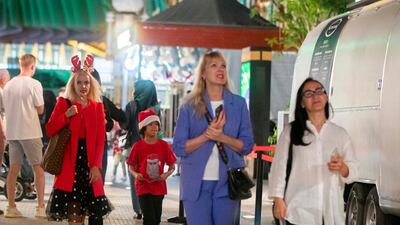
Almost 70 years on, the festive season is in full effect across the UAE. Decorations light up malls and roads and people enjoy glitzy Christmas markets, tree-lighting ceremonies and lavish festive brunches. But it wasn’t always like this.

Swapping snow for sand

Some of the first proper Christmas celebrations in the modern-day UAE took place the home of Tim Hillyard, a representative of BP in Abu Dhabi who was overseeing the search for oil.

Hillyard moved to Abu Dhabi in 1954 and was joined with his wife and daughter in one of the few stone houses at the time.

Tim Hillyard's house, where the Christmas celebration took place in 1955, under construction. Photo: Tim Hillyard

Owen was a guest of Hillyard's in 1955 and he wrote they intended on making it a “real Christmas with turkey and plum pudding, a Christmas tree and all the accessories”.

“Christmas Day in Abu Dhabi dawned, clear and sunny,” Owen wrote. “By half-closing one’s eyes, the sand stretching away towards the town looked like snow, rutted with wheel tracks, powdery and sparkling.”

A special festive guest

Sheikh Shakhbout, Ruler of Abu Dhabi at the time, paid courtesy calls to Hillyard’s house. That Christmas morning in 1955, Owen recorded Sheikh Shakhbout commenting that they must be missing their church and he was sorry there wasn’t one in Abu Dhabi for them to attend.

When they replied, asking whether he would disapprove of a church, he answered: “Of course not. You need your religion as we need ours.”

Sheikh Shakhbout made several visits to the house over the next few years and listened to carols sung there. He paid increasing attention to spiritual needs, granted land for Christian churches and the first Christmas services were held by the mid-1960s.

A yearning for Yuletide over the years

Celebrating Christmas at the was largely private. Celebrations took place in people’s homes, military bases such as RAF Sharjah and facilities such as Abu Dhabi’s The Club and Dubai Country Club.

During the 1970s, expatriate communities were still small enough that UAE leaders often visited homes personally to say happy Christmas, and the courtesy was returned at Eid. Christian services began to take place across the UAE.

“My recollection is Christmas Day was not a holiday, although Dubai's merchants liked Christmas for obvious reasons,” said Len Chapman, who arrived in Dubai in 1971. “Shops were appropriately decorated — not all but many.”

A typical Christmas was going to services, followed by dinner at home. A familiar sight at schools and clubs was Santa arriving to dispense presents and Christmas cheer at schools across the country.

Sally Brocklebank and her husband Peter at their Christmas party in Dubai, 1980. Photo: Sally Brocklebank - one time use for 2022 article - permission must be sought for future use

“We would decorate our villa, spray the windows with fake snow, crank up the AC, play Christmas tunes and cook a traditional Christmas dinner, all purchased from Spinneys in Jumeirah,” said Sally Brocklebank, who lived in Dubai with husband Peter from 1979 to 1985.

“But most important of all was to invite friends of all nationalities to enjoy the feast, pull crackers wear paper crowns, read silly jokes and finish off with a game of charades.”

John Jacobs, who lived in Sharjah from 1976 to 1983, with his wife, three children and nanny, said there wasn't much for sale.

"No decorations, postcards or whatsoever," said Mr Jacobs, who is from The Netherlands. Mr Jacobs brought his own decorations from home and managed to source a real tree though contacts in the aviation industry.

"Every year we managed to create a real Christmas ambiance in our house with a real Christmas tree, decorations and lights," he said. "Nice and sweet memories for us, the three children and the nanny."

By the 1980s in Abu Dhabi, artificial trees could be purchased locally and staff could even be hired to decorate it.

“The following year, we got out the same tree which, of course, needed decorating again,” said Harry Bonning, a British citizen who lived in Abu Dhabi from 1988 to 1999. “This was solved by a phone call to the shop where we bought it and they sent one of their staff to decorate it. Try that in England.”

By the 1980s, the Christmas spirit had been embraced by major hotels such as the Sheraton Dubai Creek and the now demolished Metropolitan Hotel. What had been a largely private affair was becoming more visible and commercialised.

“Christmas was behind closed doors until the hotels got involved,” said Michelle Brown, a singer who performed at 1980s festive concerts in Dubai. “I believe these hotels were entrusted with trying out Christmas events appropriately, which were enthusiastically received by the public at that time.”

Michelle Brown and Mark Lloyd, a musical duo who were performing Christmas shows at the Dubai Hilton, pose for a festive shoot in 1987. Photo: Michelle Brown

But it was still hard to get decorations. Ms Brown, who performed as a duo with Mark Lloyd, recounted one episode in 1987 where they could not find decorations for a Christmas-themed photo shoot. One supermarket, however, had a display inside the shop.

“So we went down in taxi, climbed into the display while a friend took picture of us from outside. We left before they realised what we were up to,” she recalls with a chuckle.

A more sobering Christmas took place several years later in 1990 during the Gulf War. Dubai was filled with troops from the US, France, UK, the Netherlands and more as Desert Storm — the operation to drive Iraqi forces from Kuwait — was weeks away. Tension was high. No one knew what was to come.

“That year was emotional as we all knew why the troops were building up in the area and we had no idea who would make it home afterwards,” said Ms Brown, who performed at the Hilton by the Trade Centre that year.

“It was very poignant. Young men lined up in their dozens snaking across the lobby waiting for five-minute call. People were in tears after it.”

By the mid-1990s, Christmas became a much more visible celebration, particularly in Dubai. Although not a public holiday, Christmas today has grown to a lengthy affair that caps a month of celebrations that also include the UAE’s National Day and Diwali, the Hindu festival of lights.

Christmas songs were even played in some Dubai malls in October this year, a far cry from that small, quiet celebration in Abu Dhabi in 1955.

A version of this article was first published in December 2022.

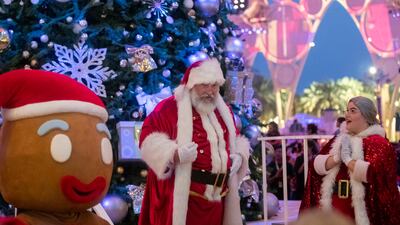
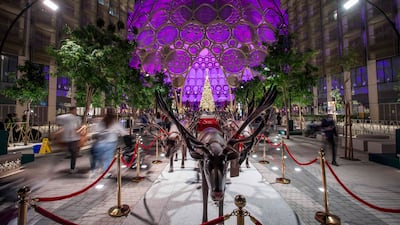
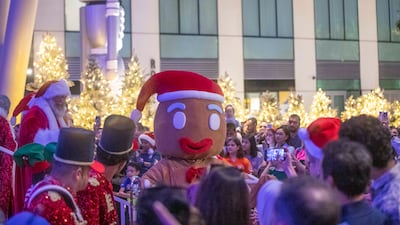
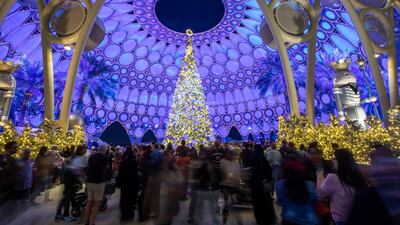
The Christmas season in the UAE — in pictures

What can victims do?

Always use only regulated platforms

Stop all transactions and communication on suspicion

Save all evidence (screenshots, chat logs, transaction IDs)

Report to local authorities

Warn others to prevent further harm

Courtesy: Crystal Intelligence

UAE currency: the story behind the money in your pockets
Our legal consultant

Name: Hassan Mohsen Elhais

Position: legal consultant with Al Rowaad Advocates and Legal Consultants.

UAE currency: the story behind the money in your pockets
Iftar programme at the Sheikh Mohammed Centre for Cultural Understanding

Established in 1998, the Sheikh Mohammed Centre for Cultural Understanding was created with a vision to teach residents about the traditions and customs of the UAE. Its motto is ‘open doors, open minds’. All year-round, visitors can sign up for a traditional Emirati breakfast, lunch or dinner meal, as well as a range of walking tours, including ones to sites such as the Jumeirah Mosque or Al Fahidi Historical Neighbourhood.

Every year during Ramadan, an iftar programme is rolled out. This allows guests to break their fast with the centre’s presenters, visit a nearby mosque and observe their guides while they pray. These events last for about two hours and are open to the public, or can be booked for a private event.

Until the end of Ramadan, the iftar events take place from 7pm until 9pm, from Saturday to Thursday. Advanced booking is required.

For more details, email openminds@cultures.ae or visit www.cultures.ae


The biog

Favourite book: Animal Farm by George Orwell

Favourite music: Classical

Hobbies: Reading and writing


What vitamins do we know are beneficial for living in the UAE

Vitamin D: Highly relevant in the UAE due to limited sun exposure; supports bone health, immunity and mood.Vitamin B12: Important for nerve health and energy production, especially for vegetarians, vegans and individuals with absorption issues.Iron: Useful only when deficiency or anaemia is confirmed; helps reduce fatigue and support immunity.Omega-3 (EPA/DHA): Supports heart health and reduces inflammation, especially for those who consume little fish.

Our legal advisor

Ahmad El Sayed is Senior Associate at Charles Russell Speechlys, a law firm headquartered in London with offices in the UK, Europe, the Middle East and Hong Kong.

Experience: Commercial litigator who has assisted clients with overseas judgments before UAE courts. His specialties are cases related to banking, real estate, shareholder disputes, company liquidations and criminal matters as well as employment related litigation. 

Education: Sagesse University, Beirut, Lebanon, in 2005.

Overview

Cricket World Cup League Two: Nepal, Oman, United States tri-series, Tribhuvan University, Kathmandu

Fixtures
Wednesday February 5, Oman v Nepal
Thursday, February 6, Oman v United States
Saturday, February 8, United States v Nepal
Sunday, February 9, Oman v Nepal
Tuesday, February 11, Oman v United States
Wednesday, February 12, United States v Nepal

UAE currency: the story behind the money in your pockets
Tonight's Chat on The National

Tonight's Chat is a series of online conversations on The National. The series features a diverse range of celebrities, politicians and business leaders from around the Arab world.

Tonight’s Chat host Ricardo Karam is a renowned author and broadcaster who has previously interviewed Bill Gates, Carlos Ghosn, Andre Agassi and the late Zaha Hadid, among others.

Intellectually curious and thought-provoking, Tonight’s Chat moves the conversation forward.

Facebook | Our website | Instagram

Director: Paul Weitz
Stars: Kevin Hart
3/5 stars

The specs

Engine: 3.0-litre 6-cyl turbo

Power: 435hp at 5,900rpm

Torque: 520Nm at 1,800-5,500rpm

Transmission: 9-speed auto

Price: from Dh498,542

On sale: now

Mercer, the investment consulting arm of US services company Marsh & McLennan, expects its wealth division to at least double its assets under management (AUM) in the Middle East as wealth in the region continues to grow despite economic headwinds, a company official said.

Mercer Wealth, which globally has $160 billion in AUM, plans to boost its AUM in the region to $2-$3bn in the next 2-3 years from the present $1bn, said Yasir AbuShaban, a Dubai-based principal with Mercer Wealth.

Within the next two to three years, we are looking at reaching $2 to $3 billion as a conservative estimate and we do see an opportunity to do so,” said Mr AbuShaban.

Mercer does not directly make investments, but allocates clients’ money they have discretion to, to professional asset managers. They also provide advice to clients.

“We have buying power. We can negotiate on their (client’s) behalf with asset managers to provide them lower fees than they otherwise would have to get on their own,” he added.

Mercer Wealth’s clients include sovereign wealth funds, family offices, and insurance companies among others.

From its office in Dubai, Mercer also looks after Africa, India and Turkey, where they also see opportunity for growth.

Wealth creation in Middle East and Africa (MEA) grew 8.5 per cent to $8.1 trillion last year from $7.5tn in 2015, higher than last year’s global average of 6 per cent and the second-highest growth in a region after Asia-Pacific which grew 9.9 per cent, according to consultancy Boston Consulting Group (BCG). In the region, where wealth grew just 1.9 per cent in 2015 compared with 2014, a pickup in oil prices has helped in wealth generation.

BCG is forecasting MEA wealth will rise to $12tn by 2021, growing at an annual average of 8 per cent.

Drivers of wealth generation in the region will be split evenly between new wealth creation and growth of performance of existing assets, according to BCG.

Another general trend in the region is clients’ looking for a comprehensive approach to investing, according to Mr AbuShaban.

“Institutional investors or some of the families are seeing a slowdown in the available capital they have to invest and in that sense they are looking at optimizing the way they manage their portfolios and making sure they are not investing haphazardly and different parts of their investment are working together,” said Mr AbuShaban.

Some clients also have a higher appetite for risk, given the low interest-rate environment that does not provide enough yield for some institutional investors. These clients are keen to invest in illiquid assets, such as private equity and infrastructure.

“What we have seen is a desire for higher returns in what has been a low-return environment specifically in various fixed income or bonds,” he said.

“In this environment, we have seen a de facto increase in the risk that clients are taking in things like illiquid investments, private equity investments, infrastructure and private debt, those kind of investments were higher illiquidity results in incrementally higher returns.”

The Abu Dhabi Investment Authority, one of the largest sovereign wealth funds, said in its 2016 report that has gradually increased its exposure in direct private equity and private credit transactions, mainly in Asian markets and especially in China and India. The authority’s private equity department focused on structured equities owing to “their defensive characteristics.”

What the law says

Micro-retirement is not a recognised concept or employment status under Federal Decree Law No. 33 of 2021 on the Regulation of Labour Relations (as amended) (UAE Labour Law). As such, it reflects a voluntary work-life balance practice, rather than a recognised legal employment category, according to Dilini Loku, senior associate for law firm Gateley Middle East.

“Some companies may offer formal sabbatical policies or career break programmes; however, beyond such arrangements, there is no automatic right or statutory entitlement to extended breaks,” she explains.

“Any leave taken beyond statutory entitlements, such as annual leave, is typically regarded as unpaid leave in accordance with Article 33 of the UAE Labour Law. While employees may legally take unpaid leave, such requests are subject to the employer’s discretion and require approval.”

If an employee resigns to pursue micro-retirement, the employment contract is terminated, and the employer is under no legal obligation to rehire the employee in the future unless specific contractual agreements are in place (such as return-to-work arrangements), which are generally uncommon, Ms Loku adds.

Tips for taking the metro

- set out well ahead of time

- make sure you have at least Dh15 on you Nol card, as there could be big queues for top-up machines

- enter the right cabin. The train may be too busy to move between carriages once you're on

- don't carry too much luggage and tuck it under a seat to make room for fellow passengers

Silent Hill f

Publisher: Konami

Platforms: PlayStation 5, Xbox Series X/S, PC

Rating: 4.5/5

The specs: 2017 Dodge Ram 1500 Laramie Longhorn

Price, base / as tested: Dhxxx
Engine: 5.7L V8
Transmission: Eight-speed automatic
Power: 395hp @ 5,600rpm
Torque: 556Nm @ 3,950rpm
Fuel economy, combined: 12.7L / 100km

Updated: December 25, 2023, 3:03 AM