

The UAE's stunning 51st National Day show celebrated the best of the nation and showcased its grand ambitions for the next 50 years.
An extravaganza of dancers, live music and performances ― as well as the arrival of an Etihad Rail passenger train ― delivered a taste of Emirati heritage and a snapshot of how the UAE will be shaped in the coming years.
Almost 7,000 international engineers, creatives and technicians worked behind the scenes to bring together a show streamed at 50 locations nationwide and to millions of homes on local television.
The rulers of the seven emirates, led by President Sheikh Mohamed, watched on as a visually breathtaking show unfolded at Abu Dhabi National Exhibition Centre.
-
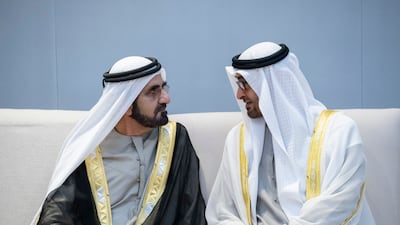
President Sheikh Mohamed bin Zayed, right, and Sheikh Mohammed bin Rashid, Prime Minister and Ruler of Dubai, at the 51st UAE National Day ceremony at the Abu Dhabi National Exhibition Centre. Hamad Al Kaabi / UAE Presidential Court -

Sheikh Mohammed, right, and Sheikh Tahnoon bin Mohamed, Ruler's Representative in Al Ain Region. Hamad Al Kaabi / UAE Presidential Court -
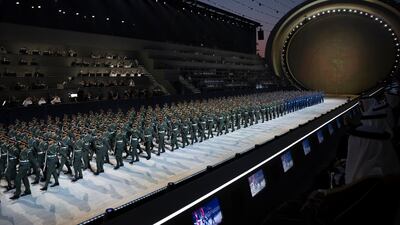
Members of the UAE armed forces participate in the show. Hamad Al Kaabi / UAE Presidential Court -
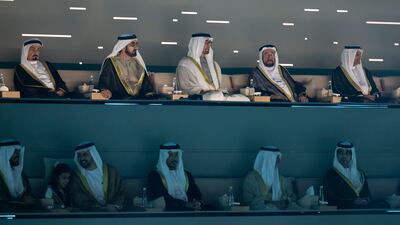
Second row, left to right: Sheikh Humaid bin Rashid, Ruler of Ajman; Sheikh Mohammed bin Rashid; President Sheikh Mohamed; Sheikh Dr Sultan bin Mohamed Al Qasimi, Ruler of Sharjah; and Sheikh Hamad bin Mohamed Al Sharqi, Ruler of Fujairah. Mohamed Al Hammadi / UAE Presidential Court -

The 51st UAE National Day official ceremony. Ryan Carter / UAE Presidential Court -
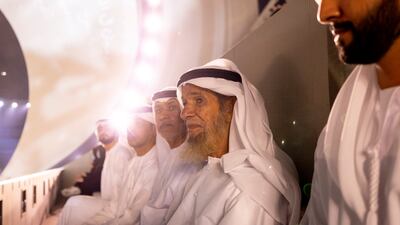
Guests attend the 51st UAE National Day official ceremony, at the Abu Dhabi National Exhibition Centre (ADNEC). Ryan Carter / UAE Presidential Court -
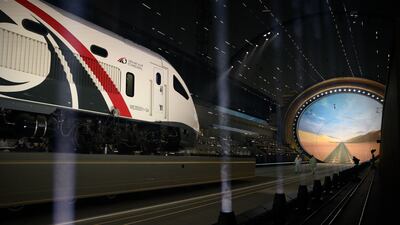
Performers take part in the 51st UAE National Day show. Abdulla Al Neyadi / UAE Presidential Court -
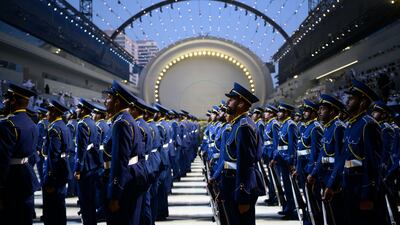
Members of the UAE Armed Forces participate. Abdulla Al Neyadi / UAE Presidential Court -

Pictured right to left: Sheikh Saud bin Rashid Al Mu'alla, Ruler of Umm Al Quwain; Sheikh Hamad bin Mohamed Al Sharqi, Ruler of Fujairah; Sheikh Dr Sultan bin Mohamed Al Qasimi, Ruler of Sharjah; President Sheikh Mohamed; and Sheikh Mohammed bin Rashid. Hamad Al Kaabi / UAE Presidential Court -

Members of the UAE Armed Forces. Ryan Carter / UAE Presidential Court -
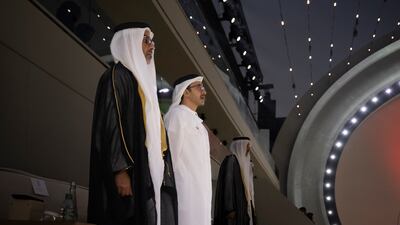
Sheikh Hamed bin Zayed, managing director of Abu Dhabi Investment Authority and Abu Dhabi Executive Council member, left, and Sheikh Abdullah bin Zayed, UAE Minister of Foreign Affairs and International Co-operation. Hamad Al Kaabi / UAE Presidential Court -

Sheikh Saif bin Zayed, UAE Deputy Prime Minister and Minister of Interior, left, with Sheikh Hamdan, centre, and Sheikh Hamdan bin Zayed Al Nahyan, Ruler’s Representative in Al Dhafra Region. Hamad Al Kaabi / UAE Presidential Court -
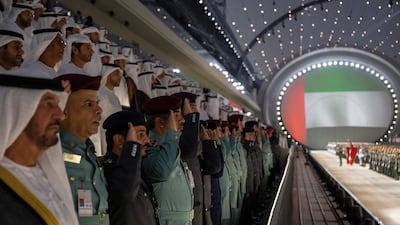
Members of the UAE Armed Forces stand for the national anthem. Mohamed Al Blooshi for the UAE Presidential Court -
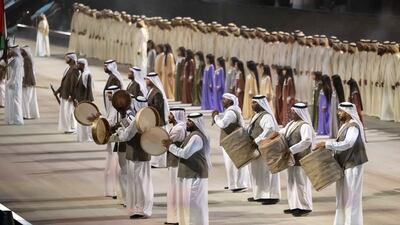
Musicians perform. Mohamed Al Blooshi for the UAE Presidential Court -
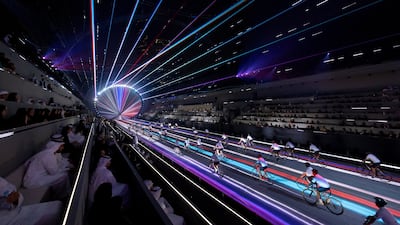
Cyclists participate in the official ceremony. Ryan Carter / UAE Presidential Court -

Young performers participate in the show. Mohamed Al Blooshi for the UAE Presidential Court -
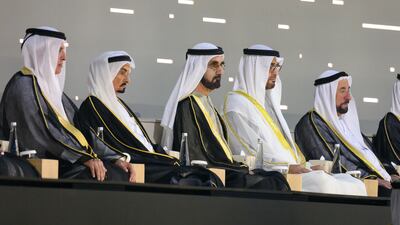
Pictured left to right: Sheikh Saud bin Saqr Al Qasimi, Sheikh Humaid bin Rashid Al Nuaimi, Sheikh Mohammed bin Rashid, President Sheikh Mohamed, Sheikh Dr Sultan bin Mohamed Al Qasimi, and Sheikh Hamad bin Mohamed Al Sharqi. Abdulla Al Neyadi / UAE Presidential Court -
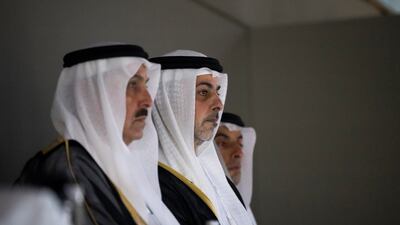
Saqr Ghobash, speaker of the Federal National Council, left, Sheikh Omar bin Zayed Al Nahyan, deputy chairman of the board of Zayed bin Sultan Al Nahyan Charitable and Humanitarian Foundation, centre, and Sheikh Khaled bin Zayed, chairman of the board of Zayed Higher Organisation for Humanitarian Care and Special Needs. Hamad Al Kaabi / UAE Presidential Court -

Guests and foreign Ambassadors watch the show. Mohamed Al Blooshi for the UAE Presidential Court -

Musicians perform. Ryan Carter / UAE Presidential Court -

President Sheikh Mohamed. Hamad Al Kaabi / UAE Presidential Court -

Performers participate in the 51st UAE National Day show. Mohamed Al Blooshi for the UAE Presidential Court -

Performers in the spotlight. Mohamed Al Blooshi for the UAE Presidential Court -

Performers participate. Abdulla Al Neyadi / UAE Presidential Court -

An image of the late Sheikh Khalifa, former president of the UAE, is projected during the show. Abdulla Al Neyadi / UAE Presidential Court -
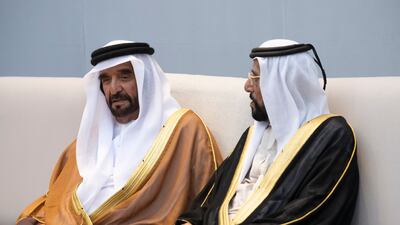
Sheikh Saif bin Mohamed, left, speaks with Sheikh Tahnoon bin Mohamed. Hamad Al Kaabi / UAE Presidential Court -
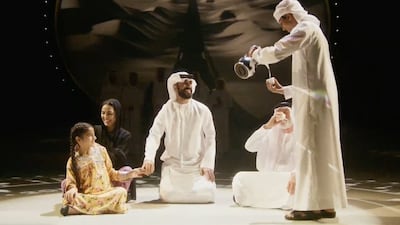
The 51st National Day show celebrated Emirati past and present, and looked to the future. National Day show -
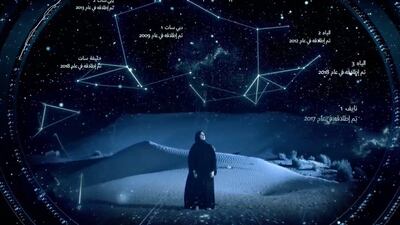
A enthralling show highlighted the UAE's significant successes in the space sector. National Day show -
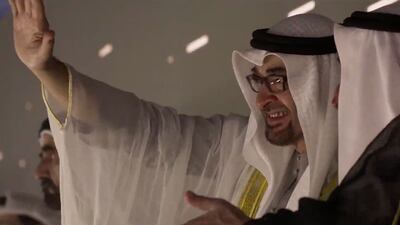
President Sheikh Mohamed. National Day show -

A spectacular time tunnel opened up to welcome an Etihad Rail passenger train. National Day show -
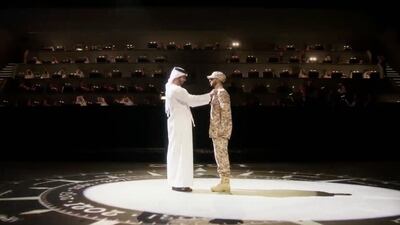
The lavish production paid homage to those serving their country. National Day show -
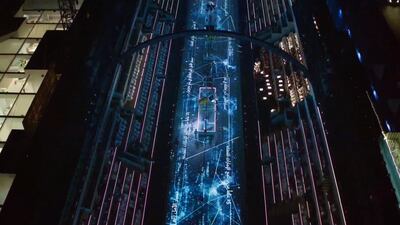
An overhead view of the impressive show venue. National Day show -
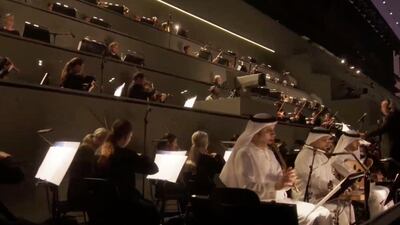
A team of talented musicians provided a stirring soundtrack. National Day show -
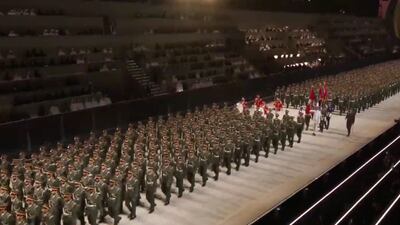
A magnificent military parade started the show in style. National Day show -
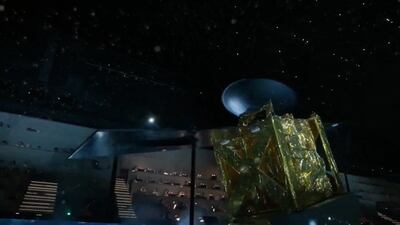
The UAE's achievements in space were celebrated. National Day show -
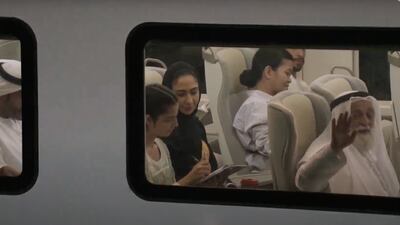
Passengers on board an Etihad Rail train which rolled onto the stage. National Day show


Running just short of an hour in length, the celebration of Emirati trailblazers played out on a stage themed as a time tunnel to demonstrate the nation’s progress since 1971.
At each end, 51 lights signified every year of its history.
Performance focused on an everyday Emirati, born in the UAE, as he aged and raised a family, with his growth signifying the progress of the UAE, until his 100th birthday in 2071.
Played out to a live performance from the Royal Philharmonic Orchestra and Emirates Choir, the story began with a rousing rendition of the national anthem.

Tribute was paid to the late President Sheikh Khalifa, who led the UAE from 2004 to 2022, with archive footage shown to celebrate his many achievements.
Particular focus was paid on his impact in areas such as the environment, sustainability, technology, the economy and education.
UAE climate action and food security efforts
The show highlighted the UAE’s rich biodiversity and its long maritime connections, with huge handmade models of fish, turtles, rays and sharks sweeping across the stage, illuminated to signify the surrounding seas.
A short speech by Noura Al Mansoori, a marine scientist and conservationist, raised the importance of protecting sea life and preserving biodiversity.
“Our sea is our culture, history and future,” she said. “Together we can keep it safe.”
About 10,000 mangrove saplings were part of the ceremony, to be planted at various sites to contribute to the UAE’s pledge to plant 100 million mangroves by 2030.
Mangroves act as the nation’s lungs, because they sequester four times the carbon of tropical rainforests and protect against sandstorms.
The show went on to describe how agriculture is adopting new methods, such as hydroponics and vertical farming, as the climatic conditions evolve.
More than 35,000 farms in the UAE now use these kinds of techniques to save water and space.
“Our land is fertile,” said Abdulla Al Kaabi, an agritech expert. “In it, we planted our dreams and from it, we reap its fruit.”
UAE's growing role in space race

The time tunnel then took viewers into the cosmos, with a nod to the UAE’s space programme.
Where once the nation’s forefathers relied upon the stars for navigation, modern-day Emiratis prepare to explore the outer reaches of space and embark on new journeys to the Moon and Mars.
The show heard from Fatema Al Hamili, an aerospace engineer who has dreamt of venturing into space since the age of seven.
In 2022, the UAE marked 25 years of its space programme.
Etihad Rail then took centre stage during the live performance, as the 400-seat passenger train that will connect all seven emirates on a 1,200km network rolled into view.
The carriage was accompanied by a stream of about 100 amateur and professional cyclists from around the country with illuminated wheels to signify the growing popularity of the sport.
Hundreds of kilometres of cycle tracks have opened up throughout the country in recent years.
Women formed a key foundation of the show, with Maryam Al Mazrouei, an Emirati who works in the solar industry, explaining the importance of generating more clean energy.
The UAE aims to generate 50 per cent of its electricity from carbon-free sources by 2050, and will host the Cop28 UN climate change conference in 2023.
Literacy was another passage of the performance, with the transfer of knowledge between generations celebrated via the Arabic Reading Challenge and Arab Literacy initiative that has led to an increase in those able to read from 53 per cent of the population in 1975 to 96 per cent today.
Flag-waving children then joined the celebration, with hundreds in a procession through the time tunnel, many of whom had their lives' aspirations beamed on to the stage in Arabic script.
The performance concluded with a vivid display of Al Ayyala dancing from a 200-strong troupe of Emirati performers, another nod to the nation’s cultural heritage.
Where to watch the show in person

Following a spectacular show beamed to homes across the nation, the public will have a chance to join the celebrations in person.
The National Day show will be performed before crowds at Abu Dhabi National Exhibition Centre from December 3 to 11.
Tickets for the nine shows ― which start at 6pm each day ― are available for Dh200 via the National Day website. Children under three can attend for free.

