Israel's President Isaac Herzog will attend the Abu Dhabi Space Debate. Bloomberg

Israeli president and Indian prime minister to participate in Abu Dhabi Space Debate


Sarwat Nasir
  • English
  • Arabic

Israeli President Isaac Herzog and Indian Prime Minister Narendra Modi will take part in a space conference in Abu Dhabi next month.

The Abu Dhabi Space Debate will take place on December 5 and 6 at the Adnoc Business Centre.

Mr Herzog will attend in person, while Mr Modi will make an address by video link.

The conference will bring together politicians with industry leaders in space, avionics and defence technologies.

Topics of discussion will include the geopolitics of space, the rise of the private sector in space exploration, the weaponisation of space assets, sustainability and the role of space systems in defence and intelligence.

Indian Prime Minister Narendra Modi will speak at the Abu Dhabi Space Debate. Reuters

Sarah Al Amiri, Minister of State for Public Education and Advanced Technology, and chairwoman of the UAE Space Agency, said that “at a time of unprecedented global challenges, this platform has a vital role to play in forging consensus, co-operation and development in this vital sector”.

“It has been an important goal for us as we approach the debate that the world’s emerging space nations are represented, as well as legacy players,” said Ms Al Amiri.

“To that end, we are delighted to be joined by representatives of the Romanian, Rwandan, Norwegian, Philippines and Portuguese space agencies, as well as global private sector pioneers.

“Some of the most exciting developments in the sector are now coming from these younger players and they are driving the expansion in global demand for access to space.”

Speakers will include strategists such as Dr George Friedman, founder of online publication Geopolitical Futures, and Dr Robin Geiss, director of the UN Institute for Disarmament Research.

There will be representatives from more than 30 countries, including Saudi Arabia, the US, India, the UK, Korea, France and Japan.

The private sector will also have a heavy participation, including Airbus, Northrop Grumman, Thales and Amazon.

2023 set to be UAE’s busiest year ever in space exploration - in pictures

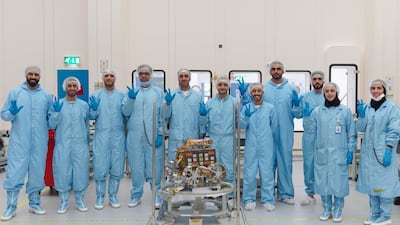
  • A team of Emirati engineers have developed the UAE's lunar mission. They are pictured with the Rashid rover at the Mohammed bin Rashid Space Centre. Photo: MBRSC
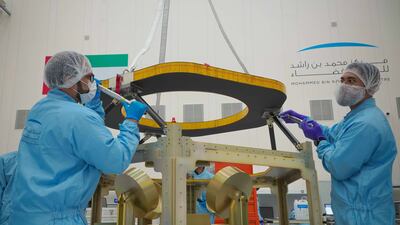
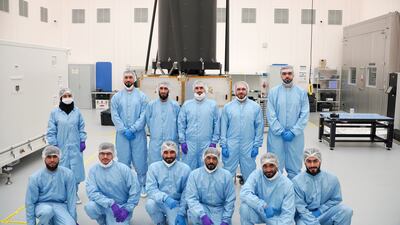
    A team of Emirati engineers have developed the UAE's lunar mission. They are pictured with the Rashid rover at the Mohammed bin Rashid Space Centre. Photo: MBRSC
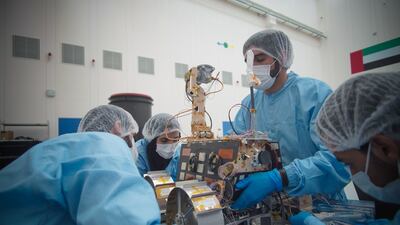
  • Emirati engineers carry the Rashid rover inside a clean room at the space centre. Photo: MBRSC
    Emirati engineers carry the Rashid rover inside a clean room at the space centre. Photo: MBRSC
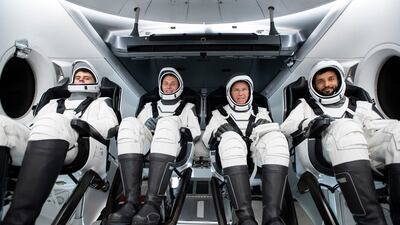
  • Emirati astronaut Sultan Al Neyadi, right, wears a SpaceX suit as he sits with fellow astronauts in a Dragon Crew Capsule during training for the Crew-6 mission next spring. Photo: Nasa / SpaceX
    Emirati astronaut Sultan Al Neyadi, right, wears a SpaceX suit as he sits with fellow astronauts in a Dragon Crew Capsule during training for the Crew-6 mission next spring. Photo: Nasa / SpaceX
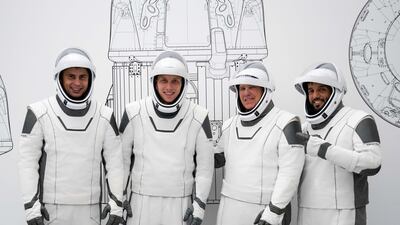
  • UAE astronaut Sultan Al Neyadi, right, in his SpaceX astronaut suit with fellow crew members, from left, Andrey Fedyaev, William Hoburg and Stephen Bowen. Photo: Nasa / SpaceX
    UAE astronaut Sultan Al Neyadi, right, in his SpaceX astronaut suit with fellow crew members, from left, Andrey Fedyaev, William Hoburg and Stephen Bowen. Photo: Nasa / SpaceX
  • The UAE's first two astronauts Hazza Al Mansouri and Sultan Al Neyadi after they graduated from Nasa's basic training programme. Photo: MBRSC
    The UAE's first two astronauts Hazza Al Mansouri and Sultan Al Neyadi after they graduated from Nasa's basic training programme. Photo: MBRSC
  • Engineers at the Mohammed Bin Rashid Space Centre work on the MBZ-Sat, the most advanced satellite in the region in the field of high-resolution imagery, which is due to be launched in 2023. Photo: Dubai Media Office
    Engineers at the Mohammed Bin Rashid Space Centre work on the MBZ-Sat, the most advanced satellite in the region in the field of high-resolution imagery, which is due to be launched in 2023. Photo: Dubai Media Office
  • Mohammed bin Rashid Space Centre engineers with the MBZ-Sat satellite. Photo: Dubai Media Office
    Mohammed bin Rashid Space Centre engineers with the MBZ-Sat satellite. Photo: Dubai Media Office
  • The PHI-Demo satellite developed at the space centre. Photo: MBRSC
    The PHI-Demo satellite developed at the space centre. Photo: MBRSC
In numbers

- Number of children under five will fall from 681 million in 2017 to 401m in 2100

- Over-80s will rise from 141m in 2017 to 866m in 2100

- Nigeria will become the world’s second most populous country with 791m by 2100, behind India

- China will fall dramatically from a peak of 2.4 billion in 2024 to 732 million by 2100

- an average of 2.1 children per woman is required to sustain population growth

The Gentlemen

Director: Guy Ritchie

Stars: Colin Farrell, Hugh Grant 

Three out of five stars

The five pillars of Islam

1. Fasting 

2. Prayer 

3. Hajj 

4. Shahada 

5. Zakat 

David Haye record

Total fights: 32
Wins: 28
Wins by KO: 26
Losses: 4

Mercer, the investment consulting arm of US services company Marsh & McLennan, expects its wealth division to at least double its assets under management (AUM) in the Middle East as wealth in the region continues to grow despite economic headwinds, a company official said.

Mercer Wealth, which globally has $160 billion in AUM, plans to boost its AUM in the region to $2-$3bn in the next 2-3 years from the present $1bn, said Yasir AbuShaban, a Dubai-based principal with Mercer Wealth.

Within the next two to three years, we are looking at reaching $2 to $3 billion as a conservative estimate and we do see an opportunity to do so,” said Mr AbuShaban.

Mercer does not directly make investments, but allocates clients’ money they have discretion to, to professional asset managers. They also provide advice to clients.

“We have buying power. We can negotiate on their (client’s) behalf with asset managers to provide them lower fees than they otherwise would have to get on their own,” he added.

Mercer Wealth’s clients include sovereign wealth funds, family offices, and insurance companies among others.

From its office in Dubai, Mercer also looks after Africa, India and Turkey, where they also see opportunity for growth.

Wealth creation in Middle East and Africa (MEA) grew 8.5 per cent to $8.1 trillion last year from $7.5tn in 2015, higher than last year’s global average of 6 per cent and the second-highest growth in a region after Asia-Pacific which grew 9.9 per cent, according to consultancy Boston Consulting Group (BCG). In the region, where wealth grew just 1.9 per cent in 2015 compared with 2014, a pickup in oil prices has helped in wealth generation.

BCG is forecasting MEA wealth will rise to $12tn by 2021, growing at an annual average of 8 per cent.

Drivers of wealth generation in the region will be split evenly between new wealth creation and growth of performance of existing assets, according to BCG.

Another general trend in the region is clients’ looking for a comprehensive approach to investing, according to Mr AbuShaban.

“Institutional investors or some of the families are seeing a slowdown in the available capital they have to invest and in that sense they are looking at optimizing the way they manage their portfolios and making sure they are not investing haphazardly and different parts of their investment are working together,” said Mr AbuShaban.

Some clients also have a higher appetite for risk, given the low interest-rate environment that does not provide enough yield for some institutional investors. These clients are keen to invest in illiquid assets, such as private equity and infrastructure.

“What we have seen is a desire for higher returns in what has been a low-return environment specifically in various fixed income or bonds,” he said.

“In this environment, we have seen a de facto increase in the risk that clients are taking in things like illiquid investments, private equity investments, infrastructure and private debt, those kind of investments were higher illiquidity results in incrementally higher returns.”

The Abu Dhabi Investment Authority, one of the largest sovereign wealth funds, said in its 2016 report that has gradually increased its exposure in direct private equity and private credit transactions, mainly in Asian markets and especially in China and India. The authority’s private equity department focused on structured equities owing to “their defensive characteristics.”

Islamic%20Architecture%3A%20A%20World%20History
%3Cp%3E%3Cstrong%3EAuthor%3A%3C%2Fstrong%3E%20Eric%20Broug%3Cbr%3E%3Cstrong%3EPublisher%3A%3C%2Fstrong%3E%20Thames%20%26amp%3B%20Hudson%3Cbr%3E%3Cstrong%3EPages%3A%3C%2Fstrong%3E%20336%3Cbr%3E%3Cstrong%3EAvailable%3A%3C%2Fstrong%3E%20September%3C%2Fp%3E%0A
Updated: November 03, 2022, 1:47 PM