


Billionaire philanthropist Bill Gates has backed the Middle East to be “part of the solution” to pressing environmental challenges facing the world.
The Microsoft co-founder praised the UAE for its ambitious efforts to achieve net zero emissions by 2050, highlighting the significant progress being made on the Barakah Nuclear Energy Plant.
He stressed the region's key role in the global climate change fight in a video address broadcast at the Countdown to Cop27 event on Thursday, held at the Jumeirah at Saadiyat Island Resort in Abu Dhabi.
And he called on major oil-producing nations to find cleaner ways to extract hydrogen to further protect the environment.
“This is how we achieve our goals here by … investing in new approaches; looking at hydrogen pathways … ahead of the Cop28 [in the UAE],” said Mr Gates, the founder of Breakthrough Energy, which aims to bolster innovation in sustainable energy to slash greenhouse gases.
US climate envoy John Kerry, Sheikha Shamma bint Sultan, founder and chief executive of the Alliances for Global Sustainability, and Mohamed Al Ramahi, chief executive of Masdar, were among the climate change champions to speak at the event hosted by First Abu Dhabi Bank.
Talks were held virtually and in person and centred on the UAE's bid to achieve net zero emissions by 2050.
Countdown to Cop 27 event — in pictures
-
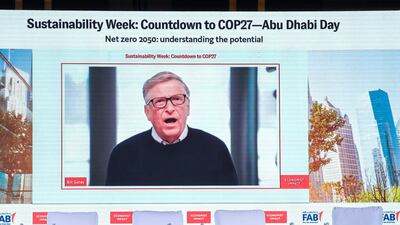
Bill Gates gives a video address. All photos: Victor Besa / The National -
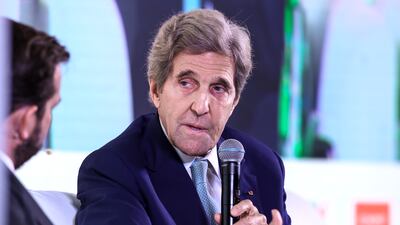
John Kerry, US Special Presidential Envoy for Climate, gives an interview. -
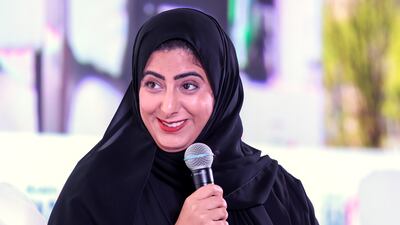
Sheikha Shamma bint Sultan, executive director of UAE Independent Climate Change Accelerators, speaks of forging partnerships for a circular economy on the path to net zero. -
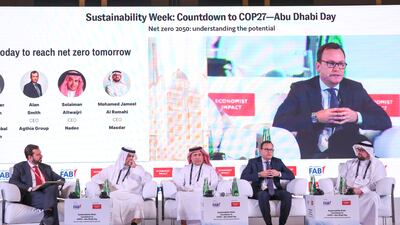
Keynote panel: Taking action today to reach net zero tomorrow. (L-R) Phillip Cornell, principal at Economist Impact, Abdulnasser Bin Kalban, CEO of Emirates Global Aluminium, Alan Smith, CEO of Agthia Group, Solaiman Abdulaziz Altwaijri, CEO of Saudi Arabia’s National Agricultural Development Company and Mohamed Jameel Al Ramahi, CEO of Masdar. -
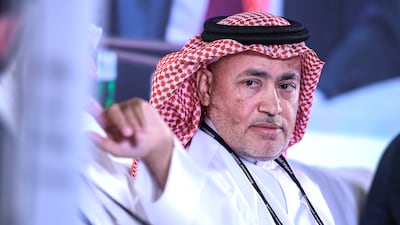
Solaiman Abdulaziz Altwaijri, CEO of Saudi Arabia’s National Agricultural Development Company. -
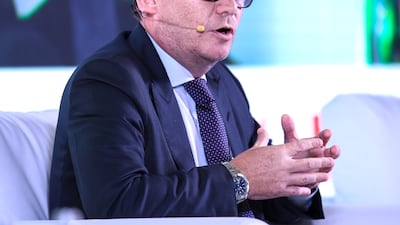
Alan Smith, CEO of Agthia Group, speaks on the theme of taking action today to reach net zero tomorrow. -
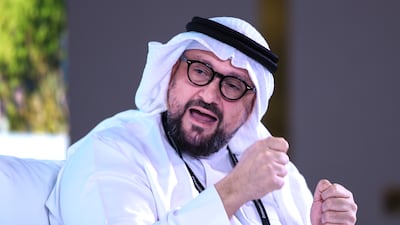
Mohamed Jameel Al Ramahi, CEO of Masdar, was also part of the keynote panel. -

The audience listens to a speech by Bill Gates.


Commending the UAE on its efforts, Mr Gates said the emirates was “very forward looking” in its ambitions, and was setting aggressive goals as part of its transition to cleaner energy sources.
“The nuclear reactors at the Barakah power plant that are operational and pumping electricity into the grid are examples of how the country is managing the transition thoughtfully,” he said.
Barakah is the region’s first operational multi-unit nuclear plant.
Its power generation will significantly reduce the country's use of gas-fired power stations to generate electricity.
In February 2020 and March 2021, FANR issued the operating licences for Unit 1 and Unit 2, respectively.
Commercial operations at Unit 1 began on April 18, 2021, and within a year, the energy produced by it prevented the release of more than 5 million tonnes of carbon emissions.
This is the quantity of emissions that would have been released if fossil fuels had instead been used to generate power.
It is the equivalent of more than “one million cars driven for a year”, the Emirates Nuclear Energy Corporation (Enec) said in April.
The four units of the Barakah plant will produce enough electricity to cover 25 per cent of the country’s energy needs. It is now halfway towards this goal.
Mr Gates said Middle East countries, particularly the UAE, Qatar and Saudi Arabia, can play an important role in embracing in technology to move away from traditional fossil fuels.
"The world at large underinvests in R&D [research and development] on these issues,” he said. “The Middle East can be part of the solution.”
He said the region could lead the way by developing new nuclear fusion reactors that are “inherently safe and whose economics are significantly lesser than what we have today.”
“It has incredible level of profitability on a per capita basis. In the end,” he said, it is human capital that decides how well off we are.
“Everything else is a bit ephemeral, besides human capital.”

