



Temperatures in the Middle East are set to rise by almost half a degree Celsius per decade, a study has forecast, with extreme weather events — including droughts and torrential rain — becoming more common.
While half a degree might not sound like a major shift, given that temperatures in the region can fluctuate by 10°C to 15°C per day, an IMF report in March said with 1.1°C of warming, half the global population faces water insecurity for at least one month per year.
Researchers in the latest study said the Eastern Mediterranean and the Middle East have in recent decades warmed significantly faster than other inhabited regions.
They also highlighted how greenhouse gas emissions in the region were “growing rapidly” and as a result were making a significant contribution to climate change.
Khalifa University
However, scientists said if major action was taken globally to reduce carbon emissions and combat other contributors to climate change, the rate at which temperatures continued to increase could be slowed.
“People's day-to-day life will be affected mostly by extreme heat and extreme rain. Both of them are expected to have an increased frequency and intensity,” said Dr Diana Francis of Khalifa University in Abu Dhabi, one of the authors of the study.
“It is time to act at all levels to mitigate and adapt to the changes happening to our climate and weather.”
Written by 21 scientists in the UAE, Saudi Arabia, Jordan, Israel and European countries, the paper reviews a host of previous studies to determine the overall situation regarding climate change in the Eastern Mediterranean and Middle East (EMME).
It said the increase in temperatures in the region up to now, of about 0.45 °C per decade, was projected to continue.
The EMME “is warming almost two times faster than the global average”, according to the paper, published in Reviews of Geophysics.
“For the remainder of the century, climate projections indicate an overall warming of up to 5°C and more being strongest in the summer”, the authors wrote.
There will be probably be, the researchers said, a “strongly increasing severity and duration” of extreme weather events such as heatwaves, droughts and dust storms. More torrential rain events able to cause flash floods are also predicted.
The paper said that “a strong increase in the intensity and duration of heatwaves” in the region was a “robust outcome” of all climate models and scenarios, with heat extremes having “the potential to become societally disruptive”.
Another of the study’s authors, Prof Jos Lelieveld of the Max Planck Institute for Chemistry in Mainz and The Cyprus Institute in Nicosia, indicated that there was little room for temperatures in the Middle East to increase further and for lives not to be affected.
“These temperatures are already at the verge of what’s acceptable or bearable for some people. It’s already life-threatening in some cases,” he said.
Reduce carbon emissions
While painting a potentially alarming picture, the paper also said if action was taken, the overall warming and the increase in the frequency of extreme weather events could be limited.
According to Prof Lelieveld, the Middle East should “take very much more seriously” the need to reduce carbon emissions by, for example, deploying more solar power, a sector the UAE has invested in more heavily than some of its neighbours.
As well as deploying renewables and nuclear power, Dr Francis, who heads Khalifa University’s environmental and geophysical sciences lab, said it was important to capture CO2 by planting trees and other greenery or by using carbon capture and storage technology.
“Developing public transportation via trains across the Middle East should be a high priority as well, as this will help to limit emissions from both the air and road traffic sectors,” Dr Francis said.
In addition to CO2, emissions of other greenhouse gases, especially methane, must be reduced, according to Dr Francis.
Bob Ward, policy and communications director at the Grantham Research Institute on Climate Change and the Environment, part of the London School of Economics, which was not connected to the new study, said preventing deforestation should be an additional priority globally.
“Trees and forests soak up CO2 and help us deal with the CO2 we’re pumping into the atmosphere,” he said.
"When we chop down forests we’re making that more difficult. We must stop and replant with trees."

Limiting climate change
While mitigation — efforts to limit climate change — are regarded by scientists as a priority, Prof Lelieveld said there was also a need for the region to adapt to the coming changes.
“They should get ready for life-threatening or societal impact weather extremes, they should adapt the cities,” he said.
“Simple measures will be possible. For example, making the buildings more resilient to heat extremes and making them more reflective.”
While emphasising the importance of action to combat climate change, Dr Francis indicated there were no quick fixes.
“It should be clear to everyone that what we are experiencing now is the price of what was emitted decades ago and that all efforts we do now will pay off decades later,” she said.
An International Monetary Fund report in March said the Middle East and Central Asia face dire economic and financial consequences if nothing is done to address the worsening climate crisis.
According to the Feeling the Heat: Adapting to Climate Change in the Middle East and Central Asia report, climate disasters in the Middle East and Central Asia this century have so far injured and displaced 7 million people, caused more than 2,600 deaths and resulted in $2 billion in damage in an average year.
To address the problem, the world needs to cut global emissions by one half by 2030, the IMF said.
"The UAE has led regional efforts with its pledge to invest more than $160 billion in renewables to achieve net zero carbon emissions by 2050,” said IMF’s managing director, Kristalina Georgieva.
Inside Dubai's vast solar project leading clean energy drive
-
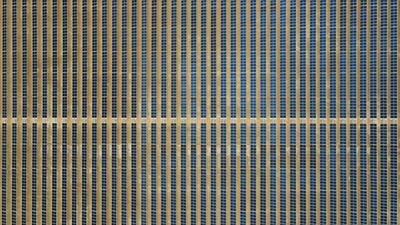
An aerial view of Mohammed bin Rashid Solar Park in Dubai in January 2022. Solar is essential to the UAE's new energy mix. All photos by Pawan Singh / The National -
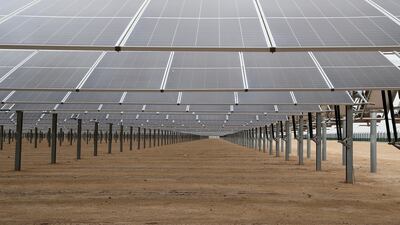
The fifth phase of a clean energy project at the Mohammed bin Rashid Solar Park will further help reduce carbon emissions. -

An aerial view of the Solar Park in the Dubai desert. -
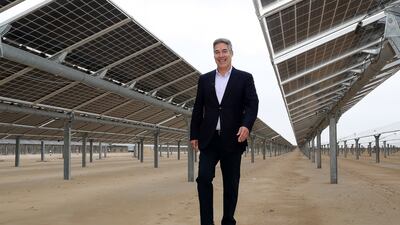
Marco Garcia, chief commercial officer of Nextracker, a US company which has provided photovoltaic technology used in the project. -
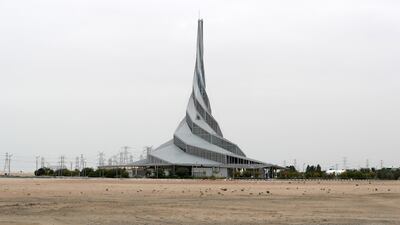
The Innovation Centre at the MBR Solar Park in Dubai, where machine learning is being utilised to track direct sunlight to maximise efficient energy capture, storage and transmission. -

The solar powered panels follow the path of the sun to help the emirate reach its clean energy transition goals. -
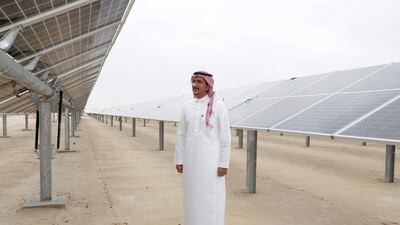
Omar Al Hassan, chief executive of Shuaa Energy 3, the company operating the scheme, says the vast project will ultimately create clean energy to power more than 250,000 houses in Dubai. -
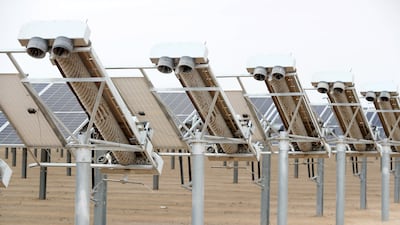
Robotic cleaning systems are installed on the solar panels. -
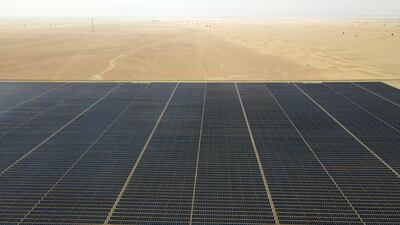
More than 2.5 million photovoltaic modules have been fitted during phase 5 of the project.



