

The UAE will develop a series of highly accurate satellites to improve forecasting and monitor climate change.
The Dh3 billion National Space Fund, announced earlier this year, will pave the way for the research and construction of the 'Sirb' project.
The constellation of Synthetic Aperture Radar (SAR) satellites can create highly detailed radar images of land use, ice cover and surface changes, with a wide range of scientific and commercial applications.
Scientists can use the data to trace oil spills, track maritime vessels and monitor crop yields, a government statement said.
UAE Space Agency
President Sheikh Mohamed and Sheikh Mohammed bin Rashid, Vice President and Ruler of Dubai, announced the project on Sunday.
The President said the fund will “expand our growing capabilities in this vital sector while accelerating innovation in environmental sustainability”.
Sheikh Mohammed bin Rashid said the satellites would send data and imagery “with an accuracy of one metre” by day and night.
Sarah Al Amiri, Minister of State for Public Education and Advanced Technology and Chairwoman of the UAE Space Agency, said the fund will lead to new jobs, support research and create new leaders in technology.
"A long-term plan and programme for the development of the Emirates’ space sector is in place to create economic opportunities, new jobs and help to fund global partnerships and new leaders in technology, space sciences and engineering here in the UAE," the minister said.
"We are planning for a bright future filled with new challenges and openings for our young people – and this fund is precisely targeted at building opportunities for international co-operation in building Emirati enterprises."
The fund will encourage partnerships between international and local enterprises, providing them with incentives as a part of the UAE Space Agency’s Space Economic Zones Programme, a statement said.
Six-year timeline
The six-year satellite development programme will see the first satellite launch in three years, a much faster time to launch than was possible using traditional earth observation satellite design principles.
The Sirb satellites - Sirb is the Arabic term for a flock of birds - will be built through a number of partnerships between the Emirati public and private sector together with international players.
Submissions will be opened for a range of development and construction opportunities as part of the constellation development, launch, operation and commercialisation plan.
The statement said the project provides private sector partners the opportunity to bridge the gap between the Emirates Mars Mission and the upcoming Beyond Mars Mission to Venus and the Main Asteroid Belt, due to launch in 2028.
Ms Al Amiri said: "SAR technology leapfrogs traditional imaging satellites, providing more powerful imaging using X-band radar technologies, allowing us to continue observations day and night, through fog and cloud cover as well as combining observations to create big data pictures simply not possible through conventional imaging.
"These small-scale satellites are more agile, faster to develop and more powerful – an indicator of the types of new generation systems that technology is now making possible.”
James Webb satellite sends back images of deep space: in pictures
-
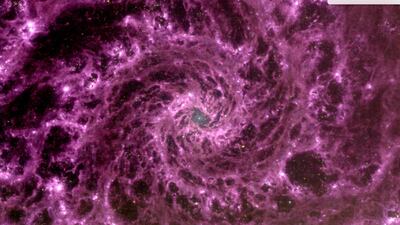
A colour composite image of the Messier 74 galaxy. Photo: Gabriel Brammer (Cosmic Dawn Center, Niels Bohr Institute, University of Copenhagen) / James Webb Space Telescope -
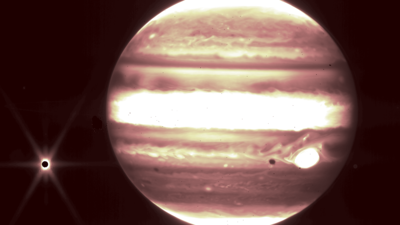
Jupiter and its moon Europa, left, are seen through the James Webb Space Telescope. Photo: Nasa -
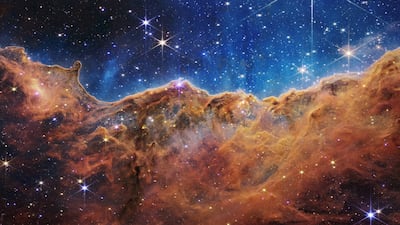
Captured in infrared light by Nasa's new James Webb Space Telescope, this image reveals areas of star birth in Carina Nebula. All photos: James Webb Space Telescope -
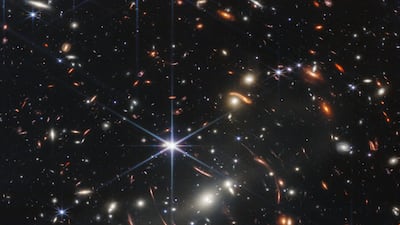
Known as Webb's First Deep Field, the picture showcases a galaxy cluster called SMACS 0723 as it appeared 4.6 billion years ago. The image was revealed by US President Joe Biden on July 11 during an event at the White House. -
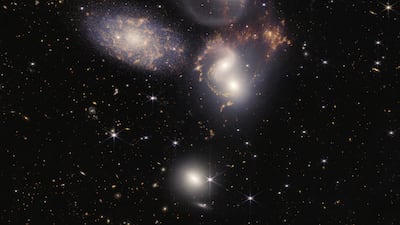
An image of Stephan's Quintet, an area in space with a group of five galaxies. -
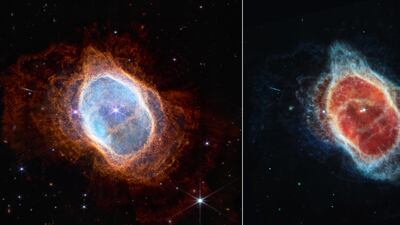
Side-by-side comparison shows observations of the Southern Ring Nebula in near-infrared light (left) and mid-infrared light. -
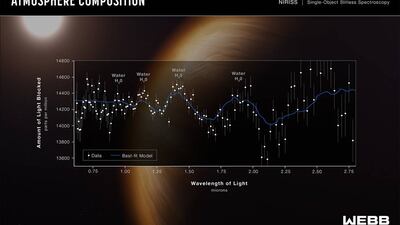
The telescope has captured the distinct signature of water, along with evidence for clouds and haze, in the atmosphere surrounding a hot, puffy gas giant planet orbiting a distant Sun-like star, called WASP-96 b. Photo: James Webb Space Telescope



