
Police in Dubai gave their social media followers a hint of what the future of patrol cars might look like in a video shared on Facebook.
The five-minute, story-led video, released during the inaugural World Police Summit, tracks the evolution of Dubai Police patrol vehicles throughout its 66-year history.
Starting in 1956, the story begins with CB radio communication between Bur Dubai patrol and Naif police station reporting "blue light sightings" – referring to the police car's flashing lights.
In the ensuing pursuits, each police patrol car is overtaken by a newer one, starting with a Land Rover Defender being outstripped by a Mercedes-Benz 240 in 1978.
The number of vehicles increases until the entire supercar fleet is involved in the chase.
Dubai Police has 35 supercars, which are often seen at tourist areas in the emirate and national events such as the Dubai Marathon and the UAE cycle tour, as well as various parades and celebrations.
-
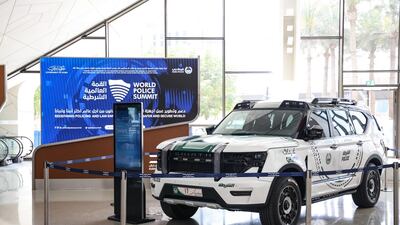
Dubai Police will welcome 400 smart patrol cars over the next five years. All photos: Dubai Police -

The cars will help to monitor Dubai's roads. -
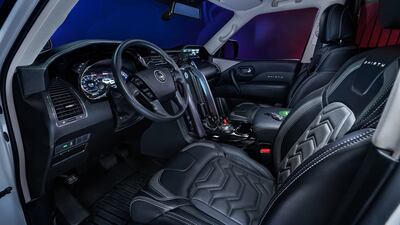
They are equipped with the very latest technology and equipment. -
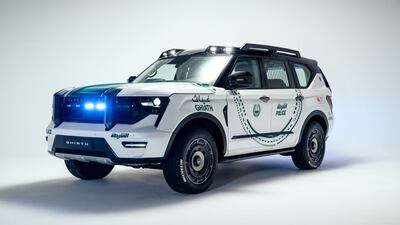
The smart cars will communicate with the police's control and command room to help keep the city safer.


Public engagement is the reason Dubai Police wants to expand its garage of luxury cars.
The video also shows the latest technology that Dubai Police has at its disposal, including facial recognition and use of drones.
The force's latest addition to its fleet – the Dh196 million ($53.3m) Ghiath smart patrol vehicle – is featured towards the end of the video.
The force recently announced plans to add 400 Ghiath vehicles to its fleet.
Produced by Emirati carmaker W Motors, the Ghiath is one of the first cars to be fully manufactured in the UAE.
The expansion of the fleet will include unmanned vehicles, rapid intervention vehicles, rescue vehicles, electric vehicles and bicycles.
In scenes reminiscent of the film Back To The Future, the video concludes with a flying police car, decked out in Dubai Police livery, landing in the middle of a circle of patrol vehicles.
Dubai police unveils AI patrol bots - in pictures
-
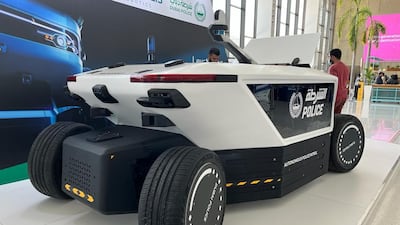
The M01 at the World Police Summit, which brings together law enforcement officers, police departments and organisations from more than 50 countries. All photos: Salam Al Amir / The National -
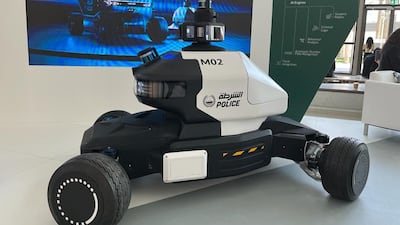
The M02 is buggy-like and can drive on narrow roads. -
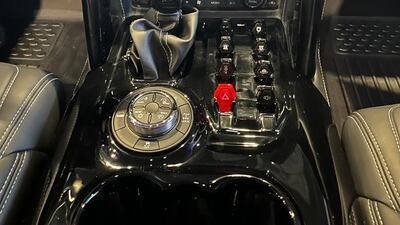
The Dubai-built police vehicle Giath is custom made and equipped with artificial-intelligence systems. -
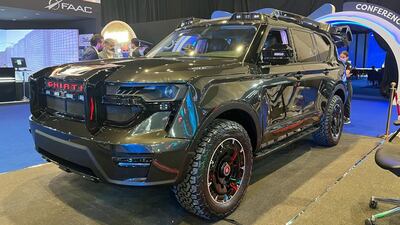
The Giath is on display at the inaugural World Police Summit in Dubai. -
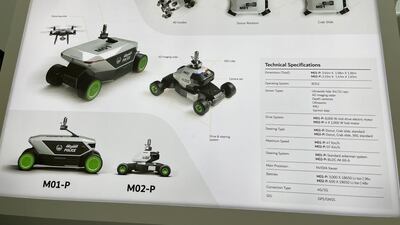
The next generation of patrol cars at the World Police Summit. -
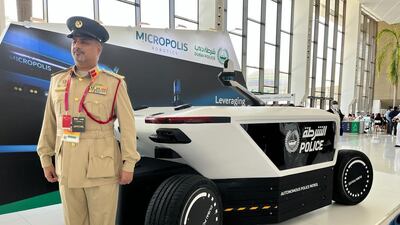
The M01 will be able to drive on all roads. -
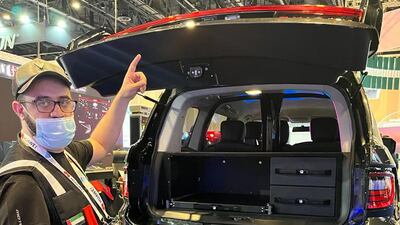
The Giath at the World Police Summit at Expo 2020 Dubai.



