


Sending humans to Mars remains unlikely until scientists work out how to protect crew against deadly radiation, a space medicine doctor has said.
Dr Ashok Narayanamoorthi was speaking to The National on the sidelines of the final day of the Dubai Health Forum at the World Trade Centre on Thursday.
Billionaire Elon Musk hopes to send the first humans to the Red Planet in 2026, but Dr Narayanamoorthi said there were still many health hazards to overcome.
He said there needs to be technology on spacecraft and spacesuits that prevent radiation from harming humans during the long journey to the Red Planet and after landing.
“The main hindrance is the radiation — that's why we have not gone to other planetary bodies,” he said.
“There have been a lot of studies here in simulating those neurons, but we still have not achieved key indicators.
“There are different aspects that are being looked at, for example, if we should use certain medications to make us radio-resistant or we need to shield our environment.”

Nasa is hoping to send humans to Mars in the future through its Artemis programme, which aims to build a sustainable human presence on the Moon, so astronauts can eventually travel to Mars from there.
Meanwhile, China has plans to send humans to the Red Planet in 2033. It achieved an un-crewed landing on Mars last year for the first time.
Mr Musk’s SpaceX company is building the Starship, the world’s largest rocket, to eventually take humans on deep space missions, especially Mars.
However, there are concerns about whether the rocket would be able to withstand secondary radiation. This is caused by primary radiation and may be in the form of electromagnetic waves or moving particles.
While humans have survived short-durations trips to the Moon, travelling to Mars would require shielding because of the harmful levels of radiation.
There are many health risks involved if humans are exposed to acute radiation, including from cancers and damage to central nervous system, which could prove fatal.
“Secondary radiation is the problem, which comes from the primary radiation. It bombards the space capsule or your habitat,” Dr Narayanamoorthi said.
“It enters through with secondary harmful radiation, so that’s not good. And, the protective clothing that is available so far is very bulky — it can't be easily used for daily use.”
Dr Narayanamoorthi said that it is also unclear what kind of psychological impact an astronaut crew would face during their nine-month trip to Mars, when they would be isolated in deep space with each other and away from their loved ones.
Field tests on Earth called analogue missions, which simulate space journeys, have also been taking place, but Dr Narayanamoorthi said it was “too difficult” to recreate all of the risk factors.
“They are confined a very small environment, how are they going to react to it psychologically and socially? If it’s a Mars mission, it’s going to last for two to three years,” he said.
“We need a lot of studies to be done if it’s a long-duration mission, and we cannot create all of the risk factors involved in analogue missions.”
Saleh Al Ameri is an Emirati participating in an analogue mission in Russia. He has been living in near-isolation with an international crew of six people inside a closed environment that simulates a journey to the Moon and Mars.
Scientists are monitoring their behaviour around the clock, and will study the psychological impact they faced while living inside the facility.
Meet UAE's first analogue astronaut — in pictures
-
Saleh Al Ameri lived inside a remote Russian plant, in near-isolation, as part of an eight-month spaceflight research project. Locked away on November 4, he conducted several experiments. All photos: Mohammed bin Rashid Space Centre -
Mr Al Ameri is part of the Sirius 20/21 project that measures the psychological and physiological effect on humans living in the extreme environments that astronauts face during space travel. -
The international crew of six entered the NEK experimental complex in Moscow on November 4, where scientists are observing their behaviour using cameras installed throughout the centre. -
Mr Al Ameri inside the centre in Moscow. -
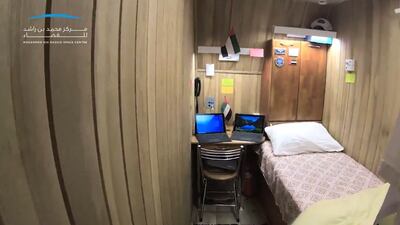
Mr Al Ameri's room in the complex. Each participant has a similar small space for privacy, while a small living room allows them to socialise and watch television. Each bedroom has a bed, desk and cupboard. -
Aballa Al Hammadi, the back-up Emirati for the project, checks in on his colleague Mr Al Ameri, who is inside the complex. -
Mr Al Ameri, 31, is the first Arab to be part of an analogue mission – field tests that simulate lengthy space journeys. These are crucial to understanding how space flight affects the body and mind, as governments and private companies work towards landing people on the Moon and Mars. -
He celebrated the UAE's Golden Jubilee on December 2 inside the centre. -
His colleagues celebrated the UAE's Golden Jubilee with him. -
Crew members simulated a space journey to the Moon as part one of the experiments. They docked their 'spacecraft' with an interplanetary station and then transferred to a transport ship that will take them to the Moon.


