• Patrick Stevens and Nicholas Bruylants, founders of Dubai company Terraplus, with a palm tree root system. Antonie Robertson / The National
    Patrick Stevens and Nicholas Bruylants, founders of Dubai company Terraplus, with a palm tree root system. Antonie Robertson / The National
  • Terraplus is using underground technology to water palm trees, which it says could save up to about a trillion litres of water each year in the UAE if widely adopted. Antonie Robertson / The National
    Terraplus is using underground technology to water palm trees, which it says could save up to about a trillion litres of water each year in the UAE if widely adopted. Antonie Robertson / The National
  • A famer walks among date palm trees at a Sharjah farm that is using the company's underground watering system. Antonie Robertson / The National
    A famer walks among date palm trees at a Sharjah farm that is using the company's underground watering system. Antonie Robertson / The National
  • Agronomist Khalil Ur Rahman inspects an above-ground component of the Terraplus system. Antonie Robertson / The National
    Agronomist Khalil Ur Rahman inspects an above-ground component of the Terraplus system. Antonie Robertson / The National
  • The Terraplus system saves between 40,000 and 50,000 litres of water per date palm every year, compared with traditional systems. Antonie Robertson / The National
    The Terraplus system saves between 40,000 and 50,000 litres of water per date palm every year, compared with traditional systems. Antonie Robertson / The National

Dubai company producing basmati rice that is far cheaper than imports


Nick Webster
  • English
  • Arabic

To grow rice in the barren desert landscape is an achievement in itself, but to turn seedlings into large quantities of the daily staple using minimal water is a breakthrough that could change the face of farming altogether.

That is the progress made by the team at Terraplus Solutions, a UAE-Belgian partnership of entrepreneurs and economists seeking to solve the riddle of water shortages and food security.

The issue threatens to become a crisis in the years ahead as climate change strips the land of groundwater reserves in arid parts of the world.

By using an innovative underground irrigation system delivering water direct to the roots, Sharjah farmers produced rice seedlings using just 0.9 litres for every kilogram of basmati rice.

Rice can be produced easily with unlimited water, but that is not a sustainable solution here in the UAE - the challenge was how to make it profitable for market distribution
Nicolas Bruylants,
agritech entrepeneur

It is a huge saving compared with the usual 200 litres of clean water required to produce the same amount under traditional paddy field methods, where ploughed fields are fertilised and flooded.

Patrick Stevens, managing director and co-founder of Terraplus Solutions, is an economist who entered the area of water conservation after working on a mineral plant in Turkey.

“This solution is the most economic way of farming that can save water and money,” he said. “Feasibility in terms of water was the big question, so we completely changed the system of cultivation.”

$550 per tonne versus $800-plus for imports

The average subsidised price for an imported tonne of rice in the UAE is approximately $817 and the country has imported more than 900,000 tonnes of rice over the past 12 months.

Terraplus says it can produce rice locally for $550 per tonne.

“We keep the soil moist around the roots, in the morning and evening,” said Mr Stevens. “That way we reduce the typical use of water from 6,000 litres per kilo down to 1,200 litres.

“I believe we can do it with less than 600 litres per kg; that makes it absolutely viable to grow over here.”

Similar techniques have already been used across the UAE to relieve the strain on groundwater supplies in the farming of date palms alongside Al Nakhli, a government agricultural agency.

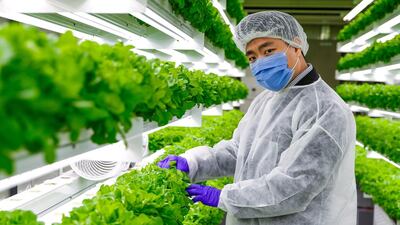
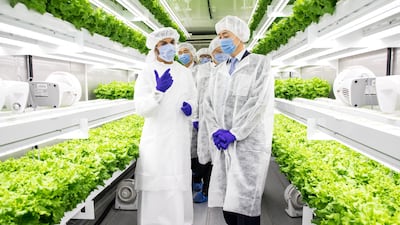
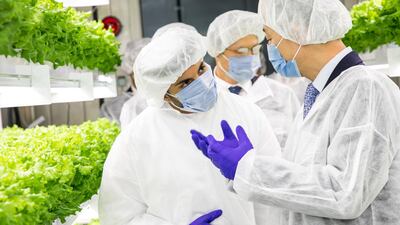
  • Sean Lee, director of Smart Acres, at the hydroponics farm at the Armed Forces Officers Club, Abu Dhabi, which produces lettuce and leafy greens for sale in UAE supermarkets. Victor Besa / The National
    Sean Lee, director of Smart Acres, at the hydroponics farm at the Armed Forces Officers Club, Abu Dhabi, which produces lettuce and leafy greens for sale in UAE supermarkets. Victor Besa / The National
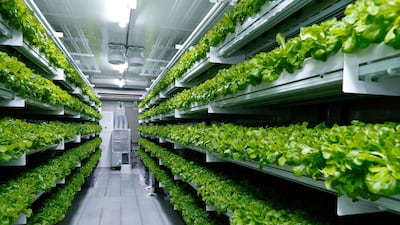
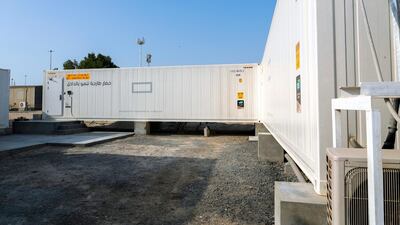
  • Lettuce is grown in converted shipping containers. Victor Besa / The National
    Lettuce is grown in converted shipping containers. Victor Besa / The National
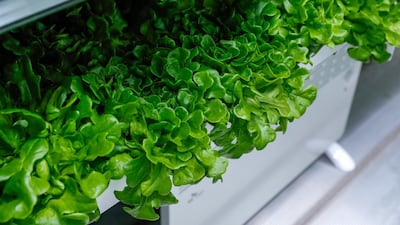
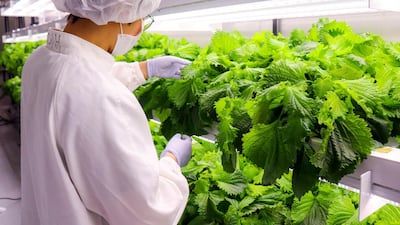
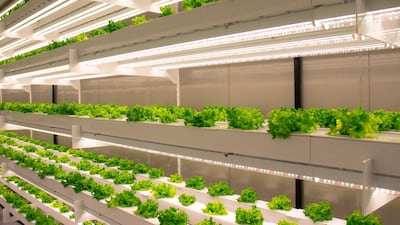
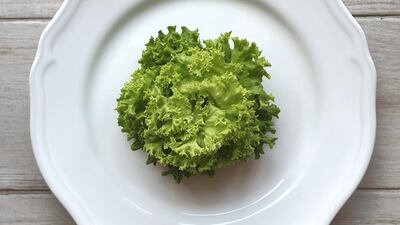
  • The produce grown using hydroponics. Victor Besa / The National
    The produce grown using hydroponics. Victor Besa / The National
  • Sean Lee, director of the Smart Acres hydroponics farm. We want it to be commercially viable, he said.Victor Besa / The National
    Sean Lee, director of the Smart Acres hydroponics farm. We want it to be commercially viable, he said.Victor Besa / The National
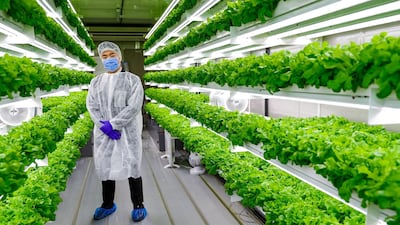
  • The farm is spread across eight converted shipping containers. Victor Besa / The National
    The farm is spread across eight converted shipping containers. Victor Besa / The National
  • The UAE’s newest vertical farm, Smart Acres, has started operation. All photos courtesy Smart Acres
    The UAE’s newest vertical farm, Smart Acres, has started operation. All photos courtesy Smart Acres
  • The company collaborated with n.thing, a Korean-based technology company, to design the farm modules.
    The company collaborated with n.thing, a Korean-based technology company, to design the farm modules.
  • Smart Acres grows fresh produce for UAE residents and businesses.
    Smart Acres grows fresh produce for UAE residents and businesses.
  • Smart Acres says its system not only consumes less resources but generates ultra-high quality crops.
    Smart Acres says its system not only consumes less resources but generates ultra-high quality crops.
  • Smart Acres was founded to improve food security in the UAE and develop the country’s farming capabilities.
    Smart Acres was founded to improve food security in the UAE and develop the country’s farming capabilities.
  • Smart Acres is in talks with hypermarkets and government entities to expand their distribution of produce across the country.
    Smart Acres is in talks with hypermarkets and government entities to expand their distribution of produce across the country.

Trials took place at a 450-square-metre patch of land in a farm at Dhaid in Sharjah in 2020.

A second crop planted in June yielded a healthy harvest of rice in October using substantially less water than a traditional paddy field.

After the farmers factored in costs of labour, seeds, fertiliser and water, the project turned out slightly cheaper and more sustainable than importing rice.

Nicolas Bruylants, a food and beverage entrepreneur, said it shows there are better ways of irrigating crops to support food security.

“For most farms in the UAE water is still accessible from the ground for free, but how those resources are being used is not really monitored,” he said.

“Terraplus is there to find solutions to reduce the amount of water used in agriculture to preserve this resource in the UAE.

“Rice can produced easily with unlimited water, but that is not a sustainable solution here in the UAE.

“The challenge was how to make it profitable for market distribution.”

The team at Terraplus are preparing more trials to see if the same techniques and T+ irrigation system could be used to grow quinoa and other seed crops.

Testing has also taken place in Jordan and Iraq, and Egypt is also likely to be a destination in the future.

A similar joint project between UAE University scientists and South Korean experts took place in 2020, where 763kg of rice was grown in a 1,000-square-metre plot of the Sharjah desert.

Food demand to place huge pressure on farming

The global population is expected to reach around 10 billion by 2050, with food demand predicted to rise by 60 per cent as a result.

Alternative and sustainable farming methods are vital if that is to be maintained — particularly in regions of water scarcity.

Vertical farming in huge warehouses without sunlight and soil is one solution, producing highly consumed vegetables and leafy greens with 40 per cent less power, and 95 per cent less water.

Agritech firm AeroFarms is behind a vast 8,200-square-metre research and development centre in Abu Dhabi — the largest in the world — which aims to advance sustainable agriculture in arid climates.

In the UAE, the food and beverage trade has increased steadily to reach more than $20 billion in the first nine months of 2021, with almost 90 per cent of food products imported.

Hassan Al Hashemi, vice president of international relations at Dubai Chambers, home to 300,000 private sector members, told a recent food security forum at Dubai Expo 2020 the country must shift towards more self-sufficiency.

“Our government has underlined the importance of food security as a key element of comprehensive development,” he said.

“It has formulated policies aimed at facilitating sustainable food production by utilising the latest in technology and innovative approaches.

“As global food suppliers become increasingly stretched by rising demand, the focus has shifted from capacity to achieving greater efficiency and self-sufficiency in order to increase local production and reduce environmental impact.”


Porsche Macan T: The Specs

Engine: 2.0-litre 4-cyl turbo 

Power: 265hp from 5,000-6,500rpm 

Torque: 400Nm from 1,800-4,500rpm 

Transmission: 7-speed dual-clutch auto 

Speed: 0-100kph in 6.2sec 

Top speed: 232kph 

Fuel consumption: 10.7L/100km 

On sale: May or June 

Price: From Dh259,900  

Mercer, the investment consulting arm of US services company Marsh & McLennan, expects its wealth division to at least double its assets under management (AUM) in the Middle East as wealth in the region continues to grow despite economic headwinds, a company official said.

Mercer Wealth, which globally has $160 billion in AUM, plans to boost its AUM in the region to $2-$3bn in the next 2-3 years from the present $1bn, said Yasir AbuShaban, a Dubai-based principal with Mercer Wealth.

Within the next two to three years, we are looking at reaching $2 to $3 billion as a conservative estimate and we do see an opportunity to do so,” said Mr AbuShaban.

Mercer does not directly make investments, but allocates clients’ money they have discretion to, to professional asset managers. They also provide advice to clients.

“We have buying power. We can negotiate on their (client’s) behalf with asset managers to provide them lower fees than they otherwise would have to get on their own,” he added.

Mercer Wealth’s clients include sovereign wealth funds, family offices, and insurance companies among others.

From its office in Dubai, Mercer also looks after Africa, India and Turkey, where they also see opportunity for growth.

Wealth creation in Middle East and Africa (MEA) grew 8.5 per cent to $8.1 trillion last year from $7.5tn in 2015, higher than last year’s global average of 6 per cent and the second-highest growth in a region after Asia-Pacific which grew 9.9 per cent, according to consultancy Boston Consulting Group (BCG). In the region, where wealth grew just 1.9 per cent in 2015 compared with 2014, a pickup in oil prices has helped in wealth generation.

BCG is forecasting MEA wealth will rise to $12tn by 2021, growing at an annual average of 8 per cent.

Drivers of wealth generation in the region will be split evenly between new wealth creation and growth of performance of existing assets, according to BCG.

Another general trend in the region is clients’ looking for a comprehensive approach to investing, according to Mr AbuShaban.

“Institutional investors or some of the families are seeing a slowdown in the available capital they have to invest and in that sense they are looking at optimizing the way they manage their portfolios and making sure they are not investing haphazardly and different parts of their investment are working together,” said Mr AbuShaban.

Some clients also have a higher appetite for risk, given the low interest-rate environment that does not provide enough yield for some institutional investors. These clients are keen to invest in illiquid assets, such as private equity and infrastructure.

“What we have seen is a desire for higher returns in what has been a low-return environment specifically in various fixed income or bonds,” he said.

“In this environment, we have seen a de facto increase in the risk that clients are taking in things like illiquid investments, private equity investments, infrastructure and private debt, those kind of investments were higher illiquidity results in incrementally higher returns.”

The Abu Dhabi Investment Authority, one of the largest sovereign wealth funds, said in its 2016 report that has gradually increased its exposure in direct private equity and private credit transactions, mainly in Asian markets and especially in China and India. The authority’s private equity department focused on structured equities owing to “their defensive characteristics.”

Our legal advisor

Ahmad El Sayed is Senior Associate at Charles Russell Speechlys, a law firm headquartered in London with offices in the UK, Europe, the Middle East and Hong Kong.

Experience: Commercial litigator who has assisted clients with overseas judgments before UAE courts. His specialties are cases related to banking, real estate, shareholder disputes, company liquidations and criminal matters as well as employment related litigation. 

Education: Sagesse University, Beirut, Lebanon, in 2005.

Western Region Asia Cup T20 Qualifier

Sun Feb 23 – Thu Feb 27, Al Amerat, Oman

The two finalists advance to the Asia qualifier in Malaysia in August


Group A

Bahrain, Maldives, Oman, Qatar


Group B

UAE, Iran, Kuwait, Saudi Arabia

Traits of Chinese zodiac animals

Tiger:independent, successful, volatile
Rat:witty, creative, charming
Ox:diligent, perseverent, conservative
Rabbit:gracious, considerate, sensitive
Dragon:prosperous, brave, rash
Snake:calm, thoughtful, stubborn
Horse:faithful, energetic, carefree
Sheep:easy-going, peacemaker, curious
Monkey:family-orientated, clever, playful
Rooster:honest, confident, pompous
Dog:loyal, kind, perfectionist
Boar:loving, tolerant, indulgent   

Updated: February 26, 2022, 4:26 AM