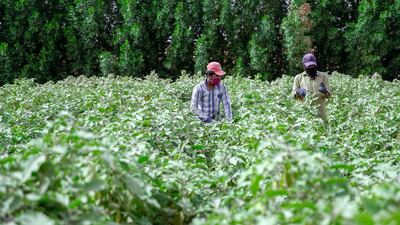
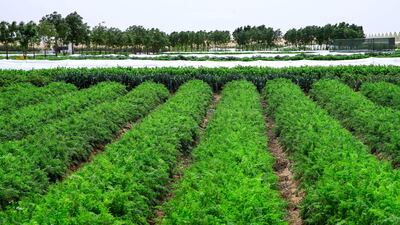
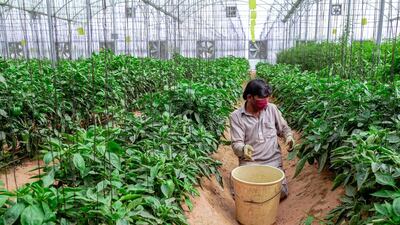
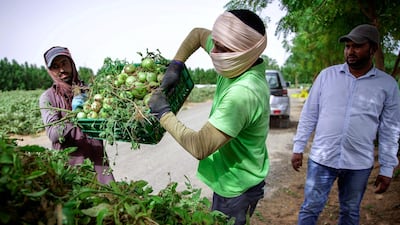
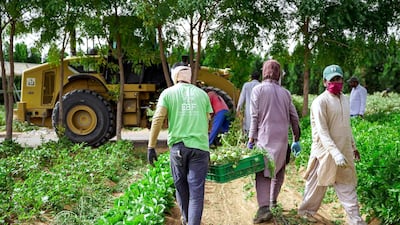
Rice is a demanding crop to grow. It typically requires specific conditions and flooded paddies but a group of scientists in the UAE are learning to turn the dry deserts of Sharjah into land capable of nurturing this global staple.
It is hoped the joint project between UAE University scientists and South Korean experts could lead the way for similar initiatives that will reduce the country's reliance on imported food.
The coronavirus pandemic has forced some rice growing nations to restrict the amount of produce they export.
If successful on a large scale, this groundbreaking project has the potential to shape the future of agriculture as it can be replicated
To counter the growing food security threat, local scientists are using the latest technology to grow 763 kilograms of rice in a 1,000 square metre plot of desert.
Dr Thani Al Zeyoudi, Minister of Climate Change and Environment, said the impressive results could change agriculture across the arid region.
“The innovative venture is the first of its kind in the Middle East,” he said.
“If successful on a large scale, this groundbreaking project has the potential to shape the future of agriculture as it can be replicated.
"Rice is one of the most important foods that is consumed on a daily basis in this area.
“We are focusing on driving innovation and exploring agritech in growing the crops that are in high demand.”
After extensive testing, experts selected Asemi (Japonica) and FL478 (Indica) rice varieties to grow because of their ability to tolerate heat, salinity and poor soil conditions.
Seeds were sowed in November last year and harvested in three stages between May 5 and May 30.
The crops had a growing cycle of 180 days and were watered via an underground drip irrigation system to reduce cost and wastage.
The harvested rice will only be used commercially once tested to ensure compliance with standard specifications.
Despite the UAE being in the top 10 global rice importers and relying on shipping and air freight for 90 per cent of its food, serious pandemic related disruption has so far been avoided.
The impressive rice growing results at the Ministry of Climate Change and Environment’s Al Dhaid research centre have added hope for other agricultural innovations.
“We seek to make the most of our resources and find the crops and methods that are suitable for our desert climate,” said Dr Al Zeyoudi.
“We have to target the crops that are in high demand locally. This is one of the things we’ve noticed during the pandemic.
“We are exploring and adopting more innovative solutions in every phase.”
The results will provide a baseline for other research programmes and undertakings related to food and agriculture.
The rice project was completed in partnership with the Rural Development Administration (RDA) of the Republic of Korea.
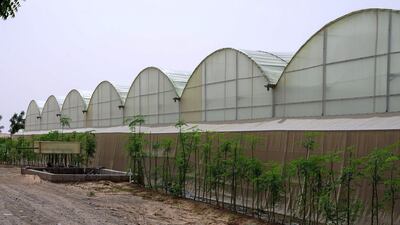
Other initiatives in the pipeline to encourage more self sufficiency include smart greenhouse projects, vertical farms that grow crops inside climate-controlled facilities and the control of date palm pests.
In March, at the height of the pandemic in Asia, Vietnam announced a ban on rice exports to ensure the country had sufficient foods to cope.
Quotas on white rice exports from the country have since increased to 500,000 tonnes a month.
It was a warning to nations reliant on imported goods to become more self-sufficient in the post-pandemic world.
South Korea will continue to work with the UAE on developing further water-saving technologies to maximise crop growth.
“Korea has long experience and cutting-edge technologies in the field of agriculture and food security, which it is ready to share with the UAE,” said Kwon Yongwoo, Republic of Korea ambassador to the UAE.
"The two countries have great potential to become ideal partners in agriculture and food security, just as they are in many other areas.”
Farms in the UAE find a way to thrive amid pandemic:
UAE currency: the story behind the money in your pockets
COMPANY%20PROFILE%20
%3Cp%3E%3Cstrong%3ECompany%20name%3A%20%3C%2Fstrong%3EAlmouneer%3Cbr%3E%3Cstrong%3EStarted%3A%3C%2Fstrong%3E%202017%3Cbr%3E%3Cstrong%3EFounders%3A%3C%2Fstrong%3E%20Dr%20Noha%20Khater%20and%20Rania%20Kadry%3Cbr%3E%3Cstrong%3EBased%3A%20%3C%2Fstrong%3EEgypt%3Cbr%3E%3Cstrong%3ENumber%20of%20staff%3A%20%3C%2Fstrong%3E120%3Cbr%3E%3Cstrong%3EInvestment%3A%20%3C%2Fstrong%3EBootstrapped%2C%20with%20support%20from%20Insead%20and%20Egyptian%20government%2C%20seed%20round%20of%20%3Cbr%3E%243.6%20million%20led%20by%20Global%20Ventures%3Cbr%3E%3C%2Fp%3E%0A
Profile of VoucherSkout
Date of launch: November 2016
Founder: David Tobias
Based: Jumeirah Lake Towers
Sector: Technology
Size: 18 employees
Stage: Embarking on a Series A round to raise $5 million in the first quarter of 2019 with a 20 per cent stake
Investors: Seed round was self-funded with “millions of dollars”
Mercer, the investment consulting arm of US services company Marsh & McLennan, expects its wealth division to at least double its assets under management (AUM) in the Middle East as wealth in the region continues to grow despite economic headwinds, a company official said.
Mercer Wealth, which globally has $160 billion in AUM, plans to boost its AUM in the region to $2-$3bn in the next 2-3 years from the present $1bn, said Yasir AbuShaban, a Dubai-based principal with Mercer Wealth.
“Within the next two to three years, we are looking at reaching $2 to $3 billion as a conservative estimate and we do see an opportunity to do so,” said Mr AbuShaban.
Mercer does not directly make investments, but allocates clients’ money they have discretion to, to professional asset managers. They also provide advice to clients.
“We have buying power. We can negotiate on their (client’s) behalf with asset managers to provide them lower fees than they otherwise would have to get on their own,” he added.
Mercer Wealth’s clients include sovereign wealth funds, family offices, and insurance companies among others.
From its office in Dubai, Mercer also looks after Africa, India and Turkey, where they also see opportunity for growth.
Wealth creation in Middle East and Africa (MEA) grew 8.5 per cent to $8.1 trillion last year from $7.5tn in 2015, higher than last year’s global average of 6 per cent and the second-highest growth in a region after Asia-Pacific which grew 9.9 per cent, according to consultancy Boston Consulting Group (BCG). In the region, where wealth grew just 1.9 per cent in 2015 compared with 2014, a pickup in oil prices has helped in wealth generation.
BCG is forecasting MEA wealth will rise to $12tn by 2021, growing at an annual average of 8 per cent.
Drivers of wealth generation in the region will be split evenly between new wealth creation and growth of performance of existing assets, according to BCG.
Another general trend in the region is clients’ looking for a comprehensive approach to investing, according to Mr AbuShaban.
“Institutional investors or some of the families are seeing a slowdown in the available capital they have to invest and in that sense they are looking at optimizing the way they manage their portfolios and making sure they are not investing haphazardly and different parts of their investment are working together,” said Mr AbuShaban.
Some clients also have a higher appetite for risk, given the low interest-rate environment that does not provide enough yield for some institutional investors. These clients are keen to invest in illiquid assets, such as private equity and infrastructure.
“What we have seen is a desire for higher returns in what has been a low-return environment specifically in various fixed income or bonds,” he said.
“In this environment, we have seen a de facto increase in the risk that clients are taking in things like illiquid investments, private equity investments, infrastructure and private debt, those kind of investments were higher illiquidity results in incrementally higher returns.”
The Abu Dhabi Investment Authority, one of the largest sovereign wealth funds, said in its 2016 report that has gradually increased its exposure in direct private equity and private credit transactions, mainly in Asian markets and especially in China and India. The authority’s private equity department focused on structured equities owing to “their defensive characteristics.”
RESULTS
5pm: Maiden (PA) Dh80,000 1,600m
Winner: Omania, Saif Al Balushi (jockey), Ibrahim Al Hadhrami (trainer)
5.30pm: Conditions (PA) Dh85,000 1,600m
Winner: Brehaan, Richard Mullen, Ana Mendez
6pm: Handicap (TB) Dh100,000 1,600m
Winner: Craving, Connor Beasley, Simon Crisford
6.30pm: The President’s Cup Prep (PA) Dh100,000 2,200m
Winner: Rmmas, Tadhg O’Shea, Jean de Roualle
7pm: Wathba Stallions Cup (PA) Dh70,000 1,200m
Winner: Dahess D’Arabie, Connor Beasley, Helal Al Alawi
7.30pm: Handicap (PA) Dh80,000 1,400m
Winner: Fertile De Croate, Sam Hitchcott, Ibrahim Aseel
EMERGENCY PHONE NUMBERS
Estijaba – 8001717 – number to call to request coronavirus testing
Ministry of Health and Prevention – 80011111
Dubai Health Authority – 800342 – The number to book a free video or voice consultation with a doctor or connect to a local health centre
Emirates airline – 600555555
Etihad Airways – 600555666
Ambulance – 998
Knowledge and Human Development Authority – 8005432 ext. 4 for Covid-19 queries
Kanguva
Director: Siva
Stars: Suriya, Bobby Deol, Disha Patani, Yogi Babu, Redin Kingsley
if you go
The flights
Emirates fly direct from Dubai to Houston, Texas, where United have direct flights to Managua. Alternatively, from October, Iberia will offer connections from Madrid, which can be reached by both Etihad from Abu Dhabi and Emirates from Dubai.
The trip
Geodyssey’s (Geodyssey.co.uk) 15-night Nicaragua Odyssey visits the colonial cities of Leon and Granada, lively country villages, the lake island of Ometepe and a stunning array of landscapes, with wildlife, history, creative crafts and more. From Dh18,500 per person, based on two sharing, including transfers and tours but excluding international flights. For more information, visit visitnicaragua.us.
Groom and Two Brides
Director: Elie Semaan
Starring: Abdullah Boushehri, Laila Abdallah, Lulwa Almulla
Rating: 3/5
'The worst thing you can eat'
Trans fat is typically found in fried and baked goods, but you may be consuming more than you think.
Powdered coffee creamer, microwave popcorn and virtually anything processed with a crust is likely to contain it, as this guide from Mayo Clinic outlines:
Baked goods - Most cakes, cookies, pie crusts and crackers contain shortening, which is usually made from partially hydrogenated vegetable oil. Ready-made frosting is another source of trans fat.
Snacks - Potato, corn and tortilla chips often contain trans fat. And while popcorn can be a healthy snack, many types of packaged or microwave popcorn use trans fat to help cook or flavour the popcorn.
Fried food - Foods that require deep frying — french fries, doughnuts and fried chicken — can contain trans fat from the oil used in the cooking process.
Refrigerator dough - Products such as canned biscuits and cinnamon rolls often contain trans fat, as do frozen pizza crusts.
Creamer and margarine - Nondairy coffee creamer and stick margarines also may contain partially hydrogenated vegetable oils.
THE%20STRANGERS'%20CASE
%3Cp%3E%3Cstrong%3EDirector%3C%2Fstrong%3E%3A%20Brandt%20Andersen%3Cbr%3E%3Cstrong%3EStarring%3A%20%3C%2Fstrong%3EOmar%20Sy%2C%20Jason%20Beghe%2C%20Angeliki%20Papoulia%3Cbr%3E%3Cstrong%3ERating%3A%3C%2Fstrong%3E%204%2F5%3C%2Fp%3E%0A
The specs
- Engine: 3.9-litre twin-turbo V8
- Power: 640hp
- Torque: 760nm
- On sale: 2026
- Price: Not announced yet
The President's Cake
Director: Hasan Hadi
Starring: Baneen Ahmad Nayyef, Waheed Thabet Khreibat, Sajad Mohamad Qasem
Rating: 4/5