


The Hubble Space Telescope has captured a rare image of three galaxies possibly interacting with each other.
Collectively known as NGC 7764A, the galaxy cluster is about 425 million light years from Earth.
It is in the Phoenix constellation, named after a mythical bird that is consumed by fire and then reborn from the ashes.
The European Space Agency said the image gives the impression that the two galaxies in the upper right side of the frame are interacting with one another.
Interactions between galaxies are common and happen when they drift too close to each other, causing their gravitational fields to be disturbed.
A major interaction would be when galaxies eventually collide, allowing the larger one to destroy the smaller one, and ultimately forming a much larger galaxy.
Astronomers have predicted that the Milky Way galaxy, home to Earth, will collide with the neighbouring Andromeda galaxy about four billion years from now.
“The long trails of stars and gas extending from them give the impression that they have both just been struck at great speed, thrown into disarray by the bowling-ball-shaped galaxy to the lower left of the image,” the space agency said on its website.
“In reality, interactions between galaxies happen over very long time periods, and galaxies rarely collide head-on with one another.
“It is also unclear whether the galaxy to the lower left is interacting with the other two, although they are so relatively close in space that it seems possible that they are.”
The view of NGC 7764A is among the tens of thousands of images that the Hubble telescope has captured since it was launched in 1990.
It has contributed to solving many mysteries of space, including by helping scientists to pin down the age of the universe, the rate at which the universe is expanding, discovering two Moons of Pluto and capturing detailed images of nebulas.
The most distant galaxies discovered so far have been found by Hubble. However, the telescope cannot see the very first galaxies of the universe.
Its successor, the James Webb Space Telescope, will help fill in those gaps.
The $10 billion Webb telescope, which took more than 20 years to build, arrived at its home in space last week and will begin operations by the summer.
It should be able to see more than 13.5 billion light years away and capture data concerning the birth of the universe.
The farthest galaxy discovered so far by Hubble is GN-z11, which is about 13.4 billion light years away.
Fascinating images of space - in pictures
-
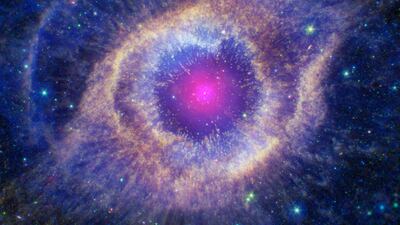
Helix Nebula is a phase when a star like the Sun runs out of fuel, it expands and its outer layers puff off, and then the core of the star shrinks. All photos: Nasa -
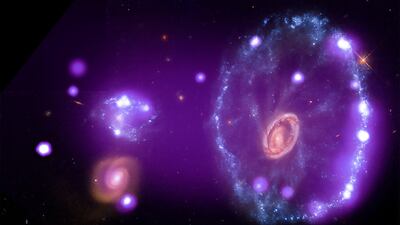
This Cartwheel Galaxy resembles a bull's eye, which is appropriate because its appearance is partly due to a smaller galaxy that passed through the middle of this object. -
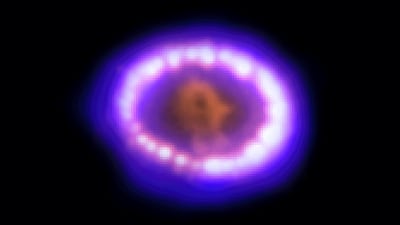
On February 24, 1987, observers in the southern hemisphere saw a new object in a nearby galaxy called the Large Magellanic Cloud. This was one of the brightest supernova explosions in centuries and soon became known as Supernova 1987A. -
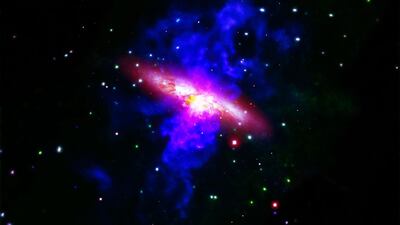
Messier 82, or M82, is a galaxy that is oriented edge-on to Earth. This gives astronomers an interesting view of what happens as this galaxy undergoes bursts of star formations. -
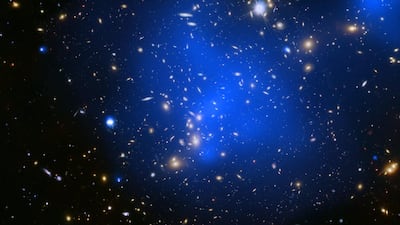
Galaxy clusters are the largest objects in the universe held together by gravity. They contain enormous amounts of superheated gas, with temperatures of tens of millions of degrees, which glow brightly in X-rays and can be observed across millions of light years between galaxies. -

What will be the next star in our Milky Way galaxy to explode as a supernova? Astronomers aren't certain, but one candidate is in Eta Carinae, a volatile system containing two massive stars that closely orbit each other.



