• The Ruler of Sharjah, Sheikh Dr Sultan bin Muhammad Al Qasimi, holds a news conference in San Francisco in 1973 to discuss plans for developing oil operations in the emirate. AP
    The Ruler of Sharjah, Sheikh Dr Sultan bin Muhammad Al Qasimi, holds a news conference in San Francisco in 1973 to discuss plans for developing oil operations in the emirate. AP
  • High rise buildings and hotels sprout on the sandy shore of Sharjah during its transformation from fishing town to major city in 1977. AP
    High rise buildings and hotels sprout on the sandy shore of Sharjah during its transformation from fishing town to major city in 1977. AP
  • A British official mingles with local dignitaries at a feast in November 1971. AP
    A British official mingles with local dignitaries at a feast in November 1971. AP
  • Sharjah's Central Souq in January 1980. AP
    Sharjah's Central Souq in January 1980. AP
  • An electronics shop in the city in the 1970s. Getty
    An electronics shop in the city in the 1970s. Getty
  • The park established by the Sharjah Municipality in front of Al Hisn, the city's fort, pictured in 1967. Photo: Sharjah Documentation and Archive Authority
    The park established by the Sharjah Municipality in front of Al Hisn, the city's fort, pictured in 1967. Photo: Sharjah Documentation and Archive Authority
  • The Rolla tree in Sharjah in the 1950s during Eid celebrations. The enormous tree fell in 1978, to be commemorated by a statue in Rolla Square. Photo: Sharjah Documentation and Archive Authority
    The Rolla tree in Sharjah in the 1950s during Eid celebrations. The enormous tree fell in 1978, to be commemorated by a statue in Rolla Square. Photo: Sharjah Documentation and Archive Authority
  • Old Sharjah Airport Mosque, which was located near the airport in Al Qasimia. It was demolished and Al Khayal Mosque was built at the same site. Photo: Sharjah Documentation and Archive Authority
    Old Sharjah Airport Mosque, which was located near the airport in Al Qasimia. It was demolished and Al Khayal Mosque was built at the same site. Photo: Sharjah Documentation and Archive Authority
  • Sharjah city seen from the east in the late 1960s including the Clock Tower Square. Photo: Sharjah Documentation and Archive Authority
    Sharjah city seen from the east in the late 1960s including the Clock Tower Square. Photo: Sharjah Documentation and Archive Authority
  • Al Hisn. The old fort was built around 1820 by then Ruler of Sharjah, Sheikh Sultan bin Saqr Al Qasimi, as Sharjah’s government headquarters. Photo: Sharjah Documentation and Archive Authority
    Al Hisn. The old fort was built around 1820 by then Ruler of Sharjah, Sheikh Sultan bin Saqr Al Qasimi, as Sharjah’s government headquarters. Photo: Sharjah Documentation and Archive Authority
  • A mosque in Sharjah city in 1972. Photo: Sharjah Documentation and Archive Authority
    A mosque in Sharjah city in 1972. Photo: Sharjah Documentation and Archive Authority
  • The entrance of the Sharjah Radio building, which was constructed in 1972. The station broadcast in Arabic for 16 hours a day. Photo: Sharjah Documentation and Archive Authority
    The entrance of the Sharjah Radio building, which was constructed in 1972. The station broadcast in Arabic for 16 hours a day. Photo: Sharjah Documentation and Archive Authority
  • The Sharjah TV and Radio building in 1989. Photo: Sharjah Documentation and Archive Authority
    The Sharjah TV and Radio building in 1989. Photo: Sharjah Documentation and Archive Authority
  • Sharjah's Central Post Office in the 1970s. Photo: Sharjah Documentation and Archive Authority
    Sharjah's Central Post Office in the 1970s. Photo: Sharjah Documentation and Archive Authority
  • Sharjah Public Library. Photo: Sharjah Documentation and Archive Authority
    Sharjah Public Library. Photo: Sharjah Documentation and Archive Authority
  • The entrance to the Sharjah Radio building, constructed in 1972. Photo: Sharjah Documentation and Archive Authority
    The entrance to the Sharjah Radio building, constructed in 1972. Photo: Sharjah Documentation and Archive Authority
  • Eid celebrations in front of Al Hisn in the early 1970s. Photo: Sharjah Documentation and Archive Authority
    Eid celebrations in front of Al Hisn in the early 1970s. Photo: Sharjah Documentation and Archive Authority
  • Mleiha Archaeological Centre. Photo: Sharjah Media Office
    Mleiha Archaeological Centre. Photo: Sharjah Media Office
  • Khor Fakkan Beach. Photo: Sharjah Media Office
    Khor Fakkan Beach. Photo: Sharjah Media Office
  • Al Majaz Amphitheatre, Sharjah. Photo: Sharjah Media Office
    Al Majaz Amphitheatre, Sharjah. Photo: Sharjah Media Office
  • Sharjah International Book Fair is an 11-day event that was first held in Sharjah in 1982. Photo: Sharjah Media Office
    Sharjah International Book Fair is an 11-day event that was first held in Sharjah in 1982. Photo: Sharjah Media Office
  • The College of Sharia and Islamic Studies is one of the foremost colleges that rose to prominence with the establishment of the University of Sharjah in the year 1977. Photo: Sharjah Media Office
    The College of Sharia and Islamic Studies is one of the foremost colleges that rose to prominence with the establishment of the University of Sharjah in the year 1977. Photo: Sharjah Media Office
  • Al Noor Mosque and Al Noor Island, which sits in Khalid Lake in the city of Sharjah. Photo: Sharjah Media Office
    Al Noor Mosque and Al Noor Island, which sits in Khalid Lake in the city of Sharjah. Photo: Sharjah Media Office
  • The House of Wisdom, Sharjah's state-of-the-art public library that opened in 2020. Photo: Sharjah Media Office
    The House of Wisdom, Sharjah's state-of-the-art public library that opened in 2020. Photo: Sharjah Media Office
  • The Sharjah Mosque, the largest mosque in the emirate, opened in 2019. Photo: Sharjah Media Office
    The Sharjah Mosque, the largest mosque in the emirate, opened in 2019. Photo: Sharjah Media Office
  • The Ruler of Sharjah, Sheikh Dr Sultan bin Muhammad Al Qasimi, is shown a new housing and business development by Sheikh Sultan bin Ahmed, right, in 2020. The National
    The Ruler of Sharjah, Sheikh Dr Sultan bin Muhammad Al Qasimi, is shown a new housing and business development by Sheikh Sultan bin Ahmed, right, in 2020. The National
  • The Ruler of Sharjah, Sheikh Dr Sultan bin Muhammad Al Qasimi, ​​​​​​presents his latest novel at a dinner reception hosted by the Sharjah Book Authority at the Literaturhaus in Frankfurt in 2018. Photo: Sharjah Media Corporation
    The Ruler of Sharjah, Sheikh Dr Sultan bin Muhammad Al Qasimi, ​​​​​​presents his latest novel at a dinner reception hosted by the Sharjah Book Authority at the Literaturhaus in Frankfurt in 2018. Photo: Sharjah Media Corporation

Long-time Sharjah residents recall how life changed under Sheikh Dr Sultan


Salam Al Amir
  • English
  • Arabic

Related: Seven highlights from the life of Sheikh Dr Sultan Al Qasimi

Sparsely developed, no buildings for long stretches, no paved roads and very few cars on the roads - that is how long-time residents of Sharjah remember the city in the late 1960s and early 1970s.

It was around this time, in 1972, when a young member of the Al Qasimi family was unanimously selected to become the Ruler of the Emirate.

And then began the rule of Sheikh Dr Sultan bin Muhammad Al Qasimi, who on Tuesday completed 50 years in service.

He had big plans. He wanted to transform the emirate but preserve the heritage and culture of the city.

Long-time residents of the city recall the period just before Sheikh Dr Sultan came to power.

There was sand all around, the asphalt roads you see now did not exist, and the buildings were nowhere to be seen
Nawal Al Ashram,
Sharjah resident

Nawal Al Ashram, who came to the UAE in 1963 to take on a teaching job in Dubai, told The National she never imagined the city would change so much.

“The difference between Sharjah then and now is the difference between the land and sky,” she said.

Ms Al Ashram said she vividly remembers the day she landed in the emirate for the first time – before the UAE was formed.

"My plane landed at Sharjah Air Station," she said.

Sharjah Air Station was the oldest airport in the UAE and opened long before the sprawling international hubs that now serve Dubai and Abu Dhabi.

The station was converted to a museum in 2000 and highlights the region's aviation achievements.

Ms Al Ashram said that was a time when goods and the latest products were more readily available in Sharjah than in other emirates, making it a popular shopping area.

“I remember going to Sharjah every Thursday for grocery shopping because that was when products arrived,” she said.

But because there were no air-conditioned malls, she said she often sat under the famous Rolla tree to escape the heat.

“My brother and I would sit in its shade when we came for shopping, as did many others because goods only came on Thursdays,” she said.

“But there was sand all around, the asphalt roads you see now did not exist, and the buildings were nowhere to be seen,” said the 83-year-old Jordanian citizen, who now lives in Umm Al Quwain.

High-rise buildings and hotels sprout on the Sharjah shore in the late 1970s. The emirate was once a fishing village. AP

Saeed Al Tareefi, 73, another long-time resident of the city, said he missed the chance of buying land at ridiculously low prices.

“I was offered a land plot to buy near Sabaa hotel in Sharjah, but I refused out of fear of how empty the area was,” he said.

“During my first years here, there were no buildings to see in Sharjah, just a few scattered and small residential neighbourhoods,” said Mr Al Tareefi, who started as a translator at Abu Dhabi port in 1969 but later became an education expert.

“I'm very proud that I have witnessed not only Sharjah’s journey of progress but that of the country and its formation.”

That was also a time when there was no culture of needing appointments to meet people, including the royals.

Sheikh Dr Sultan was just as accessible then as he is today – the only difference being that technology has replaced face-to-face interaction.

Ms Al Ashram said she often heard from others how men would go to the Ruler's house to share their concerns.

“His majlis was always open for all people to come and share their problems or joys,” she said.

Today, Sheikh Dr Sultan still listens to the problems of his people, albeit on the radio.

He is always aware of people’s needs and the problems they are facing. Sheikh Dr Sultan launched the Al Mabarrah radio programme in 2012 to stay in touch with the common people and offer them an easy channel to connect with him.

Residents often share their concerns on the radio. Sheikh Dr Sultan has been a regular listener for years. He answers queries, responds to complaints raised and orders new projects that can help to improve people’s lives.

Culture and building a city for its people was always at the core of Sheikh Dr Sultan's growth plan. He did not want concrete to replace culture.

Nawal Al Ashram came to the UAE in 1963. She says she never imagined Sharjah would change so much. Photo: Satish Kumar / The National

“The city has [managed] to balance the development of the emirate where the progress didn’t kill the identity of the city," Ms Al Ashram said.

In less than a decade of Sheikh Dr Sultan's rule, the city got its new airport, a humanitarian services city, and Al Jazeera park.

During the 1980s, he established the Department of Culture, which later branched out into other departments such as Sharjah Art Foundation, Sharjah Book Authority, Sharjah Publishing City, and Sharjah Heritage Institute, among others.

It was around this time that the city launched Sharjah Theatre Days and its Children’s Culture Festival.

Centres and clubs geared to family, children, women and disabled people were opened.

"There was no road beyond the hotel I stayed in, just sand. But look at it now, it has become a global city, a cultural capital and an economic centre," Mr Al Tareefi said.

Sharjah Heritage Days festival – in pictures

  • Emirati women spin wool.
    Emirati women spin wool.
  • Emiratis play traditional music.
    Emiratis play traditional music.
  • An Emirati boy stands in front of a traditional house.
    An Emirati boy stands in front of a traditional house.
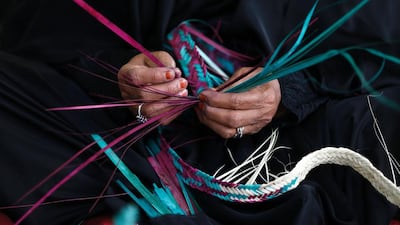
  • An Emirati woman weaves palm fronds.
    An Emirati woman weaves palm fronds.
  • Emiratis play traditional music.
    Emiratis play traditional music.
  • An Emirati woman walks past traditional houses.
    An Emirati woman walks past traditional houses.
  • An Emirati boy stands in front of traditional houses.
    An Emirati boy stands in front of traditional houses.
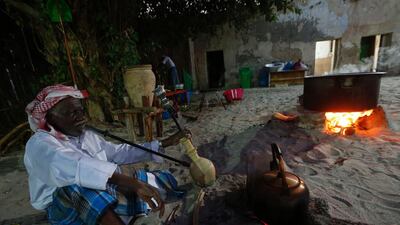
  • An Emirati man prepares traditional food.
    An Emirati man prepares traditional food.
  • An Emirati man prepares traditional food.
    An Emirati man prepares traditional food.
  • An Emirati woman works on a weaving loom.
    An Emirati woman works on a weaving loom.
  • An Emirati woman weaves palm fronds.
    An Emirati woman weaves palm fronds.
RESULTS

6.30pm: Al Maktoum Challenge Round-1 Group 1 (PA) Dh119,373 (Dirt) 1,600m
Winner: Brraq, Adrie de Vries (jockey), Jean-Claude Pecout (trainer)

7.05pm: Handicap (TB) Dh102,500 (D) 1,200m
Winner: Taamol, Connor Beasley, Ali Rashid Al Raihe.

7.40pm: Handicap (TB) Dh105,000 (Turf) 1,800m
Winner: Eqtiraan, Connor Beasley, Ali Rashid Al Raihe.

8.15pm: UAE 1000 Guineas Trial (TB) Dh183,650 (D) 1,400m
Winner: Soft Whisper, Pat Cosgrave, Saeed bin Suroor.

9.50pm: Handicap (TB) Dh105,000 (D) 1,600m
Winner: Hypothetical, Mickael Barzalona, Salem bin Ghadayer.

9.25pm: Handicap (TB) Dh95,000 (T) 1,000m
Winner: Etisalat, Sando Paiva, Ali Rashid Al Raihe

Emiratisation at work

Emiratisation was introduced in the UAE more than 10 years ago

It aims to boost the number of citizens in the workforce particularly in the private sector.

Growing the number of Emiratis in the workplace will help the UAE reduce dependence on overseas workers

The Cabinet in December last year, approved a national fund for Emirati jobseekers and guaranteed citizens working in the private sector a comparable pension

President Sheikh Khalifa has described Emiratisation as “a true measure for success”.

During the UAE’s 48th National Day, Sheikh Khalifa named education, entrepreneurship, Emiratisation and space travel among cornerstones of national development

More than 80 per cent of Emiratis work in the federal or local government as per 2017 statistics

The Emiratisation programme includes the creation of 20,000 new jobs for UAE citizens

UAE citizens will be given priority in managerial positions in the government sphere

The purpose is to raise the contribution of UAE nationals in the job market and create a diverse workforce of citizens

Electric scooters: some rules to remember
  • Riders must be 14-years-old or over
  • Wear a protective helmet
  • Park the electric scooter in designated parking lots (if any)
  • Do not leave electric scooter in locations that obstruct traffic or pedestrians
  • Solo riders only, no passengers allowed
  • Do not drive outside designated lanes
England squad

Goalkeepers: Jordan Pickford, Nick Pope, Aaron Ramsdale 

Defenders: Trent Alexander-Arnold, Conor Coady, Marc Guehi, Reece James, Harry Maguire, Tyrone Mings, Luke Shaw, John Stones, Ben White

Midfielders: Jude Bellingham, Conor Gallagher, Mason Mount, Jordan Henderson, Declan Rice, James Ward-Prowse

Forwards: Tammy Abraham, Phil Foden, Jack Grealish, Harry Kane, Bukayo Saka, Emile Smith Rowe, Raheem Sterling

Generation Start-up: Awok company profile

Started: 2013

Founder: Ulugbek Yuldashev

Sector: e-commerce

Size: 600 plus

Stage: still in talks with VCs

Principal Investors: self-financed by founder

Jetour T1 specs

Engine: 2-litre turbocharged

Power: 254hp

Torque: 390Nm

Price: From Dh126,000

Available: Now

Updated: January 26, 2022, 4:22 AM