



Related: Costly rapid PCR tests on offer amid demand and delayed results
Clinics in Abu Dhabi and Dubai said waiting times for PCR results should ease in the coming days.
Currently results could take up to three days, more than 48 hours longer than normal.
The delay was because of increased demand fuelled by more travel, intensified testing requirements and a rising number of cases.
Demand remains high as employers ask people to get tested before returning to offices. On Wednesday, as the government reported 2,708 new cases, it said 469,028 were tested in just 24 hours.
NMC Royal Hospital
“There was a short-term, acute increase in test loads on the 2nd and 3rd as many tourists were returning after the New Year celebration and because of school opening on the 3rd,” said Dr Naveen Kumar Tiwari, specialist in clinical pathology at NMC Royal Hospital, Dubai Investments Park.
“Thereafter, the situation has totally stabilised as the labs have now increased their capacity and there is also a slight drop in the test requests.
“Presently, the requirement of the test has been reduced by 15-20 per cent and reporting has changed back again to 12-24 hours.”
Across Burjeel's network, customers would normally receive their results in less than a day, but the company assures them the increased wait is still less than two days.
The situation has led some people to use expensive home testing services that promise fast results for as much as Dh500.
-
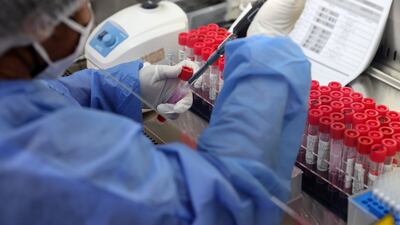
Lab staff working in the sample preparation room at Dubai Airport (DXB). All photos: Pawan Singh / The National -
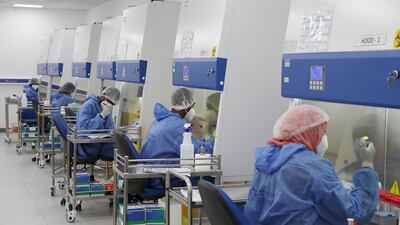
Close to Terminal 2, the laboratory is a dedicated centre for around-the-clock processing of RT-PCR test samples collected from passengers at DXB. -
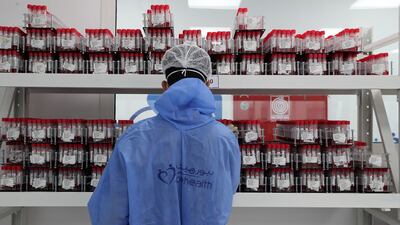
Lab staff working in Dubai Airport's in-house lab for processing Covid-19 PCR tests. -
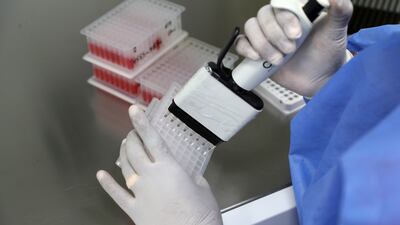
One of the world’s busiest airports now has one of the world’s biggest in-house Covid-19 testing laboratories. -

The laboratory reduces waiting times for passengers arriving by making sure their PCR test results are delivered in only four to six hours. -
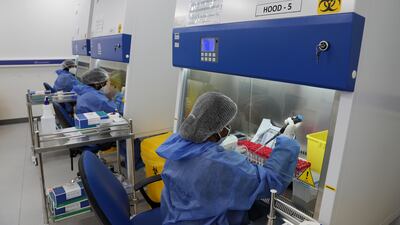
Before the lab opened in June, the passengers’ samples were collected from the airport every 12 hours. -
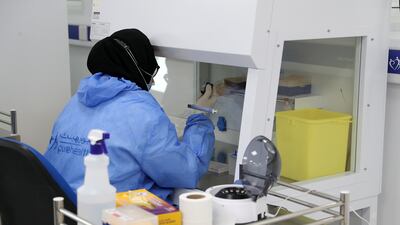
Now samples are collected every 30 minutes and transported to the in-house facility operated by Pure Health. -
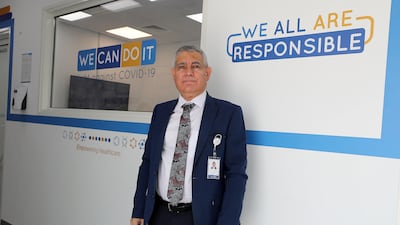
Carlo Kaabar, medical director of Mohap Laboratories, at Dubai Airport's in-house PCR lab. -
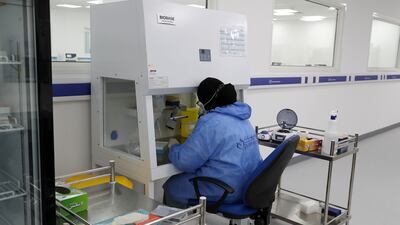
After a batch of samples is received, the staff first check their integrity and verify the passengers’ details using barcodes. -
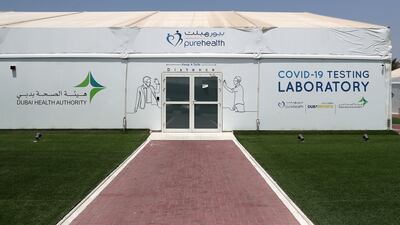
Dubai Airport's in-house lab for processing Covid-19 PCR tests. -
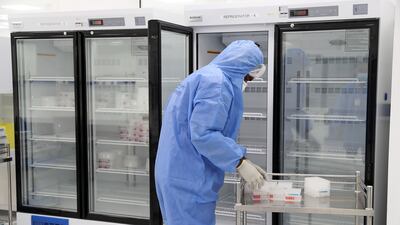
If passengers test positive, they need to undergo isolation and follow the Dubai Health Authority guidelines. -

Lab staff scanning the barcode of a Covid-19 PCR sample.


“Earlier, we were able to release results even in 12 hours. However, with the current surge in testing, turnaround time has increased,” said Dr Seema Oommen, the head of Burjeel Medical City's Covid lab.
“But by increasing our capacities and by sticking to the tier system placed by the authorities, we are still able to release the results in 24 to 36 hours.
“Priority is always given to emergency, ICU cases and all patients due for surgery.”
She said she expects demand to continue at the current level for the foreseeable future.
“However, the country has always adapted rapidly to such needs, and labs are adding capacity or activating dormant capacity to bring the turnaround time down.
“Once again, even today the turnaround here is way less than in many other countries.”
Some clinics continue to require longer wait-times as they adapt to increased demand, and customers at Abu Dhabi Stem Cell Centre’s screening sites were on Tuesday being told to expect a wait of two to three days for results.
HealthHub clinics are also experiencing longer waits for results.
Normal PCR test results, which cost Dh110, should be expected within 36 hours, while the express service, for Dh139, is taking up to 24 hours, it said.
Aster DM Healthcare said it was not affected by the recent surge in demand and has witnessed no change to its processing times, with results provided in 24 hours.
The UAE has among the best capacity for testing per population, globally.
According to Our World in Data, the country is the world’s fourth top tester, with almost 11,000 PCR tests performed for every 1,000 people.
But increased demand has stretched labs in recent days.
“More and more people are taking up screening due to the strict adherence to entry rules in all public places as mandated by the authorities,” Dr Oommen said.
“Also, many residents have returned after holidays and of course, there is an increase in tourists, who feel safe visiting UAE due to its strict preventive protocols.”
Many of the UAE’s tests take place in Abu Dhabi, where residents are required to check regularly to maintain their green pass status to visit many public areas.
In December, authorities in the capital increased requirements for testing after the emergence of Omicron, further adding to demand.
The validity of the green pass was reduced from 30 days to 14, meaning people have to record a negative PCR result every 14 days to maintain their green status.

