
It was a 2004 phone call that would change Sheikha Lubna Al Qasimi’s life.
She was in Tunisia on a government work trip when Sheikh Abdullah bin Zayed, Minister of Foreign Affairs and International Co-operation, rang.
“The government calls for you to be a minister of the Cabinet. What do you say?”
Not only would she be taking command of the crucial Ministry of Economy, she would become the first female Cabinet minister, shattering the glass ceiling and inspiring countless others to follow in her path.
“I said, ‘I’ll ask my mother’,” she recalls. “Others would say, well, this is this is strange. Why would you ask your mom? But I wanted to know whether this is something that she believed is OK.”
There was only ever one answer and Sheikha Lubna took command, brushing aside opposition from some quarters that suggested women could not lead a ministry.
-

Sheikha Lubna Al Qasimi, who blazed a trail as the first female government minister in the UAE, puts her success down to the support of her family and the UAE leadership. Randi Sokoloff / The National -
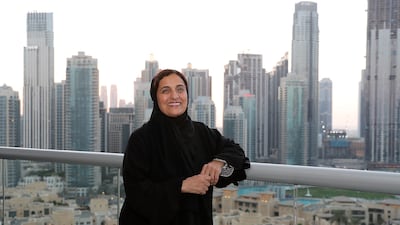
Sheikha Lubna became the first woman to hold a ministerial post in the UAE in 2004. Pawan Singh / The National -

Sheikha Lubna supporting the 'Dubai Font' initiative by the Executive Council of Dubai in 2017. Ravindranath K / The National -

Sheikha Lubna at the World Government Summit 2017 in Dubai. Pawan Singh / The National -

Sheikha Lubna with Camilla, Duchess of Cornwall, second right, at Sheikh Zayed Grand Mosque in Abu Dhabi, in 2016. Pawan Singh for the Crown Prince Court - Abu Dhabi -

Sheikha Lubna at Guru Nanak Darbar Gurudwara in Jebel Ali, in 2016. Pawan Singh / The National -

Sheikh Mohamed bin Zayed, Crown Prince of Abu Dhabi and Deputy Supreme Commander of the Armed Forces, greets Sheikha Lubna on Emirati Women's Day in Abu Dhabi in 2016. Crown Prince Court - Abu Dhabi -

Sheikha Lubna is received by Pope Francis during her visit to the Vatican in June 2016. Wam -

Sheikha Lubna attends a graduation ceremony at Zayed University in Dubai in 2016. Mona Al Marzooqi / The National -

Sheikh Mohammed bin Rashid, Vice President and Ruler of Dubai, Sheikha Lubna and Abdul Aziz Al Ghurair, chief executive of Mashreq Bank, at Zayed University in Dubai in 2016. Alex Atack for The National -

Sheikha Lubna became Minister of Tolerance in 2016. Ryan Carter / Crown Prince Court - Abu Dhabi -

Sheikha Lubna receives the Clinton Global Citizen award from Trudie Styler in New York in 2015. Reuters -

Sheikha Lubna was named among the 100 most powerful woman in the world by 'Forbes' magazine in 2010. Reem Mohammed / The National -

Sheikha Lubna with Sheikh Abdullah bin Zayed, Minister of Foreign Affairs and International Co-operation, during an iftar in 2014. Donald Weber / Crown Prince Court - Abu Dhabi -

Sheikha Lubna tours a health clinic at Za’atari Refugee Camp in Jordan in 2014. Photo: UNHCR -

Sheikha Lubna at the launch of the GCC chapter of the Women Corporate Directors in Abu Dhabi in 2013. Silvia Razgova / The National -

Sheikha Lubna attends China-Arab States Economic and Trade Forum in Yinchuan, China, in 2012. Sarah Dea / The National -

Sheikha Lubna meets Barham Salih, prime minister of the Kurdistan region of Iraq, in Abu Dhabi in 2010. Sammy Dallal / The National


“There were these opinions that are not reflective of the UAE saying, ‘how can you have a woman as a minister. It should be always men’. But then you had those who were saying, ‘this is great, this is a great break, moving forward in the Gulf’.”
Several years on, Sheikha Lubna spoke to The National about her youth, university days and time at the helm. It is a story of determination, dedication and vision built on the foundations of a supportive family.
And yet she never imagined that she would one day become a government minister. Sheikha Lubna devoured books on mathematics and physics as child.
“The love of my life was solving differential equations when I was a teenager,” she says. “Reading physics to me meant life. I was a geek.”
She studied maths and physics in secondary school and then moved to America as a student in the 1970s, graduating from California State University in 1981 with a bachelor's degree in computer science.
“I was determined that I was going to study technology, which was quite odd for people here in 1975,” she says.
Sheikha Lubna was top of her class in high school and for four years in university.
“Whenever I was second, I would come home and throw tantrums or my books,” she says, laughing.
Sheikha Lubna returned to the UAE to work at the General Information Authority, helping to automate the work of federal government, and then at Dubai Ports Authority. By the turn of the century, Sheikh Mohammed bin Rashid, Vice President and Ruler of Dubai, had appointed her as chief executive of Tejari — an online businesses-to-business exchange platform. Then Sheikh Abdullah called.
Sheikha Lubna still remembers walking into the first Cabinet meeting and feeling nervous. “You just turn around you, see the smiles and everybody's happy and excited about the decision.”
After the meeting, the hard work began in earnest and she recalls several sleepless nights at the start of her tenure.
“I went without sleep for a couple of weeks mainly because this was a merged position – Ministry of Planning with the Ministry of Economy. So you're talking about 300 employees. It was quite scary.
“And then one night, I thought, 'Well, I was appointed by the government – by His Highness [The President] Sheikh Khalifa, and they are there to back me up. So why am I scared?' And all of a sudden, I had the sense of relief and I didn't really feel that anxiety that I had before.”

Her success at the economy portfolio was such that by 2008 she was made Minister of Foreign Trade. In 2013, she became Minister of International Co-operation and Development, followed by Minister for Tolerance in 2016.
Thanks to her dedication and hard work, more women are now at the centre of government. There are nine women in the current Cabinet and she has been an inspiration to many other young Emiratis. She is even sometimes stopped in the street by parents who tell her she is their daughter’s role model.
“Or [they say] my kids have your photos everywhere or my girl has your photo right next to her bed. That was quite rewarding to me.
Young men and women thought that I was a cool minister and the reason for that is that I was a techie. So in their mind, this is quite refreshing.
“Most people look at government officials as someone who's quite traditional with a lot of prestige. But for me it wasn't the case.”
Sheikha Lubna says her success is simply down to the support from her family and the leadership. She grew knowing she could become anything she wanted and that has made all the difference.
“I came from a class where all my classmates from high school are surgeons and doctors and engineers,” she says.
“Our families were quite supportive. I think that's really the secret to my success. My late father was actually more supportive of us, the girls.
“I also came from an era of parents who were not educated. Maybe they knew a bit of mathematics, they read the Quran and read a bit of Arabic, but not much. They don't have degrees, we were the first. So in many ways we were the dream, they wanted us to get an education. And that generation is a very special generation.
“People always assume that that generation is very traditional. They are but they are progressive. They're not people who are ignorant, they're not people who, because they didn't travel the world that much means [they] don't understand. They do understand and they have love and they have passion for the country.”
Sheikha Lubna was previously recognised by magazine Forbes as the most powerful Arab woman and the 70th most powerful woman in the world in its 2010 “World's 100 Most Powerful Women list”. She has won many other awards.
But reflecting on her experience, Sheikha Lubna says what she is most proud of is that she is an “agent of change” and as the UAE celebrates its Golden Jubilee and looks forward to next 50 years, she sees a limitless opportunity to even more success.
“In the past 50 years, we have seen more advancements in the society than other societies in North America had achieved in 200 years,” she says.
“We used to say the sky is the limit, but there is no sky any more. We are going to space so we don't see the sky any more.”
Her message to the future ministers and the young girls who wants to be ministers when they grow up? “Don't be like me, be better than me,” she says.

