



Scientists and amateur astronomers are benefitting from the treasure trove of data the UAE’s Hope probe has collected from Mars.
Mohammed bin Rashid Space Centre released 110 gigabytes of raw data to the public last week, with new sets to be published every three months.
Researchers are hoping to reveal more secrets about Mars’ mysterious atmosphere by using the data, including how the escape of gases such as oxygen is stripping away the planet’s atmosphere.
Some of the latest findings showed dramatic variations in the concentrations of both atomic oxygen and carbon monoxide were present.
Scientists are now trying to understand what this could mean for the planet’s atmosphere.
“The team is working to understand what has driven these structures to appear to be this way,” Hessa Al Matroushi, the science lead of the Emirates Mars Mission, told The National.
“They’re refining the models that we're using to align them with what we see within the data.
“That's the role of every mission that we get. The circulation models are trying to capture what the data tells us, and the Mars mission is getting a unique perspective, so that’s an opportunity for us to try and compare and update our understanding of what’s happening in the Martian atmosphere.”

Unique observations of how gases interact with each other and affect solar radiation have been possible because of the spacecraft’s elliptical orbit.
Previous missions were much closer to the planetary surface, limiting observations to short periods and only certain areas of the planet.
Dr Dimitra Atri, a research scientist at the New York University in Abu Dhabi, is using Hope’s data to complete a research paper he hopes to publish.
He has been studying data from Nasa’s Maven mission and Europe’s Mars Express mission to research hydrogen and oxygen in Mars’ atmosphere, and how the planet’s liquid water disappeared.
Data from the Hope orbiter has helped fill in the gaps in Dr Atri’s research, in the area of how solar radiation interacts with the Martian atmosphere.
It is important to understand how radiation affects Mars, because strong solar winds stripped away its atmosphere in the early solar system and made the planet inhabitable.
“Each mission has its own area where it’s good, but has limitations. You only get a partial picture of a planet from these missions, but Hope is much further away and it is going to add to what we know so far,” he told The National.
“We’ll be combining the data from the Maven and Mars Express missions, but Hope will give us a more in-depth understanding of not only aurora, but also how radiation interactions with Mars’ atmosphere.”
The auroras on Mars are different from the one on Earth. There are three types - proton, diffuse and discrete – because of the lack of a global magnetic field and localised crustal magnetic fields in the southern hemisphere.
The UAE's spacecraft has taken the most detailed pictures of the discrete auroras to help scientists understand them better.
Apart from building research, the data from the spacecraft is also allowing space enthusiasts like Dr Atri and amateur astronomers to create stunning images of the planet.
-
A stunning view of Valles Marineris, one of the largest canyons of the solar system. Dr Dimitra Atri, a research scientist at the New York University in Abu Dhabi, processed this image. Photo: Hope Mars mission / Dr Dimitra Atri -
A close-up of Olympus Mons on Mars, the largest mountain in the solar system. This image was processed by Stuart Atikson, an amateur astronomer in the UK. Photo: Hope Mars mission / Stuart Atikson -
A close-up view of Olympus Mons, the largest and tallest mountain in the solar system, and the Tharsis Montes region. Photo: Hope Mars Mission / Dr Dimitra Atri -
Another Mars image. Photo: Hope Mars mission / Stuart Atkinson -
The Tharsis Montes region on Mars is visible in this photo. Hope Mars mission / Stuart Atkinson -
A monochromatic image of Mars. Hope Mars mission/ Stuart Atkinson -
A colour image of Mars. Hope Mars mission/ Stuart Atkinson
Stuart Atkinson, an amateur astronomer in the UK, has processed some of the raw data from Hope’s exploration imager instrument – a high-resolution camera – to create images.
“I love the black and white image I made showing a crescent Mars and the huge Olympus Mons volcano close to the terminator,” he told The National.
“I made that by stacking multiple images taken through different filters and then sharpened and enhanced it, but left it black and white because I love the starkness of it.
“I'm also very pleased with the colour image I made showing the Mariner Valley - Valles Marineris - and its neighbouring volcanoes. That's how I imagine Mars would look if I was flying towards it in a spaceship, at the end of my six-month journey from Earth.”
Mr Atkinson said free data helps people feel as if they are part of the mission.
He has worked with images taken by every Mars rover and orbiter, as well as spacecraft that went to Saturn, Jupiter, the Rosetta comet and Pluto.
“I really love how we now have huge galleries of images freely available online, often posted just hours after they were taken,” he said.
“Some missions don't do that though, and still only release an image now and then, which is a shame and counter-productive because it makes the mission invisible to the public.
“I believe every mission that goes to a planet or body should release at least a few images every week, to allow people to feel part of the mission.”
UAE's lunar landing mission - in pictures
-
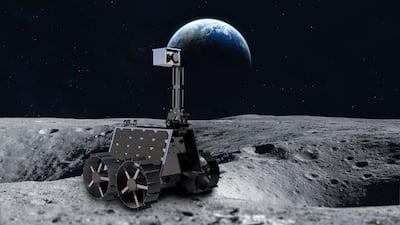
An artist's impression of the UAE's lunar rover called Rashid. -

Dr Hamad Al Marzooqi, project manager of the Emirates Lunar Mission at the Mohammed bin Rashid Space Centre. Chris Whiteoak / The National -
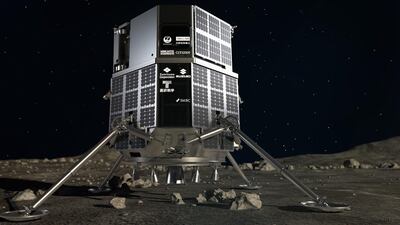
An artist's impression of iSpace's Hakuto-Reboot lunar lander. It will carry UAE's Rashid rover to the surface of the Moon in 2022. -
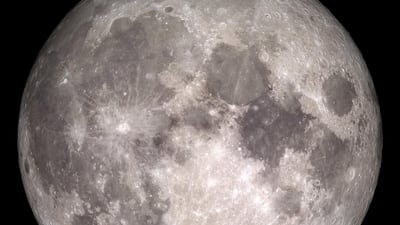
The UAE aims to land the Rashid rover on the near side of the Moon due to its smoother surface. -
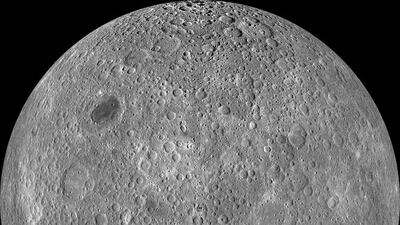
The far side of the Moon remains largely unexplored, but Nasa is turning its focus back to the lunar surface. -
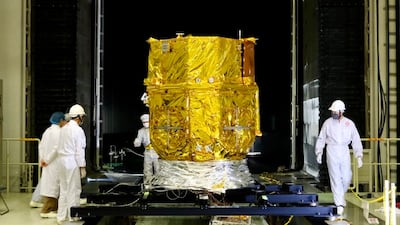
The HAKUTO-R lander, which will deliver the UAE's Rashid rover to the lunar surface in 2022, is now in final stages of assembly. -
The ispace team completed the assembly of the lander's structure thermal model in April. Courtesy: ispace -
The final assembly of the lander is being carried out in co-operation with the Ariane Group GmbH at the Ariane Group facility in Lampoldshausen, Germany. Courtesy: ispace -
Using a lander and rocket that is already available helps Emirati engineers and scientists get quicker and easier access to space. Courtesy: ispace -
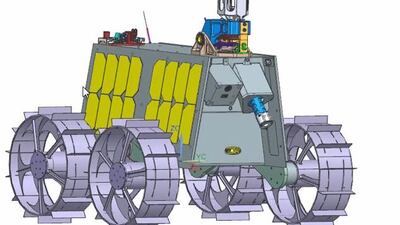
The initial concept design of the Rashid rover. Courtesy: MBRSC -
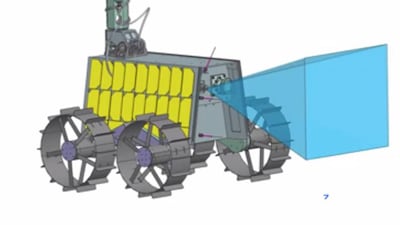
Rashid rover's thermal imager will analyse the Moon's properties through thermal energy. Courtesy: MBRSC -
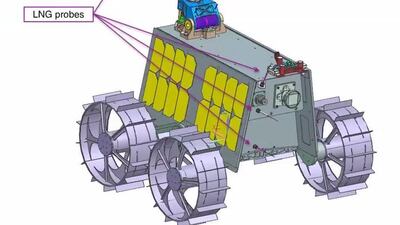
The Langmuir probes on the rover will analyse the lunar surface charge and electric fields. Courtesy: MBRSC -

One of the rover's two high-resolution optical imagers that will take photos of the Moon. Courtesy: MBRSC



