• Mars Science City would have pressurised biodomes in which ecosystems could be sustained. Dubai Media Office
    Mars Science City would have pressurised biodomes in which ecosystems could be sustained. Dubai Media Office
  • The city will be located at the Dubai Academic City and is scheduled for completion in 2024. Courtesy: Dubai Media Office
    The city will be located at the Dubai Academic City and is scheduled for completion in 2024. Courtesy: Dubai Media Office
  • Construction of the project is expected to begin next year. Courtesy: Dubai Media Office
    Construction of the project is expected to begin next year. Courtesy: Dubai Media Office
  • Adnan Al Rais is the Mars 2117 programme manager at the Mohammed bin Rashid Space Centre. Mbrsc
    Adnan Al Rais is the Mars 2117 programme manager at the Mohammed bin Rashid Space Centre. Mbrsc
  • The first image of Mars taken by the UAE's Hope probe, which arrived to the planet on February 9. EPA
    The first image of Mars taken by the UAE's Hope probe, which arrived to the planet on February 9. EPA

Construction of Dubai’s Dh500m Mars Science City to begin next year


Sarwat Nasir
  • English
  • Arabic

Construction of the world’s largest Mars simulation city is to begin in the Dubai desert next year, with completion and the start of operations scheduled for 2024.

The Dh500 million ($136.1m) Mars Science City was announced in 2017 but has been stuck in the design phase since, because officials at Mohammed bin Rashid Space Centre had yet to secure land that would allow for expansion.

The city was initially to be built next to MBRSC in Al Khawaneej, but Academic City has now been chosen as the site.

A rendering of the Mars Science City. Courtesy: Bjarke Ingels Group

One architects’ practice bidding to design the complex suggested it could occupy about 176,156 square metres, bigger than 24 football pitches.

The centre will simulate the environment of Mars, with pressurised biodomes and robotics labs. The project is part of the Mars 2117 initiative to build a city on the Red Planet by the year 2117.

Adnan Al Rais, the Mars 2117 project manager, told The National that the new location offered long-term flexibility.

“At the beginning we had a piece of land that was dedicated to the Mars Science City, but because Dubai is growing and the new urban planning of the Dubai government, that location near MBRSC is not suitable any more. It’s becoming a residential area and it wouldn’t allow expansion,” he said.

“The new location is Academic City. That’s a better area and it’s closer to universities and different institutions.”

For the past 18 months, Mr Al Rais and his team have been working to identify the requirements of the city and now a design consultant will be hired to create the layout of the project.

A model for living on Mars

The city will include biospheres, as seen in this artist's impression. Courtesy: Bjarke Ingels Group

Mr Al Rais said the city would include several features that would allow scientists from all over the world to carry out research related to the red planet.

“The Mars Science City will be a platform where we’re going to have our future space robotics lab, future analog facilities, a habitat and a space sustainability lab,” he said.

“We’re currently working on the design. Then we’ll do the construction for the next two years. Hopefully, the city will be ready and operational towards the end of 2024.

“We are also working with our partners for identifying the requirements for unique analog facilities as part of the Mars Science City.”

An analogue facility is a simulation of the harsh space-like environment, where humans live in isolation for several weeks or months to prepare for future space exploration missions.

As part of a different project, MBRSC has shortlisted two Emirati candidates who will travel to Russia at the end of this year to live in a Mars analogue facility for eight months.

If analogue facilities are built in Mars Science City, it would give Emirati astronauts easier access to training in such simulated environments.

Mr Al Rais said an architect has not yet been selected for the city, but there have been proposals.

Architects Bjarke Ingels Group proposed 3D underground buildings and recommended solar energy to power and heat the city.

As part of the UAE’s Mars programme, MBRSC also sent the Hope probe into space, to orbit around the Red Planet. The robotic craft is currently capturing scientific data about the planet’s upper and lower atmosphere.

Images taken by UAE’s Hope probe - in pictures

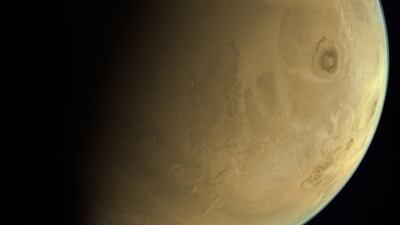
  • The first image of Mars as taken by the UAE's Hope probe, which arrived at the planet on February 9.
    The first image of Mars as taken by the UAE's Hope probe, which arrived at the planet on February 9.
  • This image taken by the Hope probe's ultraviolet spectrometer (one of its three scientific instruments) shows sunlight reflecting off the extended cloud of atomic hydrogen gas that surrounds the planet Mars. The sunlight is visible only as a dark disk hidden inside the fog of gas. The Emirates Mars Mission team said that no other mission have made such kind of recordings before.
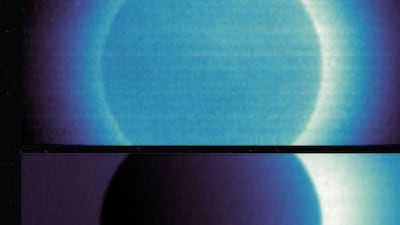
    This image taken by the Hope probe's ultraviolet spectrometer (one of its three scientific instruments) shows sunlight reflecting off the extended cloud of atomic hydrogen gas that surrounds the planet Mars. The sunlight is visible only as a dark disk hidden inside the fog of gas. The Emirates Mars Mission team said that no other mission have made such kind of recordings before.
  • The UAE's Hope probe captured a high-resolution photo of Mars.
    The UAE's Hope probe captured a high-resolution photo of Mars.
  • The Hope probe has shared new images from its journey in the orbit of Mars.
    The Hope probe has shared new images from its journey in the orbit of Mars.
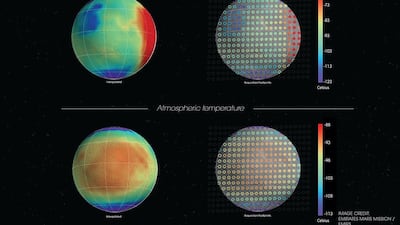
  • This image was taken by the infrared spectrometer, another instrument on the Hope probe, from an altitude of about 15,000 kilometres. The image shows the surface temperature (left), centred on the Tharsis region of Mars. Dawn can be seen towards the right side. The low surface temperatures observed are due to the dusty nature of the Martian surface. An elevated nighttime atmospheric temperature at 25 km altitude (right) is also observed over the Tharsis region.
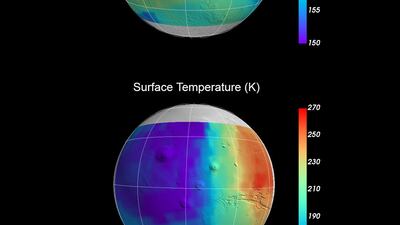
    This image was taken by the infrared spectrometer, another instrument on the Hope probe, from an altitude of about 15,000 kilometres. The image shows the surface temperature (left), centred on the Tharsis region of Mars. Dawn can be seen towards the right side. The low surface temperatures observed are due to the dusty nature of the Martian surface. An elevated nighttime atmospheric temperature at 25 km altitude (right) is also observed over the Tharsis region.
  • These images were captured by the eXploration imager, a high-resolution camera on the Hope probe. The red channel clearly shows the dark and light features of the Martian surface, while the water ice clouds stand out in the ultraviolet channel.
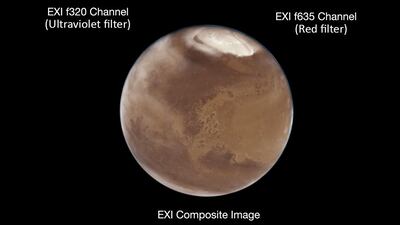
    These images were captured by the eXploration imager, a high-resolution camera on the Hope probe. The red channel clearly shows the dark and light features of the Martian surface, while the water ice clouds stand out in the ultraviolet channel.
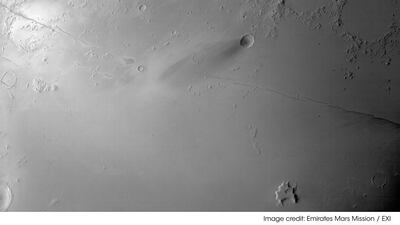
  • Hope probe sent back an image of the Cerberus Fossae, an area on the planet known for 'Marsquakes'.
    Hope probe sent back an image of the Cerberus Fossae, an area on the planet known for 'Marsquakes'.
  • Surface and atmospheric temperature readings collected by the UAE's Hope probe.
    Surface and atmospheric temperature readings collected by the UAE's Hope probe.
  • Discrete aurora on Mars captured by UAE's Hope probe
    Discrete aurora on Mars captured by UAE's Hope probe
  • Discrete aurora on Mars captured by UAE's Hope probe
    Discrete aurora on Mars captured by UAE's Hope probe
Skoda Superb Specs

Engine: 2-litre TSI petrol

Power: 190hp

Torque: 320Nm

Price: From Dh147,000

Available: Now

Mercer, the investment consulting arm of US services company Marsh & McLennan, expects its wealth division to at least double its assets under management (AUM) in the Middle East as wealth in the region continues to grow despite economic headwinds, a company official said.

Mercer Wealth, which globally has $160 billion in AUM, plans to boost its AUM in the region to $2-$3bn in the next 2-3 years from the present $1bn, said Yasir AbuShaban, a Dubai-based principal with Mercer Wealth.

Within the next two to three years, we are looking at reaching $2 to $3 billion as a conservative estimate and we do see an opportunity to do so,” said Mr AbuShaban.

Mercer does not directly make investments, but allocates clients’ money they have discretion to, to professional asset managers. They also provide advice to clients.

“We have buying power. We can negotiate on their (client’s) behalf with asset managers to provide them lower fees than they otherwise would have to get on their own,” he added.

Mercer Wealth’s clients include sovereign wealth funds, family offices, and insurance companies among others.

From its office in Dubai, Mercer also looks after Africa, India and Turkey, where they also see opportunity for growth.

Wealth creation in Middle East and Africa (MEA) grew 8.5 per cent to $8.1 trillion last year from $7.5tn in 2015, higher than last year’s global average of 6 per cent and the second-highest growth in a region after Asia-Pacific which grew 9.9 per cent, according to consultancy Boston Consulting Group (BCG). In the region, where wealth grew just 1.9 per cent in 2015 compared with 2014, a pickup in oil prices has helped in wealth generation.

BCG is forecasting MEA wealth will rise to $12tn by 2021, growing at an annual average of 8 per cent.

Drivers of wealth generation in the region will be split evenly between new wealth creation and growth of performance of existing assets, according to BCG.

Another general trend in the region is clients’ looking for a comprehensive approach to investing, according to Mr AbuShaban.

“Institutional investors or some of the families are seeing a slowdown in the available capital they have to invest and in that sense they are looking at optimizing the way they manage their portfolios and making sure they are not investing haphazardly and different parts of their investment are working together,” said Mr AbuShaban.

Some clients also have a higher appetite for risk, given the low interest-rate environment that does not provide enough yield for some institutional investors. These clients are keen to invest in illiquid assets, such as private equity and infrastructure.

“What we have seen is a desire for higher returns in what has been a low-return environment specifically in various fixed income or bonds,” he said.

“In this environment, we have seen a de facto increase in the risk that clients are taking in things like illiquid investments, private equity investments, infrastructure and private debt, those kind of investments were higher illiquidity results in incrementally higher returns.”

The Abu Dhabi Investment Authority, one of the largest sovereign wealth funds, said in its 2016 report that has gradually increased its exposure in direct private equity and private credit transactions, mainly in Asian markets and especially in China and India. The authority’s private equity department focused on structured equities owing to “their defensive characteristics.”

Look%20Both%20Ways
%3Cp%3EDirector%3A%20Wanuri%20Kahiu%3Cbr%3EStars%3A%20Lili%20Reinhart%2C%20Danny%20Ramirez%2C%20David%20Corenswet%2C%20Luke%20Wilson%2C%20Nia%20Long%3Cbr%3ERating%3A%203%2F5%3Cbr%3E%3C%2Fp%3E%0A
UAE%20SQUAD
%3Cp%3E%0D%3Cstrong%3EMen%3A%3C%2Fstrong%3E%20Saif%20Al%20Zaabi%2C%20Salem%20Al%20Marzooqi%2C%20Zayed%20Al%20Ansaari%2C%20Saud%20Abdulaziz%20Rahmatalla%2C%20Adel%20Shanbih%2C%20Ahmed%20Khamis%20Al%20Blooshi%2C%20Abdalla%20Al%20Naqbi%2C%20Khaled%20Al%20Hammadi%2C%20Mohammed%20Khamis%20Khalaf%2C%20Mohammad%20Fahad%2C%20Abdulla%20Al%20Arimi.%0D%3Cbr%3E%3Cstrong%3EWomen%3A%3C%2Fstrong%3E%20Mozah%20Al%20Zeyoudi%2C%20Haifa%20Al%20Naqbi%2C%20Ayesha%20Al%20Mutaiwei.%3C%2Fp%3E%0A
The President's Cake

Director: Hasan Hadi

Starring: Baneen Ahmad Nayyef, Waheed Thabet Khreibat, Sajad Mohamad Qasem 

Rating: 4/5

What can victims do?

Always use only regulated platforms

Stop all transactions and communication on suspicion

Save all evidence (screenshots, chat logs, transaction IDs)

Report to local authorities

Warn others to prevent further harm

Courtesy: Crystal Intelligence

The%20Mother%20
%3Cp%3E%3Cstrong%3EDirector%3A%3C%2Fstrong%3E%20Niki%20Caro%26nbsp%3B%3C%2Fp%3E%0A%3Cp%3E%3Cstrong%3EStars%3A%3C%2Fstrong%3E%20Jennifer%20Lopez%2C%20Joseph%20Fiennes%2C%20Gael%20Garcia%20Bernal%2C%20Omari%20Hardwick%20and%20Lucy%20Paez%3C%2Fp%3E%0A%3Cp%3E%3Cstrong%3ERating%3A%3C%2Fstrong%3E%203%2F5%3C%2Fp%3E%0A
COMPANY PROFILE

Name: Qyubic
Started: October 2023
Founder: Namrata Raina
Based: Dubai
Sector: E-commerce
Current number of staff: 10
Investment stage: Pre-seed
Initial investment: Undisclosed 

War 2

Director: Ayan Mukerji

Stars: Hrithik Roshan, NTR, Kiara Advani, Ashutosh Rana

Rating: 2/5

The Bio

Favourite vegetable: “I really like the taste of the beetroot, the potatoes and the eggplant we are producing.”

Holiday destination: “I like Paris very much, it’s a city very close to my heart.”

Book: “Das Kapital, by Karl Marx. I am not a communist, but there are a lot of lessons for the capitalist system, if you let it get out of control, and humanity.”

Musician: “I like very much Fairuz, the Lebanese singer, and the other is Umm Kulthum. Fairuz is for listening to in the morning, Umm Kulthum for the night.”