


Astronomy was deeply rooted in the Arab culture for thousands of years, when sailors, farmers and Bedouins would use the stars to navigate and predict the weather.
Now, a modern-day space culture is being formed in the UAE as a result of the nation’s space exploration efforts that has taken the first Emirati to space, a spacecraft to Mars and, soon, a rover to the Moon.
Experts in the field have said more people in the Emirates are pursuing astrophotography, art and an education in space-related studies.
“Right now, it’s more about rekindling the interest in space,” said Thabet Al Qaissieh, an Emirati astronomer and astrophotographer who built the Al Sadeem Observatory on his family’s farm in Abu Dhabi.
The spot in the desert hosts regular sessions for stargazing.
“If you look back thousands of years ago, or even 30 to 40 years ago, there’s always been a connection with space in different ways, whether it’s looking for the Suhail star [the second brightest in the sky after Sirius] for seasonal changes or in literature that involves the Moon or stars," he said.
“Now, it’s evolving along the lines of more modern-day tools. I follow some amazing artists on social media that recreate the images that I’ve captured. I also see people writing short stories or poems about the Moon and stars.”

Countries with large-scale space programmes such as the US and Russia have a strong space culture that was formed during the first exploration era in the 1960s.
Museums, statues, street art and education programmes that focus on space exploration are common in these countries.
Mr Al Qaissieh said the UAE could benefit from the addition of a space museum and more space-related studies in schools.
“I think the first and most important aspect is to focus more on schools because that would plant the seed. In the future, a museum would also go a long way because it’s much more interactive,” he said.
Astrophotography and art
Hassan Al Hairi, the chief executive of Dubai Astronomy Group, said more people are pursuing astrophotography since the start of the space sector boom in the UAE.
His organisation is one of a few other astronomy groups that hosts gatherings for the public to observe meteor showers and other celestial events.
“People are getting more and more involved. They are looking to buy the telescopes and equipment for astrophotography and they want to take the training courses,” he said.
“Today, we see people producing beautiful images and it inspires other people.”
-
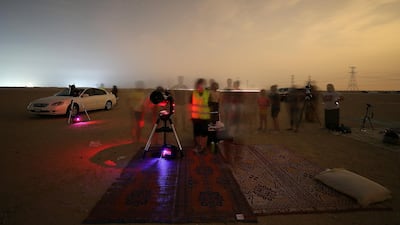
The annual Perseids meteor showers draws a crowd of more than 150 stargazers to the Al Qudra desert to watch the show in August, 2020. Pawan Singh / The National -
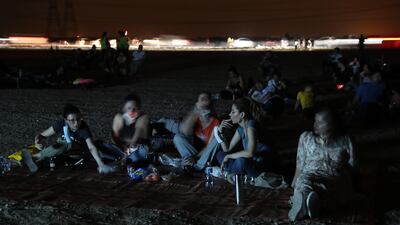
Dubai Astronomy Group organised a stargazing event but hazy, cloudy and humid weather caused low visibility, making the meteors harder to see. Pawan Singh / The National -

When a meteorite reaches a certain magnitude, it turns into a 'fireball', with a large and bright red appearance. Pawan Singh / The National -
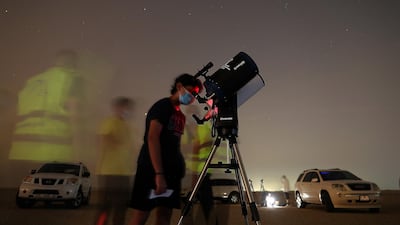
Advanced telescopes provided by Dubai Astronomy Group help members of the crowd observe different planets. Mars, Saturn and Jupiter are visible to the naked eye, but the telescopes give clearer views. Pawan Singh / The National -
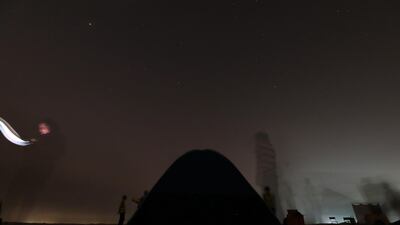
Mars becomes visible each year, but is at its brightest from August to October. Pawan Singh / The National -
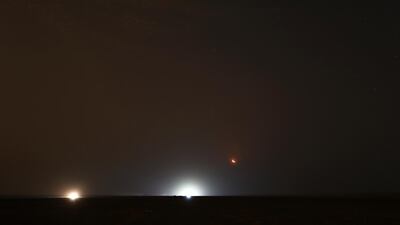
Residents in the UAE can still see Mars in the night sky. It appears as a bright red "dot". Pawan Singh / The National -
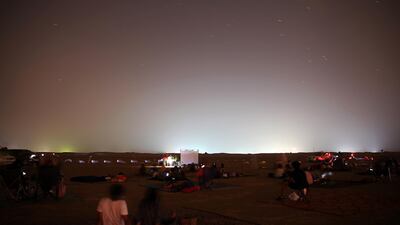
High levels of light pollution also caused low visibility of the meteor showers. Pawan Singh / The National -

Residents turn out to watch the Perseids meteor showers in Al Qudra desert, Dubai. Pawan Singh / The National -

The Perseids meteor showers were more visible in other parts of the world. Here are the meteors flying across the sky above a camping site at the Negev desert in Israel. AFP -

A meteor streaks past stars in the night sky above the Necropolis for the victims of Fascism, in Novi Travnik, Bosnia and Herzegovina. Reuters


He said only about 100 people used to come to astronomy events a few years ago, but that figure has more than doubled.
When the UAE’s Hope probe was arriving on Mars, billboards celebrating the event were placed on the side of roads in Dubai with buildings lit up in red to mark the event.
This month, a vast space-inspired artwork was painted in the Al Khawaneej tunnel to celebrate the Mars mission.
The efforts aim to create the same enthusiasm found among residents on the space coast in Florida or the desert of Kazakhstan, where rockets have been launching for years.
Saeed Al Emadi, who is part of the Mohammed bin Rashid Space Centre’s communication team, has a following of more than 10,000 people with his space-themed artwork.
He also designed Suhail, the mascot for the UAE’s first space mission in 2019, which he hopes will inspire more youth to pursue Stem studies.
“I think the recent space achievements in the UAE has created a space art culture. Many people have been inspired by those events, encouraging them to celebrate and document the achievements by creating space art,” he said.
“Art can bring people together. It can inspire the youth to go beyond their dreams because there is no limit in art. Before we explored space, artists tried to paint it, for example, Galileo Galilei produced drawings of the Moon phases after observing through a telescope in 1609.”
Space education
The passion for space among young people is also leading them to pursue an education in the field.
Dr Nidhal Guessoum, an astrophysicist and professor at the American University of Sharjah, said more students want to establish careers in the field.
“I can give the example of the American University of Sharjah, where a physics major was started just three years ago and we already have two dozen students,” he said.
“Most of them are Emiratis and many of them want to specialise in space. I have several of those students in my astrophysics research group and some of them have already published papers in top international journals.
-
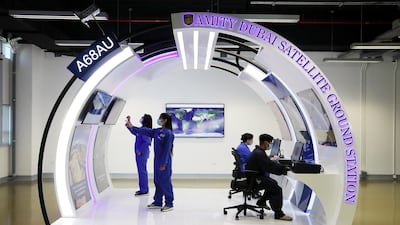
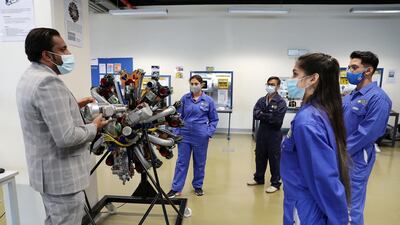
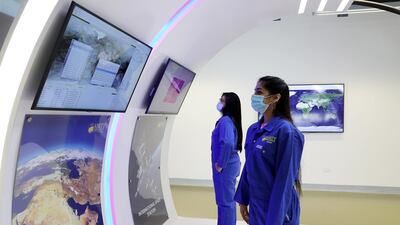
Amity University in Dubai is one of the few institutes in the UAE to offer aerospace engineering degrees to students. Here, students work at the on-campus satellite ground control station that helps gain hands-on training. All photos by Pawan Singh / The National -
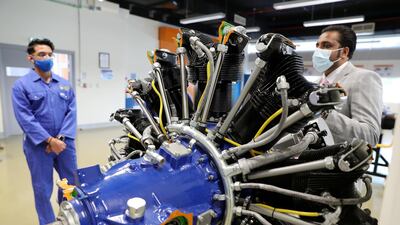
The programme had more than 15 students when it was first launched in 2015. -

Now, there are more than 50 students enrolled in the programme. -

Aerospace and other engineering students can use the ground control station to track satellites, predict weather patterns and pollution levels. -
Students can analyse the data they receive. -

In this picture Sarath Raj, programme leader of Aerospace Engineering (right) explains about the Armfield Subsonic Wind Tunnel to students -
The university is located in Academic City, Dubai.


“A year ago, I taught a course titled ‘Satellites and Space Science’ and it proved very popular. We plan to offer it again next semester.”
Dr Guessoum and Emirati astronaut Hazza Al Mansouri were among the 100 most influential leaders in space in a list compiled by Richtopia, an online magazine. They were the only two Arabs to make the list, but still an indication of the region's growth in the sector.
Dr Vajahat Hussain, chief executive of Amity Middle East, said the Dubai campus has seen a 10 to 20 per cent increase in the number of aerospace students in the past three years.
“The field has taken centre stage in the region. From incorporating space-themed installations at Expo 2020 to the National Geographic documentary ‘Reach for the Stars’ on UAE’s space programme and a calendar of space-related events and activities throughout the year, the passion for space has captured people’s hearts and minds,” he said.
“People are beginning to understand the vast scope of the field because of the awareness for space science and astronomy created by every field and sector in the UAE.
“Billboard advertisements, art installations, newspaper articles, inspiring success stories – these are just some of the many ways in which people's love for space is reinforced every day.”

