Follow the latest updates on the Covid-19 pandemic here
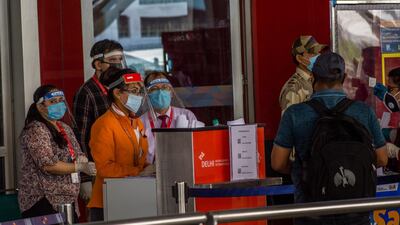
UAE residents from any emirate can now fly to Dubai, according to regulations introduced last week.
However, some, depending on where they are flying from, must seek permission first before they can travel.
The rule covers most of the 14 countries from which travel was previously banned to the UAE earlier this year, owing to a sharp increase in the number of coronavirus cases, but not all.
So, which are they?
The National explains.
From which countries do UAE residents need approval to fly to Dubai?
Residents returning from 10 countries must first seek permission from either the General Directorate of Residency and Foreigners Affairs, or the GDRFA, if they live in Dubai, or the Federal Authority for Identity and Citizenship, or ICA, if they live elsewhere in the country.
The 14 countries from where travel was previously banned to the UAE are India, Pakistan, Bangladesh, Nepal, Sri Lanka, Vietnam, Namibia, Zambia, the Democratic Republic of the Congo, Uganda, Sierra Leone, Liberia, Nigeria and South Africa.
According to Emirates airline, the 10 countries from that list from which residents must first seek permission before returning are:
- Bangladesh
- India
- Nigeria
- Pakistan
- Sri Lanka
- South Africa
- Uganda
- Vietnam
- Zambia
- Indonesia
Where is permission not necessary from?
Permission is not required for those travelling from Nepal, Namibia, the Democratic Republic of the Congo and Liberia.
What about tourists from the 10 countries?
No, the rule only applies to UAE residents.
Do residents have to be vaccinated to fly to Dubai?
No. Dubai sets its own immigration and coronavirus rules and does not require residents to be vaccinated to return.
What are the rules in Abu Dhabi?
All incoming passengers must register with the ICA before boarding flights and should have approval to travel before flying.
From August 27, passengers are now required to submit their details on the ICA platform before checking in. After registration, they will receive a QR code, which will be required to board any flight to the UAE capital.
The new rules apply to all travellers flying into Abu Dhabi, except UAE citizens and those transiting directly to another country. There are separate rules in place for anyone flying from a destination on the UAE’s flight ban list.
Any passengers planning to fly to the UAE capital and continue on to Dubai or another emirate must also receive approval from the ICA to fly. Children and infants are not exempt and must be registered by their parents before travel.
Any passengers who have been vaccinated outside of the UAE should register and upload their documents for approval at least five days in advance of travel, Etihad Airways said.
This will allow UAE authorities to review the travellers' documents to assess whether they qualify for Al Hosn app's Green Pass.
People who have been fully vaccinated in the UAE do not need to upload vaccine certificates to the platform, but all other ICA registration details must be completed.
What is the rule in other emirates?
Air Arabia said passengers from India, Pakistan, Nepal and Sri Lanka who are travelling on e-visas need to provide proof that they are vaccinated against Covid when flying to Sharjah and Ras Al Khaimah.
They must wait at least 14 days after receiving the second dose of a Covid vaccine in the UAE. Proof must be shown in the form of a vaccination certificate, and their Al Hosn app must also be green. Registration via ICA is also mandatory before flying.
Mercer, the investment consulting arm of US services company Marsh & McLennan, expects its wealth division to at least double its assets under management (AUM) in the Middle East as wealth in the region continues to grow despite economic headwinds, a company official said.
Mercer Wealth, which globally has $160 billion in AUM, plans to boost its AUM in the region to $2-$3bn in the next 2-3 years from the present $1bn, said Yasir AbuShaban, a Dubai-based principal with Mercer Wealth.
“Within the next two to three years, we are looking at reaching $2 to $3 billion as a conservative estimate and we do see an opportunity to do so,” said Mr AbuShaban.
Mercer does not directly make investments, but allocates clients’ money they have discretion to, to professional asset managers. They also provide advice to clients.
“We have buying power. We can negotiate on their (client’s) behalf with asset managers to provide them lower fees than they otherwise would have to get on their own,” he added.
Mercer Wealth’s clients include sovereign wealth funds, family offices, and insurance companies among others.
From its office in Dubai, Mercer also looks after Africa, India and Turkey, where they also see opportunity for growth.
Wealth creation in Middle East and Africa (MEA) grew 8.5 per cent to $8.1 trillion last year from $7.5tn in 2015, higher than last year’s global average of 6 per cent and the second-highest growth in a region after Asia-Pacific which grew 9.9 per cent, according to consultancy Boston Consulting Group (BCG). In the region, where wealth grew just 1.9 per cent in 2015 compared with 2014, a pickup in oil prices has helped in wealth generation.
BCG is forecasting MEA wealth will rise to $12tn by 2021, growing at an annual average of 8 per cent.
Drivers of wealth generation in the region will be split evenly between new wealth creation and growth of performance of existing assets, according to BCG.
Another general trend in the region is clients’ looking for a comprehensive approach to investing, according to Mr AbuShaban.
“Institutional investors or some of the families are seeing a slowdown in the available capital they have to invest and in that sense they are looking at optimizing the way they manage their portfolios and making sure they are not investing haphazardly and different parts of their investment are working together,” said Mr AbuShaban.
Some clients also have a higher appetite for risk, given the low interest-rate environment that does not provide enough yield for some institutional investors. These clients are keen to invest in illiquid assets, such as private equity and infrastructure.
“What we have seen is a desire for higher returns in what has been a low-return environment specifically in various fixed income or bonds,” he said.
“In this environment, we have seen a de facto increase in the risk that clients are taking in things like illiquid investments, private equity investments, infrastructure and private debt, those kind of investments were higher illiquidity results in incrementally higher returns.”
The Abu Dhabi Investment Authority, one of the largest sovereign wealth funds, said in its 2016 report that has gradually increased its exposure in direct private equity and private credit transactions, mainly in Asian markets and especially in China and India. The authority’s private equity department focused on structured equities owing to “their defensive characteristics.”
Nepotism is the name of the game
Salman Khan’s father, Salim Khan, is one of Bollywood’s most legendary screenwriters. Through his partnership with co-writer Javed Akhtar, Salim is credited with having paved the path for the Indian film industry’s blockbuster format in the 1970s. Something his son now rules the roost of. More importantly, the Salim-Javed duo also created the persona of the “angry young man” for Bollywood megastar Amitabh Bachchan in the 1970s, reflecting the angst of the average Indian. In choosing to be the ordinary man’s “hero” as opposed to a thespian in new Bollywood, Salman Khan remains tightly linked to his father’s oeuvre. Thanks dad.
BOSH!'s pantry essentials
Nutritional yeast
This is Firth's pick and an ingredient he says, "gives you an instant cheesy flavour". He advises making your own cream cheese with it or simply using it to whip up a mac and cheese or wholesome lasagne. It's available in organic and specialist grocery stores across the UAE.
Seeds
"We've got a big jar of mixed seeds in our kitchen," Theasby explains. "That's what you use to make a bolognese or pie or salad: just grab a handful of seeds and sprinkle them over the top. It's a really good way to make sure you're getting your omegas."
Umami flavours
"I could say soya sauce, but I'll say all umami-makers and have them in the same batch," says Firth. He suggests having items such as Marmite, balsamic vinegar and other general, dark, umami-tasting products in your cupboard "to make your bolognese a little bit more 'umptious'".
Onions and garlic
"If you've got them, you can cook basically anything from that base," says Theasby. "These ingredients are so prevalent in every world cuisine and if you've got them in your cupboard, then you know you've got the foundation of a really nice meal."
Your grain of choice
Whether rice, quinoa, pasta or buckwheat, Firth advises always having a stock of your favourite grains in the cupboard. "That you, you have an instant meal and all you have to do is just chuck a bit of veg in."
Benefits of first-time home buyers' scheme
- Priority access to new homes from participating developers
- Discounts on sales price of off-plan units
- Flexible payment plans from developers
- Mortgages with better interest rates, faster approval times and reduced fees
- DLD registration fee can be paid through banks or credit cards at zero interest rates
The biog
Hobby: Playing piano and drawing patterns
Best book: Awaken the Giant Within by Tony Robbins
Food of choice: Sushi
Favourite colour: Orange
Essentials
The flights
Etihad (etihad.ae) and flydubai (flydubai.com) fly direct to Baku three times a week from Dh1,250 return, including taxes.
The stay
A seven-night “Fundamental Detox” programme at the Chenot Palace (chenotpalace.com/en) costs from €3,000 (Dh13,197) per person, including taxes, accommodation, 3 medical consultations, 2 nutritional consultations, a detox diet, a body composition analysis, a bio-energetic check-up, four Chenot bio-energetic treatments, six Chenot energetic massages, six hydro-aromatherapy treatments, six phyto-mud treatments, six hydro-jet treatments and access to the gym, indoor pool, sauna and steam room. Additional tests and treatments cost extra.
The specs
- Engine: 3.9-litre twin-turbo V8
- Power: 640hp
- Torque: 760nm
- On sale: 2026
- Price: Not announced yet
MATCH INFO
Juventus 1 (Dybala 45')
Lazio 3 (Alberto 16', Lulic 73', Cataldi 90 4')
Red card: Rodrigo Bentancur (Juventus)
Desert Warrior
Starring: Anthony Mackie, Aiysha Hart, Ben Kingsley
Director: Rupert Wyatt
Rating: 3/5
DEADPOOL & WOLVERINE
Starring: Ryan Reynolds, Hugh Jackman, Emma Corrin
Director: Shawn Levy
Rating: 3/5
UAE gold medallists:
Omar Al Suweidi (46kg), Khaled Al Shehhi (50kg), Khalifa Humaid Al Kaabi (60kg), Omar Al Fadhli (62kg), Mohammed Ali Al Suweidi (66kg), Omar Ahmed Al Hosani (73), all in the U18’s, and Khalid Eskandar Al Blooshi (56kg) in the U21s.