UAE then and now: the lost cinema of Dubai


John Dennehy
  • English
  • Arabic

Today, life in the Emirates moves in the fast lane. In a regular series to mark the 50th anniversary of the UAE, 'The National' takes a trip back in time to examine how much the country has changed.

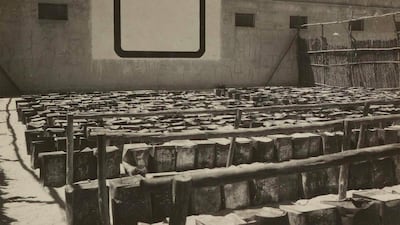
People sitting on old petrol tins, ‘Sharjah Paramount’ written on the wall and open-air screenings: this was the cinema in 1940s Sharjah.

It is believed this open-air theatre at the RAF base was the first cinema in modern-day UAE, catering to British personnel and staging screenings for the public.

But by the 1970s, stand-alone cinemas had flickered into life across the UAE.

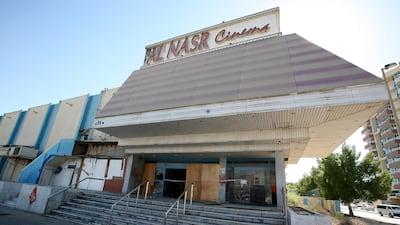
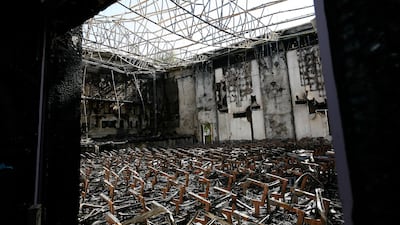
  • Al Nasr cinema in Dubai. It closed in 2006 and was then gutted by a blaze in 2008.
    Al Nasr cinema in Dubai. It closed in 2006 and was then gutted by a blaze in 2008.
  • Inside Al Nasr cinema after it was destroyed by fire. Pawan Singh / The National
    Inside Al Nasr cinema after it was destroyed by fire. Pawan Singh / The National
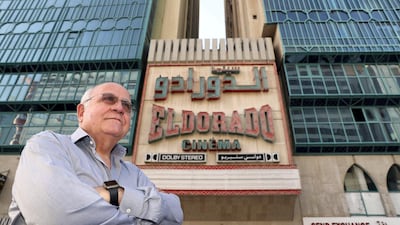
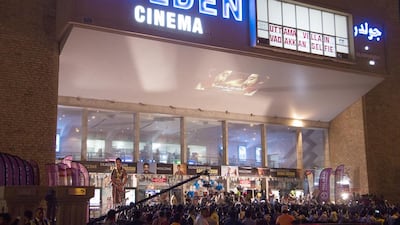
  • The much-loved El Dorado cinema on Abu Dhabi's Sultan bin Zayed the First Street (Electra street) closed in 2017.
    The much-loved El Dorado cinema on Abu Dhabi's Sultan bin Zayed the First Street (Electra street) closed in 2017.
  • Ferdinand Lama, the El Dorado's engineer, standing outside the cinema after it closed.
    Ferdinand Lama, the El Dorado's engineer, standing outside the cinema after it closed.
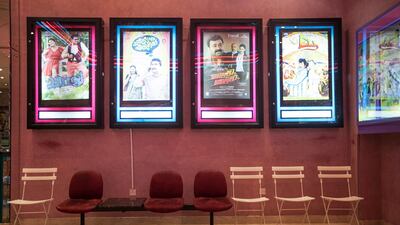
  • Film posters inside El Dorado cinema. Its closure was attributed to little online presence and a lack of parking facilities.
    Film posters inside El Dorado cinema. Its closure was attributed to little online presence and a lack of parking facilities.
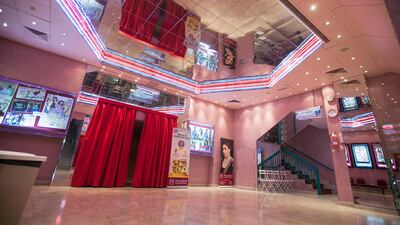
  • Inside the El Dorado cinema on Electra street.
    Inside the El Dorado cinema on Electra street.
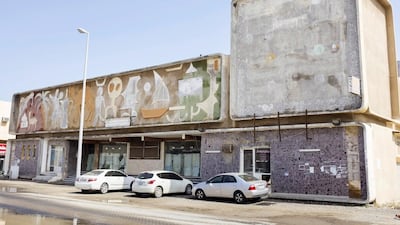
  • The site of the old El Dorado cinema today. A gym and supermarket have replaced the cinema.
    The site of the old El Dorado cinema today. A gym and supermarket have replaced the cinema.
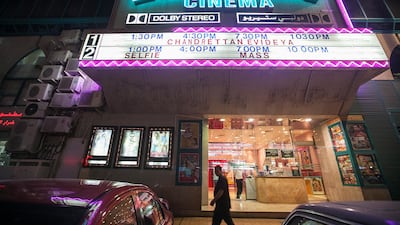
  • A night-time shot of Golden Cinema (Plaza) in Dubai. It closed in 2015. Navin Khianey / The National
    A night-time shot of Golden Cinema (Plaza) in Dubai. It closed in 2015. Navin Khianey / The National
  • There were once small cinemas across the country. One of which, the Khor Fakkan Cinema, was acquired by Sharjah Art Foundation for use as an arts space. Reem Mohammed / The National
    There were once small cinemas across the country. One of which, the Khor Fakkan Cinema, was acquired by Sharjah Art Foundation for use as an arts space. Reem Mohammed / The National
  • The RAF Sharjah cinema that opened in the 1940s. It is believed to have been the first cinema in modern-day UAE. Courtesy of the Akkasah: Center for Photography
    The RAF Sharjah cinema that opened in the 1940s. It is believed to have been the first cinema in modern-day UAE. Courtesy of the Akkasah: Center for Photography

From Dubai to Sharjah to Abu Dhabi, they screened the latest blockbusters from India but also showed films from Hollywood and the occasional one from Lebanon and Egypt.

Bur Dubai’s Plaza was among the most popular. Built in the 1970s, it was redolent of a golden age of cinema when these smaller theatres provided the only show in town.

The Plaza was also built in the happening centre of old Dubai, close to the bus station and the Creek opposite, where Al Ghubaiba metro station stands today. It was not only a cinema but a landmark and a popular meeting place.

The older photograph was taken after it was renamed Golden Cinema. The building was torn down in 2015, a casualty of changing tastes and the rise of the multiplex. Many other small standalone cinemas such as The Strand and Al Nasr in Dubai and Abu Dhabi’s El Dorado are also closed.

But the final curtain has yet to fall on the Plaza. It featured in exhibitions in 2017 and 2018 at Alserkal Avenue in Dubai and NYUAD in Abu Dhabi by Emirati artist Ammar Al Attar. His work documents the intriguing – and often overlooked history – of smaller cinemas across the UAE, from Kalba to Umm Al Quwain. It was also the subject of a podcast from Kerning Cultures.

But it has a more physical legacy, too. The founders of Cinema Akil rescued several of its old seats before it was demolished and installed them at the art house cinema in Alserkal Avenue, allowing a new generation of film buffs to time-travel through several decades. The building may be gone but the final credits have not yet rolled.


Ten tax points to be aware of in 2026

1. Domestic VAT refund amendments: request your refund within five years

If a business does not apply for the refund on time, they lose their credit.

2. E-invoicing in the UAE

Businesses should continue preparing for the implementation of e-invoicing in the UAE, with 2026 a preparation and transition period ahead of phased mandatory adoption. 

3. More tax audits

Tax authorities are increasingly using data already available across multiple filings to identify audit risks. 

4. More beneficial VAT and excise tax penalty regime

Tax disputes are expected to become more frequent and more structured, with clearer administrative objection and appeal processes. The UAE has adopted a new penalty regime for VAT and excise disputes, which now mirrors the penalty regime for corporate tax.

5. Greater emphasis on statutory audit

There is a greater need for the accuracy of financial statements. The International Financial Reporting Standards standards need to be strictly adhered to and, as a result, the quality of the audits will need to increase.

6. Further transfer pricing enforcement

Transfer pricing enforcement, which refers to the practice of establishing prices for internal transactions between related entities, is expected to broaden in scope. The UAE will shortly open the possibility to negotiate advance pricing agreements, or essentially rulings for transfer pricing purposes. 

7. Limited time periods for audits

Recent amendments also introduce a default five-year limitation period for tax audits and assessments, subject to specific statutory exceptions. While the standard audit and assessment period is five years, this may be extended to up to 15 years in cases involving fraud or tax evasion. 

8. Pillar 2 implementation 

Many multinational groups will begin to feel the practical effect of the Domestic Minimum Top-Up Tax (DMTT), the UAE's implementation of the OECD’s global minimum tax under Pillar 2. While the rules apply for financial years starting on or after January 1, 2025, it is 2026 that marks the transition to an operational phase.

9. Reduced compliance obligations for imported goods and services

Businesses that apply the reverse-charge mechanism for VAT purposes in the UAE may benefit from reduced compliance obligations. 

10. Substance and CbC reporting focus

Tax authorities are expected to continue strengthening the enforcement of economic substance and Country-by-Country (CbC) reporting frameworks. In the UAE, these regimes are increasingly being used as risk-assessment tools, providing tax authorities with a comprehensive view of multinational groups’ global footprints and enabling them to assess whether profits are aligned with real economic activity. 

Contributed by Thomas Vanhee and Hend Rashwan, Aurifer

'Fantastic Beasts: The Secrets of Dumbledore'

Rating: 3/5

Directed by: David Yates

Starring: Mads Mikkelson, Eddie Redmayne, Ezra Miller, Jude Law

THE%20SPECS
%3Cp%3EEngine%3A%204.4-litre%20twin-turbo%20V8%20hybrid%0D%3Cbr%3EPower%3A%20653hp%20at%205%2C400rpm%0D%3Cbr%3ETorque%3A%20800Nm%20at%201%2C600-5%2C000rpm%0D%3Cbr%3ETransmission%3A%208-speed%20auto%0D%3Cbr%3E0-100kph%20in%204.3sec%0D%3Cbr%3ETop%20speed%20250kph%0D%3Cbr%3EFuel%20consumption%3A%20NA%0D%3Cbr%3EOn%20sale%3A%20Q2%202023%0D%3Cbr%3EPrice%3A%20From%20Dh750%2C000%0D%3Cbr%3E%3C%2Fp%3E%0A
What is a robo-adviser?

Robo-advisers use an online sign-up process to gauge an investor’s risk tolerance by feeding information such as their age, income, saving goals and investment history into an algorithm, which then assigns them an investment portfolio, ranging from more conservative to higher risk ones.

These portfolios are made up of exchange traded funds (ETFs) with exposure to indices such as US and global equities, fixed-income products like bonds, though exposure to real estate, commodity ETFs or gold is also possible.

Investing in ETFs allows robo-advisers to offer fees far lower than traditional investments, such as actively managed mutual funds bought through a bank or broker. Investors can buy ETFs directly via a brokerage, but with robo-advisers they benefit from investment portfolios matched to their risk tolerance as well as being user friendly.

Many robo-advisers charge what are called wrap fees, meaning there are no additional fees such as subscription or withdrawal fees, success fees or fees for rebalancing.

Updated: August 04, 2021, 4:26 AM