
Life in the Emirates moves in the fast lane. In a new regular series to mark the 50th anniversary of the UAE, we take a look at some familiar places as they once were and see just how much has changed in 2021.
In a city whose future is constantly evolving, Qasr Al Hosn is an enduring reminder of its past.
Construction of a single watchtower began in the second half of the 18th century, while the Ruler’s Palace we see today is the result of a major expansion in the 1940s.
The black and white image here forms part of the BP Archive. After winning the offshore and onshore oil exploration concessions, the UK-based energy giant sent a succession of photographers to Abu Dhabi from the mid-1950s on to record not only its work in the emirate but also scenes of everyday life.
The photograph was probably taken in the late 1950s, although neither the date or the name of the photographer is recorded.
It shows the south-west tower and a section of the perimeter wall, and the windows of what were part of the private quarters of the Ruler, at the time Sheikh Shakhbut, the older brother of Sheikh Zayed.
By the 1950s, Qasr Al Hosn was no longer a defensive structure, but the seat of government, a role it retained until 1966. After a spell as the home of the National Archives, it underwent major renovation in the past decade.
As much as the palace, the eye is drawn to the simple wood and palm-frond shelter, protection for a small herd of cows against the sun’s heat.
Cattle freely roamed around what was then a town of fewer than 3,000 people. It included the old souq, a brisk walk away, on the other side of the palace.
If this view of Qasr Al Hosn has changed little in more than 60 years, the surrounding area is altered beyond all recognition.
Where the BP photographer is standing is now Al Hisn Street, lined by office buildings and apartments, with Hamdan Street to the north and Zayed the First Street (still popularly known as Electra) behind the lens. Soaring over the fort is Burj Mohammed bin Rashid skyscraper. The tower, part of the World Trade Centre complex, is the tallest building in Abu Dhabi and sits on the site of the much-loved old souq.
The cattle shelter is now the entrance to the House of Artisans, a cultural centre that forms part of the revitalised historic district, with Qasr Al Hosn now properly restored to its rightful place at the heart of the city.
Qasr Al Hosn through the years - in pictures
-
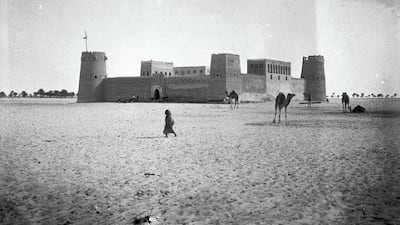
A German explorer, Hermann Burchardt, took this photograph of Qasr Al Hosn in 1904. It was one of the earliest images taken of the fort. Photo: Department of Culture and Tourism - Abu Dhabi -
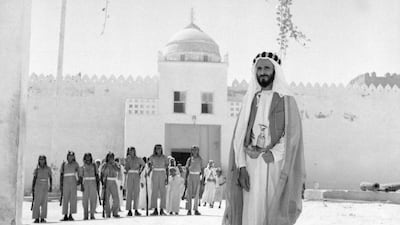
Sheikh Shakhbut, Ruler of Abu Dhabi from 1928 to 1966, in front of Qasr Al Hosn. Photo: National Archives -
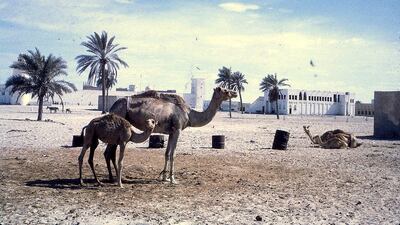
An early colour view of Qasr Al Hosn in the 1950s. Photo: John Vale -

Qasr Al Hosn as it looked in the early 1960s. Precious supplies of freshwater are being delivered in tin cans. Photo: John Vale -
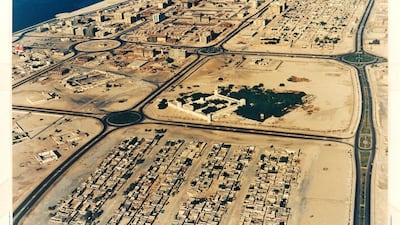
By 1974, new buildings are rising but Qasr Al Hosn is still prominent. Note the development of the Corniche on left. Photo: Ron McCulloch -
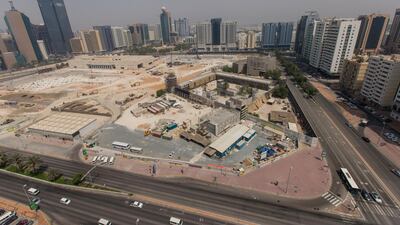
Qasr Al Hosn was closed in 2013 as it underwent a major restoration. Christopher Pike / The National -
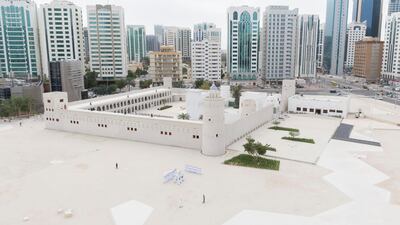
It reopened in 2018 and the renovation also included the surrounding neighbourhood, as this 2020 photograph shows. Saeed Khawaja for the Ministry of Presidential Affairs -
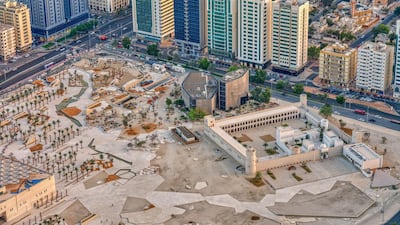
The historic Al Hosn area comprises of Qasr Al Hosn, the Cultural Foundation and House of Artisans. -
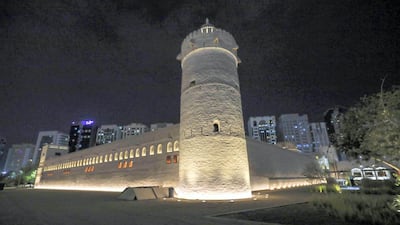
Qasr Al Hosn is now one of Abu Dhabi's most important landmarks and attracts tourists from across the globe. Victor Besa / The National



