Sotrovimab was prescribed to patients in UAE who are at high risk of suffering Covid-19 complications. Early use of the drug cuts deaths by as much as 85 per cent.

Coronavirus: UAE finds sotrovimab drug is 100 per cent successful at preventing deaths


  • English
  • Arabic

Follow the latest updates on the Covid-19 pandemic here

An antiviral drug used to treat Covid-19 has proven to be very effective at preventing deaths and hospital admissions among coronavirus patients.

Between 30 June and 13 July, 6,175 patients in the UAE received sotrovimab.

The drug was 100 per cent successful in preventing deaths and 99 per cent effective in stopping admissions to intensive care, authorities said.

Close to 97 per cent of recipients fully recovered within 14 days, which was in line with previous findings.

The results were announced on Saturday by the Ministry of Health and Prevention, in collaboration with Abu Dhabi’s Department of Health and Dubai Health Authority.

The MoHAP has approved the use of Sotrovimab, produced by global biopharmaceutical company GlaxoSmithKline (GSK). It has also been approved for emergency use by the US Food and Drug Administration.

  • Abu Dhabi residents are inoculated at the screening and vaccine centre on the Corniche. A nationwide testing and inoculation campaign is credited with driving down cases. All photos: Victor Besa / The National
    Abu Dhabi residents are inoculated at the screening and vaccine centre on the Corniche. A nationwide testing and inoculation campaign is credited with driving down cases. All photos: Victor Besa / The National
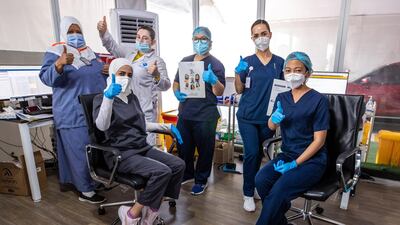
  • Staff and nurses from the Abu Dhabi public hospital group Seha urged the public to protect themselves from Covid-19 by signing up to be vaccinated.
    Staff and nurses from the Abu Dhabi public hospital group Seha urged the public to protect themselves from Covid-19 by signing up to be vaccinated.
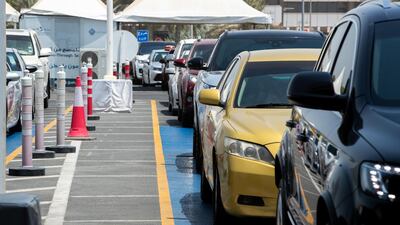
  • Motorists queue for PCR tests at Seha's testing and vaccination centre on Abu Dhabi's Corniche.
    Motorists queue for PCR tests at Seha's testing and vaccination centre on Abu Dhabi's Corniche.
  • Mass testing and a successful vaccination campaign has helped the UAE to tackle the pandemic.
    Mass testing and a successful vaccination campaign has helped the UAE to tackle the pandemic.
  • Drivers wait at a centre that provides both PCR nasal swab tests and coronavirus vaccine doses.
    Drivers wait at a centre that provides both PCR nasal swab tests and coronavirus vaccine doses.
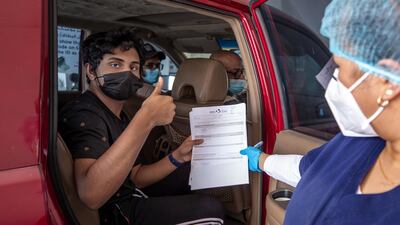
  • Shenaz Abdul Salam, 13, gives a thumbs up as he waits to receive his first vaccine dose.
    Shenaz Abdul Salam, 13, gives a thumbs up as he waits to receive his first vaccine dose.
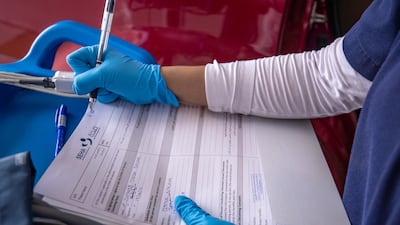
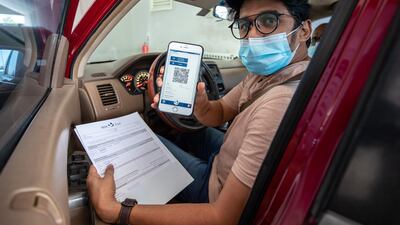
  • A staff nurse fills in a vaccination form for a driver at the Corniche centre.
    A staff nurse fills in a vaccination form for a driver at the Corniche centre.
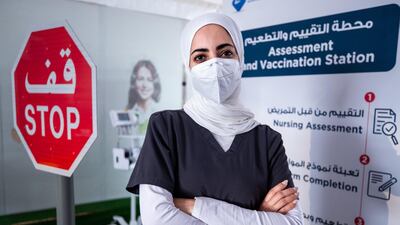
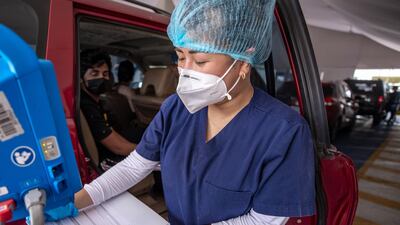
  • Mariam Al Badi, an Emirati nurse working at Seha's drive-through vaccine centre, has urged everyone to get inoculated against Covid-19.
    Mariam Al Badi, an Emirati nurse working at Seha's drive-through vaccine centre, has urged everyone to get inoculated against Covid-19.
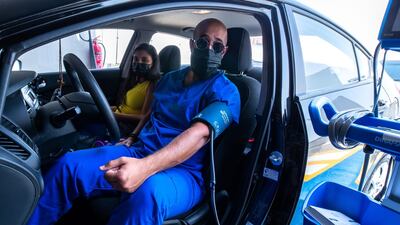
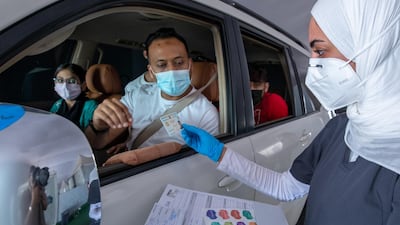
  • Ms Al Badi goes through the vaccination process with a driver.
    Ms Al Badi goes through the vaccination process with a driver.
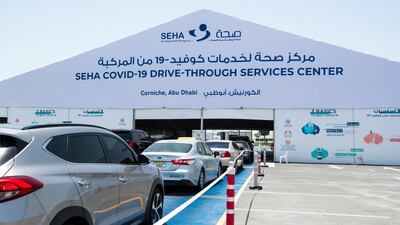
  • Cars queue at the drive-through testing and vaccination centre on Abu Dhabi's Corniche.
    Cars queue at the drive-through testing and vaccination centre on Abu Dhabi's Corniche.
  • More than 80 per cent of the UAE population has been vaccinated and the government is urging those who have not to sign up.
    More than 80 per cent of the UAE population has been vaccinated and the government is urging those who have not to sign up.
  • An Abu Dhabi resident gives the thumbs up after signing up for vaccination.
    An Abu Dhabi resident gives the thumbs up after signing up for vaccination.
  • Authorities have made the vaccines free for everyone.
    Authorities have made the vaccines free for everyone.
  • A medical worker checks papers as Abu Dhabi residents sign up for the Covid-19 vaccine.
    A medical worker checks papers as Abu Dhabi residents sign up for the Covid-19 vaccine.
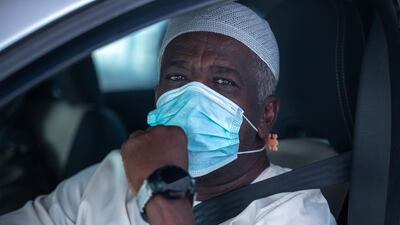
  • The drive-through Covid-19 testing and inoculation centre has proved popular with Abu Dhabi residents.
    The drive-through Covid-19 testing and inoculation centre has proved popular with Abu Dhabi residents.

About 52 per cent of patients were aged 50 or above and almost all recipients had a comorbidity such as obesity, cancer, cardiovascular disease or diabetes.

The UAE was one of the first countries in the world to receive sotrovimab.

The shipment, in mid-June, came after an agreement between the Department of Health – Abu Dhabi, Rafed – a group purchasing organisation – GSK and Etihad Cargo.

A separate study conducted by the Department of Health – Abu Dhabi found eight per cent of patients suffered from long Covid.

Feeling tired was the most commonly experienced after-effect.

Ten tax points to be aware of in 2026

1. Domestic VAT refund amendments: request your refund within five years

If a business does not apply for the refund on time, they lose their credit.

2. E-invoicing in the UAE

Businesses should continue preparing for the implementation of e-invoicing in the UAE, with 2026 a preparation and transition period ahead of phased mandatory adoption. 

3. More tax audits

Tax authorities are increasingly using data already available across multiple filings to identify audit risks. 

4. More beneficial VAT and excise tax penalty regime

Tax disputes are expected to become more frequent and more structured, with clearer administrative objection and appeal processes. The UAE has adopted a new penalty regime for VAT and excise disputes, which now mirrors the penalty regime for corporate tax.

5. Greater emphasis on statutory audit

There is a greater need for the accuracy of financial statements. The International Financial Reporting Standards standards need to be strictly adhered to and, as a result, the quality of the audits will need to increase.

6. Further transfer pricing enforcement

Transfer pricing enforcement, which refers to the practice of establishing prices for internal transactions between related entities, is expected to broaden in scope. The UAE will shortly open the possibility to negotiate advance pricing agreements, or essentially rulings for transfer pricing purposes. 

7. Limited time periods for audits

Recent amendments also introduce a default five-year limitation period for tax audits and assessments, subject to specific statutory exceptions. While the standard audit and assessment period is five years, this may be extended to up to 15 years in cases involving fraud or tax evasion. 

8. Pillar 2 implementation 

Many multinational groups will begin to feel the practical effect of the Domestic Minimum Top-Up Tax (DMTT), the UAE's implementation of the OECD’s global minimum tax under Pillar 2. While the rules apply for financial years starting on or after January 1, 2025, it is 2026 that marks the transition to an operational phase.

9. Reduced compliance obligations for imported goods and services

Businesses that apply the reverse-charge mechanism for VAT purposes in the UAE may benefit from reduced compliance obligations. 

10. Substance and CbC reporting focus

Tax authorities are expected to continue strengthening the enforcement of economic substance and Country-by-Country (CbC) reporting frameworks. In the UAE, these regimes are increasingly being used as risk-assessment tools, providing tax authorities with a comprehensive view of multinational groups’ global footprints and enabling them to assess whether profits are aligned with real economic activity. 

Contributed by Thomas Vanhee and Hend Rashwan, Aurifer

Feeding the thousands for iftar

Six industrial scale vats of 500litres each are used to cook the kanji or broth 

Each vat contains kanji or porridge to feed 1,000 people

The rice porridge is poured into a 500ml plastic box

350 plastic tubs are placed in one container trolley

Each aluminium container trolley weighing 300kg is unloaded by a small crane fitted on a truck

Company Fact Box

Company name/date started: Abwaab Technologies / September 2019

Founders: Hamdi Tabbaa, co-founder and CEO. Hussein Alsarabi, co-founder and CTO

Based: Amman, Jordan

Sector: Education Technology

Size (employees/revenue): Total team size: 65. Full-time employees: 25. Revenue undisclosed

Stage: early-stage startup 

Investors: Adam Tech Ventures, Endure Capital, Equitrust, the World Bank-backed Innovative Startups SMEs Fund, a London investment fund, a number of former and current executives from Uber and Netflix, among others.

Tips from the expert

Dobromir Radichkov, chief data officer at dubizzle and Bayut, offers a few tips for UAE residents looking to earn some cash from pre-loved items.

  1. Sellers should focus on providing high-quality used goods at attractive prices to buyers.
  2. It’s important to use clear and appealing photos, with catchy titles and detailed descriptions to capture the attention of prospective buyers.
  3. Try to advertise a realistic price to attract buyers looking for good deals, especially in the current environment where consumers are significantly more price-sensitive.
  4. Be creative and look around your home for valuable items that you no longer need but might be useful to others.
Updated: July 18, 2021, 5:26 AM