• Emirati astronaut Sultan Al Neyadi has completed Nasa's intense T-38 Talon supersonic jet training. All photos courtesy of Mr Al Neyadi Twitter
    Emirati astronaut Sultan Al Neyadi has completed Nasa's intense T-38 Talon supersonic jet training. All photos courtesy of Mr Al Neyadi Twitter
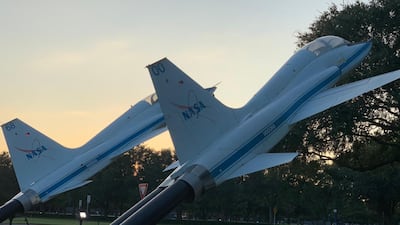
  • The T-38 jets have been used by Nasa to train astronauts since the 1960s.
    The T-38 jets have been used by Nasa to train astronauts since the 1960s.
  • Mr Al Neyadi and his American colleague on the way to train on a T-38 jet.
    Mr Al Neyadi and his American colleague on the way to train on a T-38 jet.
  • Mr Al Neyadi on a T-38 jet, which travels faster than the speed of sound and prepares astronauts for spaceflight.
    Mr Al Neyadi on a T-38 jet, which travels faster than the speed of sound and prepares astronauts for spaceflight.
  • Flying the supersonic jet involves traveling at speeds of Mach 1.6 and experiencing more than seven G-forces, or seven times the gravity, because of the speed – enough to make an average person unconscious.
    Flying the supersonic jet involves traveling at speeds of Mach 1.6 and experiencing more than seven G-forces, or seven times the gravity, because of the speed – enough to make an average person unconscious.
  • Mr Al Neyadi on board the T-38 Talon supersonic jet.
    Mr Al Neyadi on board the T-38 Talon supersonic jet.
  • Mr Al Neyadi prepares for a training session on a T-38 supersonic jet.
    Mr Al Neyadi prepares for a training session on a T-38 supersonic jet.
  • Mr Al Neyadi and Nasa astronaut Chris Cassidy at the Johnson Space Centre in Houston, Texas.
    Mr Al Neyadi and Nasa astronaut Chris Cassidy at the Johnson Space Centre in Houston, Texas.

UAE astronaut completes Nasa’s supersonic jet training


Sarwat Nasir
  • English
  • Arabic

UAE astronaut Sultan Al Neyadi has completed one of the most intense stages of his 30-month training at Nasa’s Johnson Space Centre – flying supersonic jets that travel faster than the speed of sound.

T-38 Talons have been used by the US space agency since the 1960s, achieving supersonic speed and high altitude that create gravitational forces trainees must experience.

“This week I completed all the theoretical and practical training for the T-38 aircraft here at Nasa, including final check-ride,” Dr Al Neyadi said.

“This qualifies astronauts to plan, navigate and conduct flights using onboard instruments and handle any possible emergency.”

Flying the supersonic jet involves travelling at speeds of Mach 1.6 and experiencing more than seven Gs – seven times the force of gravity – enough to make an average person lose consciousness.

In addition, T-38 Talon jets can climb from sea level to almost 30,000 feet within one minute.

“The work inside the plane is dynamic and requires agility and situational awareness of the crew, which simulates working inside spacecraft,” Dr Al Neyadi said.

“During the training, we learnt about the aircraft’s capacities, control and navigation systems, as well as standard and emergency procedures.”

Dr Al Neyadi and Maj Hazza Al Mansouri, the first Emirati man in space, have completed more than half of their 30-month training with Nasa.

They have learnt to perform spacewalks and are being prepared for long-haul space missions. They must also master the workings of the International Space Station.

The T-38 training helps them make quick decisions in challenging situations, and they are supported by qualified pilots while flying the aircraft.

While the process is considered low-risk, one incident more than 50 years ago took two astronauts’ lives.

In 1966, a T-38 crashed at Lambert Field in St Louis, Missouri, killing Gemini astronauts Charles Bassett and Elliot See.

Mohammed bin Rashid Space Centre said Maj Al Mansouri and Dr Al Neyadi will now take the ISS exam needed to qualify as operators onboard the station.

“This exam simulates the daily work onboard the ISS – dealing with computer and telecommunications systems, alongside other equipment, techniques of counting, moving and storing equipment,” the space centre said.

“The simulation also covers scenarios of electricity, air conditioners and computer faults and how astronauts deal with them while abiding by standard procedures and instructions from ground control centres.

“After accomplishing this exam, Al Mansouri and Al Neyadi will be ready to work as operators onboard the ISS.”

Dr Al Neyadi comes from an IT engineering background and did not have previous flying experience.

Maj Al Mansouri is an experienced fighter jet pilot, with thousands of flight hours under his belt.

UAE’s two new astronauts, Mohammed Al Mulla and Nora Al Matrooshi – the first Arab female astronaut – will begin their training in Houston later this year.

Emirati astronauts learn how to perform spacewalks - in pictures

  • Hazza Al Mansouri, first Emirati man in space, wears a 130 kilogram-heavy extravehicular activities suit for spacewalk training. All photos courtesy of Mohammed bin Rashid Space Centre
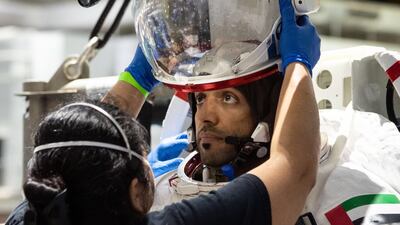
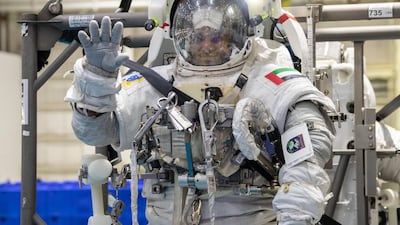
    Hazza Al Mansouri, first Emirati man in space, wears a 130 kilogram-heavy extravehicular activities suit for spacewalk training. All photos courtesy of Mohammed bin Rashid Space Centre
  • The suit is worn during spacewalks outside of the International Space Station and for training at the world's largest indoor pool at the Johnson Space Centre in Houston, Texas
    The suit is worn during spacewalks outside of the International Space Station and for training at the world's largest indoor pool at the Johnson Space Centre in Houston, Texas
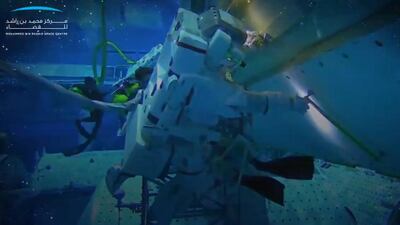
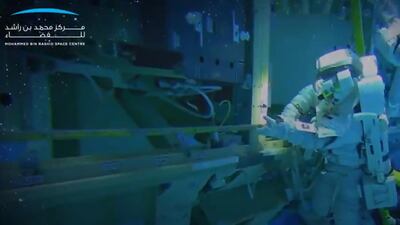
  • Located at the Neutral Buoyancy Lab (NBL), the indoor pool is 12-metres deep and has 2.4 million litres of water. It helps simulate microgravity and allows astronauts to work on a replica of the International Space Station placed underwater
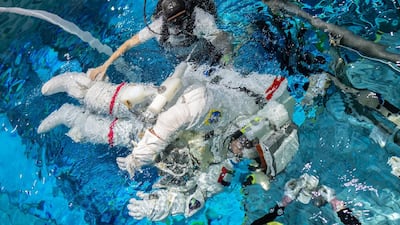
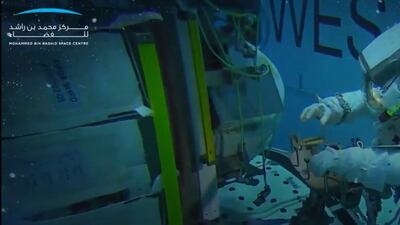
    Located at the Neutral Buoyancy Lab (NBL), the indoor pool is 12-metres deep and has 2.4 million litres of water. It helps simulate microgravity and allows astronauts to work on a replica of the International Space Station placed underwater
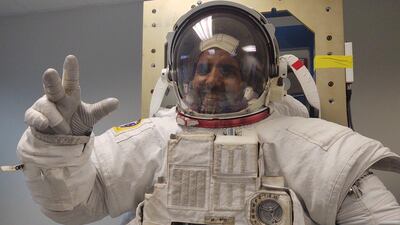
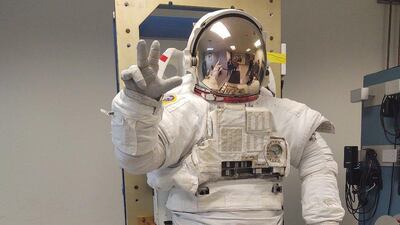
  • Sultan Al Neyadi, part of the UAE astronaut corps, wears his EVA suit for spacewalk training in the indoor pool
    Sultan Al Neyadi, part of the UAE astronaut corps, wears his EVA suit for spacewalk training in the indoor pool
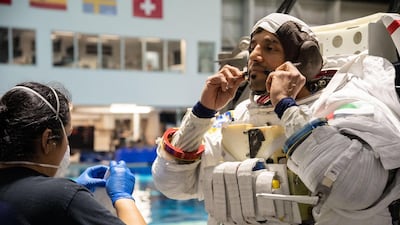
  • Sultan Al Neyadi puts his helmet on for spacewalk training under water. Mr Al Neyadi was one of two people selected from 4,022 candidates to become the first Emirati astronauts. Mbrsc
    Sultan Al Neyadi puts his helmet on for spacewalk training under water. Mr Al Neyadi was one of two people selected from 4,022 candidates to become the first Emirati astronauts. Mbrsc
  • Mr Al Neyadi prepares to go underwater
    Mr Al Neyadi prepares to go underwater
  • Mr Al Neyadi goes underwater with his EVA suit on for spacewalk training
    Mr Al Neyadi goes underwater with his EVA suit on for spacewalk training
  • Astronauts can spend up to 10 hours per day at the bottom of the pool to practise maintenance work on the space station model and refine spacewalk techniques.
    Astronauts can spend up to 10 hours per day at the bottom of the pool to practise maintenance work on the space station model and refine spacewalk techniques.
  • An Emirati astronaut underwater, refining his spacewalk technique. Performing a spacewalk is an extremely dangerous task and requires practise and skill. In 2013, Italian astronaut Luca Parmitano nearly drowned when water leaked into his helmet during a spacewalk. In 2019, Nasa astronaut Chris Cassidy’s wrist mirror broke off, releasing thousands of pieces of space junk
    An Emirati astronaut underwater, refining his spacewalk technique. Performing a spacewalk is an extremely dangerous task and requires practise and skill. In 2013, Italian astronaut Luca Parmitano nearly drowned when water leaked into his helmet during a spacewalk. In 2019, Nasa astronaut Chris Cassidy’s wrist mirror broke off, releasing thousands of pieces of space junk
  • The Emirati astronauts are training for long-haul space missions at the Johnson Space Centre in Houston, Texas. They are also training on T-38 jets, which helps a pilot experience seven G-forces because of the speed. It can fly up to Mach 1.6 and 12,000 metres high – that is 3,000m higher than average airliners.
    The Emirati astronauts are training for long-haul space missions at the Johnson Space Centre in Houston, Texas. They are also training on T-38 jets, which helps a pilot experience seven G-forces because of the speed. It can fly up to Mach 1.6 and 12,000 metres high – that is 3,000m higher than average airliners.
Mental%20health%20support%20in%20the%20UAE
%3Cp%3E%E2%97%8F%20Estijaba%20helpline%3A%208001717%3Cbr%3E%E2%97%8F%20UAE%20Ministry%20of%20Health%20and%20Prevention%20hotline%3A%20045192519%3Cbr%3E%E2%97%8F%20UAE%20Mental%20health%20support%20line%3A%20800%204673%20(Hope)%3Cbr%3EMore%20information%20at%20hope.hw.gov.ae%3C%2Fp%3E%0A
The specs

Engine: Turbocharged four-cylinder 2.7-litre

Power: 325hp

Torque: 500Nm

Transmission: 10-speed automatic

Price: From Dh189,700

On sale: now

Timeline

1947
Ferrari’s road-car company is formed and its first badged car, the 125 S, rolls off the assembly line

1962
250 GTO is unveiled

1969
Fiat becomes a Ferrari shareholder, acquiring 50 per cent of the company

1972
The Fiorano circuit, Ferrari’s racetrack for development and testing, opens

1976
First automatic Ferrari, the 400 Automatic, is made

1987
F40 launched

1988
Enzo Ferrari dies; Fiat expands its stake in the company to 90 per cent

2002
The Enzo model is announced

2010
Ferrari World opens in Abu Dhabi

2011
First four-wheel drive Ferrari, the FF, is unveiled

2013
LaFerrari, the first Ferrari hybrid, arrives

2014
Fiat Chrysler announces the split of Ferrari from the parent company

2015
Ferrari launches on Wall Street

2017
812 Superfast unveiled; Ferrari celebrates its 70th anniversary

Updated: July 06, 2021, 6:06 PM